
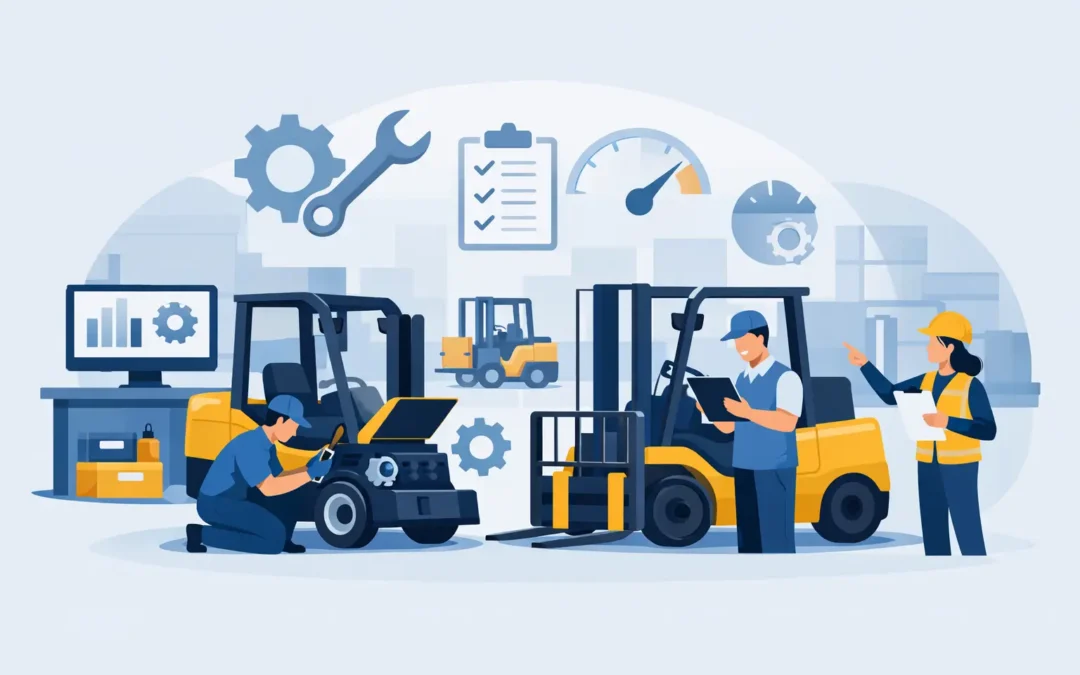
One dead forklift during peak shift can back up receiving, slow picks, and burn labor fast. A solid forklift fleet maintenance guide is not about paperwork for its own sake. It is about keeping trucks in service, catching failures early, and avoiding the kind of breakdown that wrecks a day’s production.
If you run multiple units, maintenance has to be tied to uptime, safety, and repair cost. That means looking beyond basic PM stickers and asking a harder question: which trucks are getting attention at the right time, and which ones are quietly heading toward expensive failure? The answer usually shows up in battery neglect, ignored operator reports, rushed repairs, and service schedules that look organized on paper but do not match actual usage.
What a forklift fleet maintenance guide should actually cover
A useful plan starts with the fleet you really have, not the fleet listed in an old spreadsheet. Count every truck by type, age, hours, power source, and duty cycle. An electric sit-down running two shifts indoors does not need the same service plan as an LP unit loading trailers outside, and neither should be treated like a reach truck working narrow aisles all day.
That difference matters because maintenance intervals are only half the story. Operating conditions change everything. Dust, cold storage, broken dock plates, rough yard surfaces, aggressive operators, and long charging shortcuts all add wear. If your service plan ignores those conditions, you are not preventing downtime. You are just delaying it.
The strongest maintenance programs are built around three things: scheduled preventive service, fast response when a truck goes down, and accurate tracking of repeat issues. Miss any one of those and costs creep up. You start paying for emergency calls, avoidable parts failures, and lost productivity that never shows up clearly on an invoice.
Start with usage, not calendar dates
A common mistake is servicing every forklift on the same monthly schedule regardless of how hard it works. That is simple to manage, but it is not efficient. A lightly used backup truck may not need the same frequency as a primary unit working ten hours a day.
Hours are usually a better trigger than the calendar. The right interval depends on the manufacturer, application, and truck condition, but the principle is the same: service the truck based on actual workload. For mixed fleets, this approach helps you spend maintenance dollars where they do the most good.
There is one trade-off. Hour-based scheduling only works if hour meters are accurate and someone is actually reviewing them. If your team is not disciplined about tracking hours, the schedule slips and PMs get missed. In that case, a hybrid system works better – calendar reminders backed by hour checks and supervisor review.
Daily inspections are where major failures get caught early
Most expensive forklift problems do not start as expensive problems. They start as a small hydraulic seep, a weak battery, a mast issue, a loose cable, a brake complaint, or a tire wearing unevenly. Daily inspections are supposed to catch that before it turns into a roadside call inside your own facility.
Operators should check the basics before each shift: forks, mast, chains, tires, leaks, brakes, steering, lights, alarms, seat belt, and battery or fuel system condition. On electric forklifts, battery connectors, cable damage, water levels where applicable, and charging behavior deserve extra attention. If a truck is slow to lift, losing run time, or throwing intermittent fault codes, that is not something to “watch for a few days.” That is a service issue.
The weak point is usually not the inspection form. It is follow-through. If operators report issues and nobody acts until the truck fails, your inspection process is cosmetic. Good fleets create a fast path from defect report to technician action.
Preventive maintenance for electric forklifts needs more discipline
Electric forklifts can lower fuel and maintenance costs, but only if the battery and electrical system are managed correctly. Too many facilities assume electric means low-maintenance. It does not. It means the maintenance priorities are different.
Battery care is the biggest one. Poor watering practices, opportunity charging without a plan, dirty terminals, damaged connectors, and overheating all shorten battery life and create power problems that look like truck problems. Then parts get replaced that were never the real issue.
Electrical diagnostics also require experience. Intermittent faults, drive motor issues, contactor problems, charger mismatch, and harness damage can waste hours if the technician is guessing. That is why specialist support matters, especially for electric fleets. A general repair approach can get expensive fast when the root cause is buried in the electrical system.
The forklift fleet maintenance guide for cutting repair spend
If your goal is lower total repair cost, do not focus only on the price of a service call. Look at repeat failures, parts life, labor hours, and downtime exposure. The cheapest repair is often the one that prevents the next two repairs.
This is where patterns matter. If one truck keeps eating steer tires, there may be a surface issue, alignment issue, or operator behavior problem. If another keeps coming up with battery complaints, look at charging habits and battery age before blaming the truck. If mast wear is showing up across multiple units, inspect lubrication practices and attachment use.
A good fleet manager asks two questions every time a repair happens: what failed, and why did it fail now? Without that second question, maintenance becomes reactive. You fix the symptom and wait for the next invoice.
It also helps to rank your units. Some trucks are mission-critical. Others are backup equipment. Your best technicians, fastest response, and strongest PM discipline should follow the trucks that hurt production most when they go down. Equal treatment sounds fair. It is not always smart.
Build a service process that matches real operations
The best maintenance plan on paper fails if service access is slow. Forklifts do not break at convenient times, and facility teams do not want to explain the same issue to a receptionist, then a dispatcher, then a sales rep before a technician gets involved. When a critical truck is down, speed matters.
That is why your service partner should understand your fleet, your hours, and your high-priority equipment before the emergency happens. Fast diagnosis saves money. So does sending someone who knows electric lift equipment instead of learning on your time.
For many operations, the right setup is a mix of scheduled PM visits and direct-response field service. Preventive maintenance handles wear items and routine checks. Field service handles failures quickly enough to limit disruption. If your current provider is strong on one but weak on the other, you will feel it in uptime.
CSC Forklift Repair is built around that reality – faster service, better workmanship, and fair pricing from technicians who know lift equipment and get moving quickly. That kind of support matters most when the truck that just failed is the one your whole shift depends on.
Track the numbers that actually tell the truth
A clean maintenance log is useful, but it is not enough. You need a short list of numbers that show whether the fleet is getting healthier or more expensive.
Start with downtime hours per truck, repair dollars per truck, PM compliance, repeat repairs, battery replacement history, and average response time for breakdowns. Those numbers will show where the pain really is. Sometimes the oldest truck is not your biggest problem. Sometimes the newest truck with poor charging habits is costing more than expected.
There is also the replacement question. At a certain point, maintaining an aging forklift stops being cost control and starts being delay. If a truck is seeing frequent breakdowns, hard-to-source parts, and rising labor hours, it may be cheaper to replace it. But that decision should come from data, not frustration after a bad week.
Where maintenance programs usually fail
They fail when inspections are rushed, operators stop reporting small issues, PM schedules are too generic, and managers only look at repair totals after costs spike. They also fail when service is hard to reach and every breakdown turns into a wait.
The better approach is simple. Match service intervals to usage. Take electric forklift battery and electrical care seriously. Act on daily inspection reports. Watch repeat failures. Use a repair partner who can respond fast and diagnose correctly the first time.
If your forklifts are tied directly to shipping, receiving, production, or jobsite movement, maintenance is not overhead. It is operational protection. The right plan keeps people safe, budgets under control, and equipment working when the day gets busy.
The next time one truck starts acting up, do not just fix that truck. Look at what the failure is telling you about the rest of the fleet.