
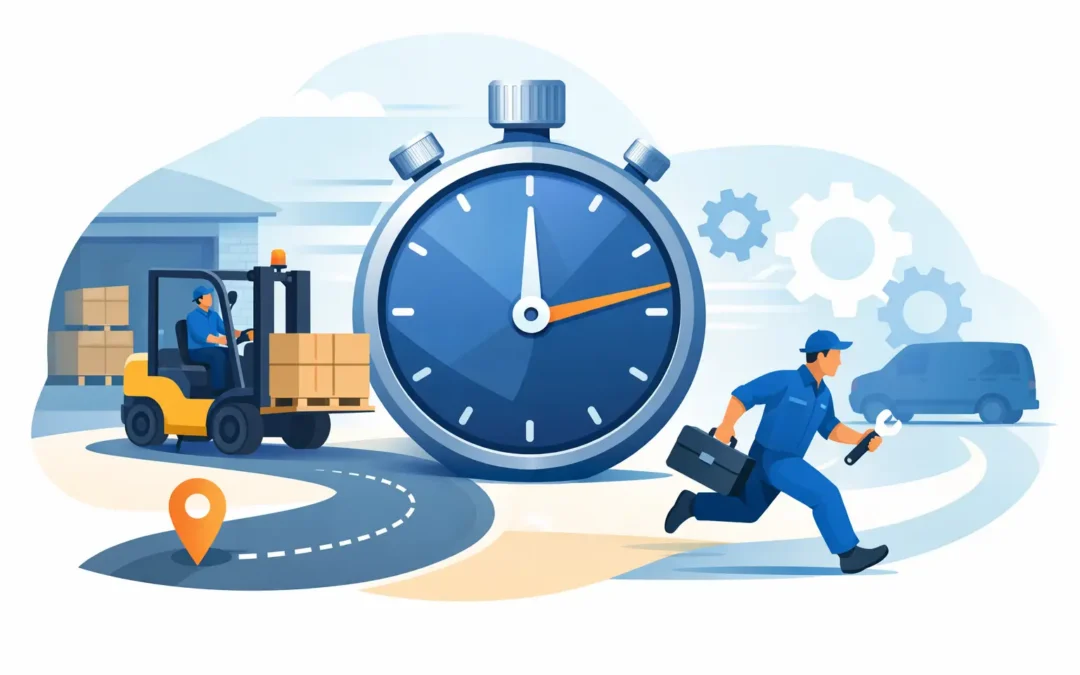
A forklift breaks down at 8:10. By 8:25, pallet movement backs up. By 9:00, shipping is behind, workers are waiting, and supervisors are making calls they did not plan to make. That is why forklift service response time is not a minor service detail. It is an operations issue, a labor cost issue, and in some cases, a safety issue.
If your lift is down, the clock starts immediately. Every minute between the first failure and the technician arriving has a cost attached to it. Some companies feel that cost in missed picks. Others feel it in delayed trucks, overtime, or crews standing around a dead machine. The faster the response, the faster the operation gets a real answer – not just a promise.
Why forklift service response time matters
When managers compare service providers, they often look at hourly rates first. That makes sense on paper. In the real world, response time can matter just as much as the invoice total.
A lower labor rate does not help much if your technician shows up tomorrow afternoon and your busiest dock door is backed up all day. The true cost of a repair includes downtime, disrupted workflow, operator idle time, missed production targets, and the added pressure that comes when one failed unit forces the rest of the fleet to work harder.
This gets even more serious with electric forklifts. Electrical faults, battery issues, charger failures, and drive or hydraulic control problems are not always something a general mechanic can sort out quickly. If the provider is slow to respond and slow to diagnose, downtime stretches. Fast response only helps if the technician can actually work the problem.
What good response time actually looks like
A good forklift service response time is not just about how quickly someone answers the phone. It includes the full chain of events from your first call to real action in the field.
First, you should be able to reach someone who understands the equipment and the urgency. If you have to work through a generic office intake process, repeat the same problem three times, and wait for a callback, the delay has already started.
Second, dispatch should happen fast. That means the service company has technicians available, the territory is covered properly, and your job is treated like a priority instead of getting buried behind routine admin.
Third, the technician needs the right skill set. A fast arrival with the wrong diagnosis is not a win. Neither is a visit that ends with, “We need to come back after we figure out what parts this takes.” Strong response time includes preparation, troubleshooting ability, and a realistic path to getting the unit moving again.
The hidden costs of slow service
Slow service is expensive in ways that do not always show up clearly on a repair ticket. Warehouse teams know this already. Once one forklift goes down, the ripple effect starts fast.
Tasks get reassigned. Operators wait for available equipment. Travel paths get longer because the remaining units are covering more ground. Shipping and receiving lose rhythm. In manufacturing, one down forklift can choke material flow to the line. On jobsites, a dead lift can stop work for entire crews.
Then there is the budget side. Emergency rentals, overtime, rescheduled deliveries, and production delays often cost more than the repair itself. A provider with a slower dispatch process may look cheaper at first, but the total cost to your operation can be much higher.
Safety also changes when equipment availability drops. People start improvising. They use the wrong machine for the task, overload available units, rush movements, or keep running equipment that should have been inspected sooner. That is where a service delay stops being just inconvenient.
What affects forklift service response time
Not every delay comes from the same place. Some are operational. Some are staffing related. Some are just signs of a provider built for sales volume instead of field service speed.
One major factor is whether you can speak directly with a technician or service team member who knows the equipment. Fast access usually means faster triage. If the person taking the call can tell the difference between a battery issue, a travel motor fault, a charger problem, or a hydraulic failure, your service call gets routed correctly from the start.
Coverage area matters too. A company can promise quick help, but if its technicians are spread thin across a wide territory, response times slip when call volume spikes. Local and regional service providers often have an advantage because they know the customers, the routes, and the equipment mix in the market.
Parts access plays a role as well. Some repairs can be handled on the first visit. Others depend on parts availability. A strong service company will still save you time by diagnosing correctly, making the unit safe, and setting clear expectations immediately.
Equipment specialization is another big one. Electric forklifts are a good example. If a company mainly works on broad equipment categories and only occasionally sees electric lift truck issues, troubleshooting can drag out. Specialist knowledge shortens the process. That is especially true when the problem involves controllers, wiring, battery systems, charging systems, or intermittent electrical faults.
How to judge response time before you need service
The worst time to test a service company is when your forklift is already down. By then, you are buying under pressure.
A better approach is to ask direct questions before there is a breakdown. Ask who answers service calls. Ask whether you will speak with a technician or a dispatcher who understands lift equipment. Ask what the normal field response looks like in your area. Ask how they handle electric forklift repairs specifically. Ask whether they support both emergency calls and ongoing maintenance.
Pay attention to the answers. Vague promises are a bad sign. So is a sales-heavy conversation that avoids specifics. A good service partner will talk plainly about coverage, urgency, equipment types, and what they can realistically do for your operation.
It also helps to look at how the provider thinks about downtime. Some companies treat breakdowns like isolated work orders. Others understand the chain reaction inside a warehouse, plant, or jobsite. The second group usually moves faster because they know what the delay is costing you.
Response time and workmanship have to go together
Fast does not mean rushed. It means efficient, prepared, and accurate.
That distinction matters. A provider can show up quickly and still waste half your day if the diagnosis is weak or the repair quality is poor. Then the same unit fails again next week, and now you have repeat downtime on top of the first service bill.
Good forklift service response time works best when it is backed by experienced field technicians. The right tech can assess the problem quickly, isolate the fault, explain what is happening in clear terms, and get the repair moving without unnecessary delay. That is what keeps speed from turning into guesswork.
For operations managers and fleet supervisors, this is the balance that matters most: rapid arrival, solid troubleshooting, fair pricing, and repair work that holds up. Miss one of those pieces and the service experience starts costing more than it should.
Why direct technician access changes the outcome
One of the biggest differences between average service and strong service is who you talk to first. If your first contact is someone with real equipment knowledge, the service call starts cleaner.
You can describe the symptoms, the fault codes, the battery condition, the travel issue, the mast problem, or the charger behavior without getting trapped in a script. That speeds up dispatch and helps the technician arrive with a better sense of what is likely wrong.
For companies running electric forklifts, this matters even more. Electrical issues are often symptom-heavy and not always obvious from a basic intake form. Direct access to a knowledgeable technician can cut out a lot of wasted time. That is one reason companies call CSC Forklift Repair when speed matters. They want real help fast, not a slow path through office layers.
The right standard for your operation
There is no single perfect number for forklift service response time because every operation is different. A single-unit small business has different pressure than a multi-shift distribution center. A planned maintenance issue is different from a dead truck at the shipping dock. It depends on fleet size, redundancy, shift structure, and how critical that specific machine is.
But the standard should still be simple. When equipment goes down, you should be able to reach a knowledgeable service team quickly, get a realistic response window, and have confidence that the technician arriving can actually solve the problem.
If your current provider cannot give you that, the low rate on the invoice is probably not saving you money. Fast response, strong workmanship, and fair pricing are not extras in this business. They are what keep your day from getting away from you.
When the next breakdown hits, do not just ask who is cheapest. Ask who can get there, who knows the equipment, and who can get your forklift back to work without wasting half your shift.