Last Updated: November 17, 2026
Quick Summary
A scissor lift safety inspection checklist is the documented set of checks an operator completes before, during, and after each shift to confirm the lift is structurally sound, mechanically functional, and safe to operate. A lift that fails one item should never leave the ground, and the operator signs the daily form while a qualified person signs off on periodic and annual inspections.
- Start at the ground and circle the unit counterclockwise, inspecting scissor arms for cracks, bends, or weld separation.
- A unit fails when any safety device is inoperable, a structural component is cracked or bent, or a hydraulic leak is active.
- On a fail, lower the platform, remove the key, and attach a lockout/tagout tag at the control panel and key switch.
- After repair, a qualified person re-inspects the failed item and any affected system, then clears the tag and signs the unit back into service.
- Inspect the ground before the lift: confirm the surface is level and rated for the lift’s loaded weight.
Table of Contents
- Scissor Lift Pre-Use Inspection Checklist: What to Check Before Every Shift
- Scissor Lift Inspection Requirements: OSHA, ANSI, and Who Signs Off
- Printable Scissor Lift Daily Inspection Checklist PDF: What a Good Form Captures
- The Weekly Scissor Lift Inspection Checklist: Going Deeper Than the Daily Walk-Around
- Pass or Fail: Inspection Criteria and What to Do When a Unit Fails
- Worksite Hazard Assessment Before the Lift Goes Up
- Schedule Your Scissor Lift Repair Before the Next Shift Starts
- Frequently Asked Questions
Scissor Lift Pre-Use Inspection Checklist: What to Check Before Every Shift
A scissor lift safety inspection checklist is the documented set of checks an operator completes before, during, and after each shift to confirm the lift is structurally sound, mechanically functional, and safe to operate. A lift that fails one item should never leave the ground. The walk-around takes minutes. Skipping it can cost a shift, a citation, or worse.
Below is the complete breakdown: what to look at, what counts as a pass or fail, who signs off, and what to do when a unit fails.
The Walk-Around: Structure, Scissor Arms, and Pivot Pins
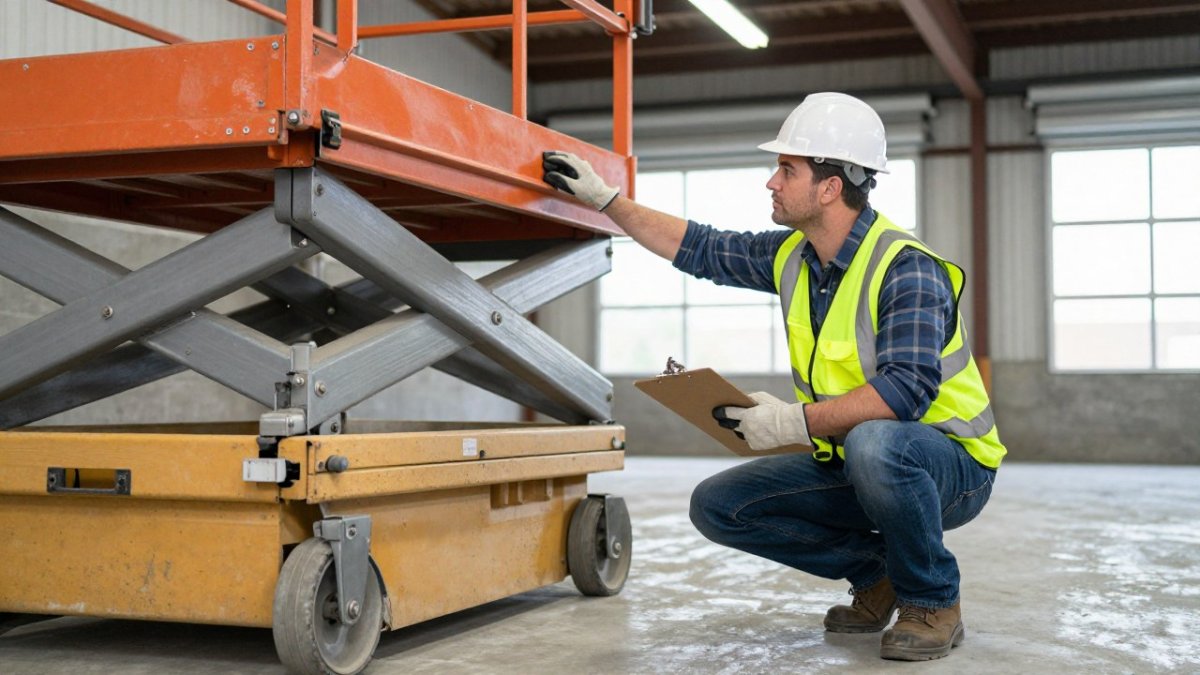
Start at the ground and circle the unit counterclockwise. Inspect the scissor arms for cracks, bends, or weld separation. Check pivot pins for looseness or missing retainers, and confirm fasteners are tight. Look for corrosion that has thinned the metal, not surface rust alone. Check the platform deck and guardrails for dents, cracks, or missing sections, and confirm the entry gate closes and latches. Confirm the unit number and inspection status decal match your log before you record anything.
Powered Checks: Controls, Gauges, and Warning Lights
With the area clear, raise and lower the platform through a full cycle. Listen for binding or uneven travel. Test the emergency stop and emergency lowering functions. Verify gauges read in range, the hour meter records, and all warning lights and alarms function. Check hydraulic lines and fittings for leaks or chafing. Confirm the horn, tilt sensor, and overload indicator work as designed.
Scissor Lift Inspection Requirements: OSHA, ANSI, and Who Signs Off
OSHA’s walking-working surfaces standard at 29 CFR 1910.29 and the mobile elevating work platform requirements in ANSI A92.22 and A92.24 set the framework: a qualified person conducts the inspection, the employer ensures it happens, and the operator performs pre-use checks. The operator signs the daily form. A qualified person signs off on periodic and annual inspections. Manufacturer instructions define the intervals and the specific items, so the manual overrides any generic checklist.
Printable Scissor Lift Daily Inspection Checklist PDF: What a Good Form Captures
A usable scissor lift daily inspection checklist PDF captures the essentials: equipment identification, unit number, shift, location, operator name, and date. Then it lists each check with a pass/fail field, a defect description area, and a signature line. Digital forms add photo capture and timestamps, which help when a defect report gets disputed. Keep the completed form on file; it is your proof of operational condition if an incident occurs.
| Form Field | What It Captures | Why It Matters |
|---|---|---|
| Unit number and location | Equipment identification | Ties the record to the right machine |
| Shift and operator name | Who inspected and when | Establishes accountability |
| Pass/fail per item | Operational condition | Documents defects before use |
| Defect description | Damage specifics | Drives the repair decision |
| Signature line | Sign-off | Proves the inspection happened |
The Weekly Scissor Lift Inspection Checklist: Going Deeper Than the Daily Walk-Around
The weekly scissor lift inspection checklist goes past the daily walk-around: hydraulic fluid levels, battery condition and charging, tire and wheel wear, axle condition, and a closer look at the scissor arm pivot points. If you want to schedule lift maintenance without disrupting production, plan weekly checks around shift changes so a unit is never pulled mid-job.
Pass or Fail: Inspection Criteria and What to Do When a Unit Fails
A unit fails when any safety device is inoperable, a structural component is cracked or bent, a hydraulic leak is active, or the emergency lowering function does not work. Those are the hard fails. The softer items, a slow lift, platform drift, a gauge reading slightly out of range, are still fails for the shift, because they point to faults that get worse under load. The pass/fail call belongs to the person who inspected the unit, and the safe default is to fail it and let a qualified person clear it.
What a pass looks like on the powered checks. Raise and lower the platform through a full cycle with the area clear. A pass means smooth, even travel with no binding, no unusual noise, and the platform holding position when the controls are released. The emergency stop must stop all functions immediately, and the emergency lowering function must bring the platform down under control. Gauges should read in range, the hour meter should record, and every warning light and alarm should function when tested. The horn, tilt sensor, and overload indicator must work as designed. If any of these does not behave as described, the item fails.
Tag-out steps. When an item fails, stop the inspection and take the lift out of service before you do anything else. Lower the platform, remove the key, and attach a lockout/tagout tag at the control panel and at the key switch. Follow the lockout/tagout procedures in 29 CFR 1910.147 so the unit cannot be energized while it is being inspected or repaired. Note the tag date, your name, and the defect on the tag itself.
Report and record. Record the defect on the inspection form with enough detail that a technician can find it: which item failed, what you observed, and where on the unit it is. Notify your supervisor the same shift. The employer is responsible for ensuring the lift is not returned to service until the defect is corrected, so the report needs to reach someone with the authority to hold the unit.
Re-inspection before return to service. After repair, a qualified person re-inspects the failed item and any system affected by the repair, then clears the tag and signs the unit back into service. Do not let the operator who reported the defect clear it alone; the re-inspection is a separate step with its own sign-off.
Watch out: the most common mistake is writing up a slow lift or platform drift as “monitor it” instead of failing it. Drift and slow rise usually point to hydraulic or valve faults that get worse under load. For the likely causes, see our guide on what causes scissor lift drift, and for slow-lift, leak, and no-rise diagnosis, read our scissor lift hydraulic troubleshooting breakdown. A failed hydraulic item is a repair call, not a note in the log.
Worksite Hazard Assessment Before the Lift Goes Up
Inspect the ground before you inspect the lift. Confirm the surface is level and rated for the lift’s loaded weight, and check for drop-offs, trenches, or soft spots. Scan overhead for power lines, beams, and obstructions. Mark the work zone and confirm pedestrian barriers are in place. Wind, weather, and traffic patterns change the risk profile, so reassess at the start of each shift rather than once per job.
Schedule Your Scissor Lift Repair Before the Next Shift Starts
A failed inspection is a downtime clock, and every hour a lift sits tagged out costs you. CSC Forklift Repair specializes in scissor lift and boom lift repair with a dispatch process built to cut downtime, plus expert diagnosis on electric forklift power and electrical faults. For the full inspection requirements behind your sign-off process, see our guide on aerial lift inspection requirements, or if you’re planning deeper service, learn how to schedule lift maintenance without downtime.
If a unit just failed inspection, don’t wait for the next shift to sort it out. Book scissor lift repair service with CSC Forklift Repair and get a technician dispatched to diagnose the fault, quote the fix, and get the lift back in service. Our dispatch process is designed around one goal: less downtime, more uptime.
Frequently Asked Questions
How often should a scissor lift be inspected?
A scissor lift needs a pre-use inspection before every shift, a more thorough weekly inspection, and periodic inspections at intervals set by the manufacturer, often quarterly or annually. OSHA requires that aerial lifts be inspected before use and that any damaged or malfunctioning unit be taken out of service. The pre-shift check is the one operators perform themselves; the weekly and periodic checks typically fall to a trained technician or maintenance lead.
What should be included in a scissor lift pre-use inspection checklist?
A complete scissor lift pre-use inspection checklist covers the walk-around and the powered checks. The walk-around includes scissor arms, pivot pins, fasteners, corrosion, cracks, bends, hydraulic lines and leaks, wheels, tires, axles, platform condition, and guardrails. The powered checks cover controls, switches, indicators, gauges, hour meter, warning lights, horn, emergency stop, and emergency lowering. Record the unit number, shift, location, operator name, and any defects found.
What should you do if a scissor lift fails an inspection?
Tag the unit out of service immediately, remove the key, and attach a visible do-not-operate tag. Report the defect to your supervisor and log it on the inspection form with the unit number and a description of the problem. Do not attempt to repair safety devices yourself unless you are trained and authorized. Call a qualified repair service to diagnose and fix the issue, and do not return the lift to service until the repair is documented and the unit passes re-inspection.
Can you use a scissor lift with a known defect?
No. Operating a scissor lift with a known defect, especially one involving the structure, hydraulics, controls, or safety devices, is a serious hazard and a violation of OSHA requirements. A lift with a cracked weld, a leaking hydraulic line, a faulty emergency stop, or damaged guardrails must be taken out of service until repaired. Using it anyway risks a tip-over, a fall, or a sudden drop and exposes the operator and employer to citations and liability.
Who is responsible for inspecting a scissor lift before use?
The operator is responsible for the pre-use inspection before every shift, and the employer is responsible for making sure inspections happen, records are kept, and operators are trained. On many sites a competent person or maintenance lead handles the weekly and periodic inspections. Whoever performs the check should sign and date the inspection form so responsibility is clear and the inspection status of each unit is easy to verify.
What is the difference between a pre-use inspection and a periodic inspection?
A pre-use inspection is a quick visual and functional check the operator performs before each shift, covering structure, hydraulics, controls, and safety devices. A periodic inspection is a more detailed examination done at manufacturer-specified intervals, often quarterly or annually, by a qualified technician. Periodic inspections dig into wear items, structural integrity, and system performance that a daily walk-around cannot catch, and they are documented separately from the daily form.

Forklift or Lift Down Right Now?
Talk directly to an experienced technician, not a call center. Mobile repair for electric, LP and diesel forklifts, scissor lifts and boom lifts across the Sacramento area.
📞 Call (916) 827-0510