Table of Contents
- Wolter vs National Lift Truck: What Operations Managers Need to Know
- Wolter vs National Lift Truck: Service Capabilities at a Glance
- Forklift Repair Services: What Each Provider Actually Delivers
- Forklift Maintenance Costs: How to Compare Without Getting Burned
- Forklift Service Response Time: The Metric That Decides Everything
- Forklift Repair Provider Comparison: A Framework for Choosing
- Conclusion: Matching the Provider to Your Operation
- Frequently Asked Questions
Last Updated: October 13, 2026
Wolter vs National Lift Truck: What Operations Managers Need to Know
The Wolter vs National Lift Truck decision comes down to one question: which provider keeps your fleet running with less downtime? Neither national name is built around the fast, local dispatch most facilities need. At CSC Forklift Repair, we work with operations managers tired of waiting days for a technician while a lift sits dead on the floor. That is the real cost of the Wolter vs National Lift Truck comparison, and it rarely shows up on a quote sheet.
Two things matter more than brand recognition: how fast a provider reaches your site, and whether they diagnose the problem correctly the first time. National dealers carry broad catalogs and factory-trained techs, but their service windows stretch across wide territories. Local specialists trade that breadth for speed.
Below, we break down service capabilities, response times, and the total cost of ownership math that most buyers skip.
Wolter vs National Lift Truck: Service Capabilities at a Glance
Most pages ranking for this query are single-company landing pages, so they never put the two providers side by side. The table below compares them on the capabilities that affect uptime and flags where public information is thin, so you know what to verify on a call.
| Capability | National Lift Truck | Wolter | What It Means for You |
|---|---|---|---|
| Business model | Material handling dealer and service provider | Industrial equipment and power systems provider with a service arm | National Lift Truck is closer to a pure lift-truck dealer; Wolter’s roots are broader industrial and power systems |
| New equipment sales | Yes, lift trucks and related material handling equipment | Yes, industrial equipment across multiple categories | Both can quote new units; compare brand lines and lead times, not just the logo |
| Used equipment | Yes | Varies by location and inventory | Ask for a current used-unit list with hours and service history |
| Forklift rental | Short- and long-term rental | Rental available through its equipment business | Confirm the rental fleet’s age and whether maintenance is bundled |
| Preventative maintenance | Scheduled PM programs | Scheduled PM programs | Nearly identical on paper, the differentiator is whether PMs are actually performed on schedule |
| Emergency repair | Dispatched through branch network | Dispatched through branch network | Response time is branch-dependent, not brand-dependent |
| Parts | Dealer parts network tied to the brands it sells | Parts support across the industrial equipment it services | Match the parts network to the brands in your fleet, not to the provider’s size |
| Aerial lift / access equipment | Limited compared with its lift-truck focus | Stronger, aerial and access equipment is a core category | If you run scissor and boom lifts alongside forklifts, this is a real split |
| Power systems / batteries | Battery and charger support through the dealer channel | Power systems are a core competency | Relevant if you run electric fleets and care about battery health, not just truck repair |
| Training | Operator and safety training offered | Training offered through its equipment business | Confirm whether training is on-site or at a facility |
| Geographic reach | Multi-state branch footprint | Multi-state branch footprint | Overlap is real; the branch nearest your dock is what matters |
Equipment Types and Brands Supported
Both providers handle the major classes of industrial equipment: counterbalance forklifts, reach trucks, order pickers, and tow tractors. The practical split shows up in two places. First, brand lines, service quality is strongest on the brands a dealer sells and stocks parts for. Second, equipment category, if your fleet mixes forklifts with scissor lifts and boom lifts, a provider whose core business includes access equipment usually has more cross-trained technicians.
Before comparing quotes, write down your fleet by brand, power type (electric, LP, diesel), and category. Then ask each provider: which of these brands do you stock common parts for, and how many technicians are trained on aerial equipment? The answers separate the two faster than any brochure.
Geographic Coverage and Dispatch Reach
Both companies operate multi-state branch networks, so the brand name on your contract is not the technician who shows up. Dispatch is handled at the branch level, meaning two facilities in the same metro can get very different response times from the same provider.
Before signing, ask for the address of the branch that would service your site, how many technicians it has, and its normal coverage radius. A branch covering a wide rural territory routes by geography, so the nearest tech may be an hour away; a tight urban branch can often dispatch same-day. National scale is not local speed, for a three-shift facility, that distance means idle equipment and lost throughput.
Forklift Repair Services: What Each Provider Actually Delivers
Forklift repair splits into three buckets: preventative maintenance, scheduled repair, and emergency breakdown response.
Preventative maintenance. Both companies run scheduled PM programs, typically on a 250-hour or quarterly interval.
Scheduled repair. This is work booked after a PM inspection turns up a worn mast chain, leaking hydraulic cylinder, or failing drive motor. Both providers handle it, but the timeline depends on parts.
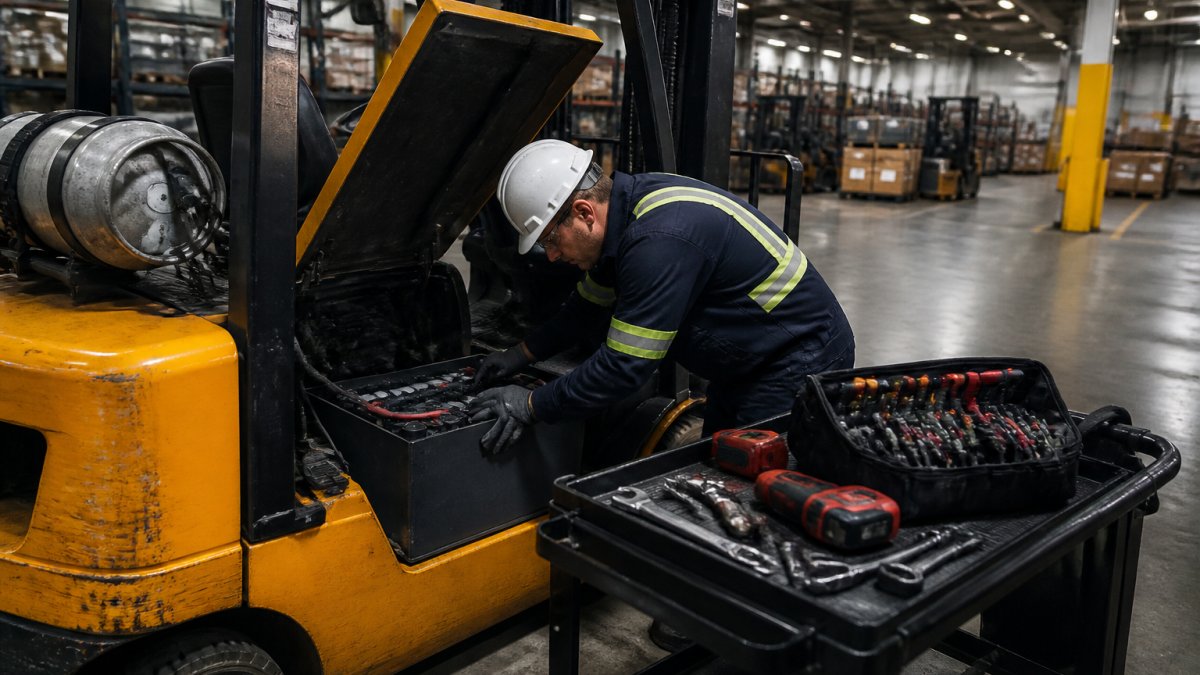
Emergency breakdown response. This is where the two models diverge most. Emergency calls dispatch through the branch that owns your territory and compete for technicians already committed to scheduled work.
A common mistake is assuming a bigger name guarantees faster emergency service.
What to Ask Before You Sign
- Response-time commitment in writing. Average and worst-case, per site, not a regional average.
- After-hours terms. Nights, weekends, and holidays, with the actual on-call structure described.
- First-time fix rate. How they track it, what their target is, and whether they will share it.
- Parts stocking. Which of your fleet’s brands they stock common parts for locally.
- Technician assignment. Whether you get a named technician or whoever is available.
- Escalation path. Who you call when the first response misses the window.
Do not sign a service contract without a written response-time commitment. A vague “we’ll get to you as soon as possible” clause is how facilities end up losing a full shift to a single dead lift.
Also check whether the provider services the specific systems your fleet depends on. Electric forklifts fail differently from internal combustion trucks, battery cells, chargers, controllers, and wiring harnesses rather than fuel and exhaust. Technicians who see those systems daily diagnose them faster than those splitting time across every power type. That specialization gap is invisible on a capabilities table but shows up in your first-time fix rate.
Forklift Maintenance Costs: How to Compare Without Getting Burned
Forklift maintenance costs are not just the hourly rate on the invoice. The number that matters is total cost of ownership: downtime, parts markup, travel charges, and the labor hours your team loses while a lift is out of service. Two providers can quote similar rates and deliver wildly different annual costs.
Forklift Down? Call Us Right Away →
The TCO Math Most Buyers Skip
Total Cost of Ownership (TCO) is the full cost of owning and running a lift over its life, including purchase, maintenance, repairs, downtime, and resale. Most buyers compare only the repair invoice, which hides the biggest line item: lost productivity.
To compare fairly, estimate one hour of downtime for your operation, then multiply it by the average hours each provider leaves you waiting. A provider with a slightly higher labor rate but two-hour faster response often costs less overall, math the invoice never shows.
The cheapest repair quote is rarely the cheapest outcome. Factor in downtime hours before you compare rates, because idle equipment usually costs more than the repair itself.
Forklift Service Response Time: The Metric That Decides Everything
Forklift service response time is the single most important number in any provider comparison, because it directly controls your downtime. A provider can have the best technicians in the region, but if they arrive a day late, your throughput already took the hit.
Ask every provider for three figures: average response time, worst-case response time, and after-hours availability. National providers may publish a target, but branch-level reality is what you live with. Get it in writing, per site.
A second metric matters just as much: first-time fix rate. A fast tech who misdiagnoses a battery or controller issue just resets the clock. Providers focused on electric forklifts and aerial lift equipment diagnose power and electrical faults faster because they see those systems daily.
OSHA powered industrial truck guidance sets the safety and inspection baseline every provider should meet, so use it as a checklist when you evaluate any service agreement.
Forklift Repair Provider Comparison: A Framework for Choosing
Use this framework to compare any two providers, including the Wolter vs National Lift Truck question, on the factors that actually move your uptime.
- Response time: Get average and worst-case figures in writing, per site
- First-time fix rate: Ask how they track it and what their target is
- After-hours coverage: Confirm weekend and emergency terms before you sign
- Equipment specialization: Match their strengths to your fleet mix
- Parts availability: Ask about common-part stock and lead times
- Fleet reporting: Request sample reports if uptime tracking matters
- Contract exit terms: Know how you leave if service slips
Fleet Management Technology and Uptime Tracking
Fleet management technology is the angle most buyers ignore, and where the strongest providers separate themselves. Basic telematics and service-history tracking show which lifts fail most, when maintenance is due, and whether a provider is improving your uptime. A provider that reports on your fleet, rather than just billing repairs, gives you data to cut recurring failures.
Ask for a sample monthly report before signing. A provider that cannot show you fleet-level uptime data is not managing your fleet, it is just reacting to breakdowns.
For operations running electric forklifts alongside scissor and boom lifts, this matters even more. Tracking battery health and charge cycles across a mixed fleet catches failures before they strand a lift mid-shift.
Conclusion: Matching the Provider to Your Operation
The Wolter vs National Lift Truck comparison has no universal winner, the right choice depends on your fleet mix, your site, and how much downtime you can absorb. But national scale is not local speed, and for most facilities, speed protects throughput.
At CSC Forklift Repair, we built our dispatch process around that reality. We specialize in electric forklifts and scissor and boom lift repair, diagnose faults efficiently, and price our work to be cost-effective. If downtime is costing you, get started with CSC Forklift Repair and keep your fleet running.
Frequently Asked Questions
What services do Wolter and National Lift Truck offer?
Both providers offer material handling equipment sales, forklift rental, preventative maintenance, and repair services. National Lift Truck focuses primarily on forklift and industrial equipment solutions, while Wolter also carries aerial lifts, industrial engines, and generators. When evaluating forklift repair services, confirm which equipment types each provider supports and whether they stock parts for your specific fleet brands. Ask about on-site service capabilities and emergency repair availability before committing to a service agreement.
How should I compare forklift service response times?
Ask each provider for their guaranteed response window for emergency calls versus scheduled maintenance. Get specifics: Is it hours or days? Does the clock start when you call or when a technician is dispatched? Ask what happens if they miss the window. Request data on their average response time for your equipment type and location. A provider that tracks and shares this data is more accountable than one that gives vague promises.
How can I compare forklift maintenance costs and service coverage?
Request a line-item breakdown of what a standard preventative maintenance visit includes and what triggers additional charges. Compare the scope of coverage: Does the plan cover both forklifts and aerial lifts? Are after-hours calls billed at a premium? Calculate total cost of ownership by factoring in downtime costs, not just the invoice. A cheaper plan that leaves you waiting two days for a technician costs more in lost productivity than a slightly higher-priced plan with same-day dispatch.
What should I ask a forklift repair provider before choosing one?
Ask about their diagnostic process for electric forklifts, especially battery and electrical fault diagnosis. Confirm whether they handle scissor lifts and boom lifts with the same priority as forklifts. Ask for their backup plan if they cannot dispatch a technician quickly. Request references from operations similar in size to yours. Finally, ask how they track and report uptime improvements, because a provider that measures results is more likely to deliver them.
Forklift or Lift Down Right Now?
Talk directly to an experienced technician, not a call center. Mobile repair for electric, LP and diesel forklifts, scissor lifts and boom lifts across the Sacramento area.
📞 Call (916) 827-0510