
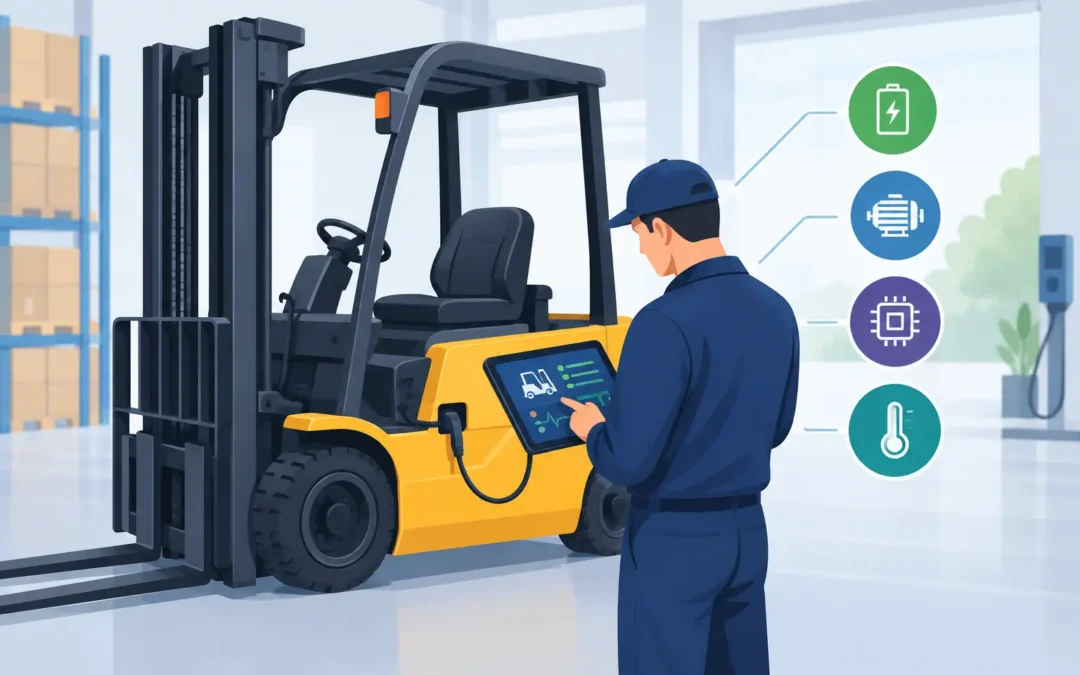
A forklift that will not lift, travel, or charge is not a minor maintenance issue. It is a stalled load, an idle operator, and a schedule that starts slipping by the minute. Effective electric forklift diagnostics get past guesswork quickly, identify the failed system, and focus repair dollars where they belong.
Electric trucks are efficient, quiet, and well suited to warehouse work. They are also dependent on a connected system of batteries, cables, chargers, contactors, controllers, sensors, motors, and safety circuits. A fault in one area can look like a problem somewhere else. That is why swapping parts until the truck runs is expensive. A proper diagnosis starts with the complaint, confirms the failure, and tests the system in the right order.
Electric Forklift Diagnostics Start With the Exact Symptom
“Forklift is down” is the call no operation wants to make, but the details matter. Does the truck power on but refuse to travel? Does it travel slowly, lift intermittently, or shut down under load? Does the charger show a fault? Did the issue begin after battery watering, washdown, impact damage, or a long weekend sitting unused?
Those answers narrow the search before a technician opens a compartment. A truck that is completely dead may have a battery connection, emergency disconnect, key switch, fuse, or control-power issue. A truck that powers up but will not move may be seeing a seat switch, brake switch, directional control, or interlock fault. A truck that loses power during a heavy lift can point to battery voltage drop, damaged cables, weak connections, or a hydraulic problem that is overloading the system.
The best repair begins with the operator’s firsthand account. Operators know whether the display flashed a code, whether the steering felt different, or whether the truck was charging normally the day before. That information saves time and helps prevent a repeat failure.
The Battery Is Often the First Check, Not Always the Fix
The battery deserves early attention because it supplies everything the truck needs. But low voltage alone does not prove the battery is bad. A discharged battery may be the result of a charger issue, poor charging practices, corroded connections, excessive draw, or a battery that can no longer hold capacity.
A technician should inspect battery condition, cable ends, connectors, electrolyte level on flooded lead-acid batteries, and signs of heat or corrosion. Voltage readings matter, but readings under load matter more. A battery can show acceptable voltage at rest and collapse when the lift motor or drive system demands current.
Battery type changes the approach. Flooded lead-acid batteries need correct watering, cleaning, equalization practices, and cell condition checks. Lithium-ion batteries have a battery management system that may limit operation or charging when it detects temperature, voltage, communication, or internal pack faults. The truck may appear to have a controller problem when the battery management system is actually protecting the pack.
Do not bypass battery safety devices or force a damaged connector to work. Heat, acid exposure, and high-current connections create real fire and injury risks. A fast repair still has to be a safe repair.
Charger Problems Can Imitate Forklift Problems
If the truck is weak at the start of every shift, the charging system needs attention. Check that the charger has proper incoming power, that the connector is fully seated, and that the charger is matched to the battery voltage and amp-hour rating. A charger can have power but fail to deliver the correct output profile.
Look for charger fault lights, damaged charge cords, burned pins, loose receptacles, and excessive heat at the connection. On-board chargers add another layer because the truck’s internal wiring and control system may affect charging authorization. External chargers can also fail because of facility power problems, not because of the forklift itself.
Replacing a battery before confirming charger output is a costly mistake. The same is true in reverse. A charger cannot restore capacity that a worn-out battery no longer has.
Controllers, Contactors, and Wiring Need Measured Testing
Modern electric forklifts use controllers to manage drive, lift, steering, braking, and safety functions. When a display shows a fault code, the code is a starting point. It is not a parts order.
A code may identify a circuit with an abnormal reading, but the root cause can be a damaged wire, loose terminal, failed sensor, weak battery supply, corroded connector, or the component named by the code. Experienced technicians use the truck’s fault history, wiring information, voltage-drop testing, continuity checks, and live data to separate the cause from the symptom.
Contactors are another common failure point. These high-current switches can develop burned contacts, weak coils, or poor connections. You may hear a click when the key is turned, but a click does not confirm that the contactor is carrying current correctly. Voltage drop across the contactor and cable path tells the real story.
Wiring faults are especially common around battery compartments, under-floor harnesses, steer axles, mast areas, and locations exposed to vibration or moisture. A cable can look fine from the outside and be corroded inside the insulation. Intermittent faults often show up only when the truck is turning, lifting, or traveling over a rough dock plate. That is why testing the machine only while parked can miss the actual problem.
Safety Interlocks Are Designed to Stop the Truck
Electric forklifts have safety systems that prevent operation when conditions are unsafe. Seat switches, seat belt switches, park brake switches, emergency disconnects, directional controls, brake sensors, and mast or hydraulic interlocks can all inhibit travel or lift functions.
These systems are frustrating when a truck will not move, but they should never be defeated to get through a shift. Bypassing an interlock can create an injury risk and hide the actual fault. A proper diagnostic process verifies switch operation, connector condition, mechanical adjustment, and controller input.
This is one area where the symptom can be misleading. A travel complaint may have nothing to do with the drive motor. A lift lockout may be caused by a safety input that the controller does not recognize as safe. The repair is often straightforward once the failed input is located, but it takes systematic testing to find it.
Drive, Steering, and Hydraulic Faults Require Different Clues
A truck that will not travel may have a drive motor, encoder, controller, brake, or transmission-related issue. Warning signs include jerking movement, one-direction travel only, slow acceleration, abnormal motor noise, or a truck that trips out when it gets warm.
Steering complaints may involve the electric steering motor, sensor feedback, wiring, hydraulic steering components, or low system voltage. If steering becomes hard after several hours of work, heat and voltage drop should be considered alongside mechanical wear.
A no-lift condition is not automatically electrical. Low hydraulic oil, a leaking hose, a failed pump, a stuck valve, worn lift cylinders, or mast binding can create symptoms that resemble an electrical failure. The technician needs to determine whether the lift motor is being commanded on, whether it is drawing the expected current, and whether the hydraulic system is producing pressure. Electrical and hydraulic checks often need to happen together.
What Your Team Can Check Before Calling for Service
Your operators and maintenance staff can provide useful information without taking risks. Record the model and serial number, any fault codes, the battery type, and exactly what the truck does when the problem occurs. Check for obvious loose battery connections, damaged charger cords, visible leaks, or a tripped emergency disconnect.
Do not open high-voltage battery packs, probe controller terminals without proper training, or keep cycling the truck when cables are hot or the battery is swollen, leaking, or smoking. Take the truck out of service and get qualified help. Repeated attempts to operate a failing truck can damage controllers, motors, connectors, or the battery.
For fleets with multiple electric trucks, keep a simple record of charge times, battery watering, recurring codes, repairs, and operator reports. Patterns matter. If three trucks in the same area develop charger faults, the facility power supply may deserve attention. If one truck repeatedly burns connectors, the problem may be cable condition, connection torque, or unusual current draw.
Fast Diagnosis Protects More Than One Shift
The cheapest repair is not always the lowest initial invoice. Replacing a part without proving failure can waste money, extend downtime, and leave the original problem in place. On the other hand, delaying a real battery, cable, brake, or controller repair can turn a manageable service call into a larger failure.
CSC Forklift Repair approaches electric lift equipment with the urgency your operation requires: verify the complaint, test the system, explain the repair clearly, and get the truck back to work at a fair rate. When a forklift is holding up receiving, production, or shipping, direct technician access matters.
If your electric forklift is slowing down, throwing codes, failing to charge, or refusing to move, stop treating the symptom as the diagnosis. Get the fault identified before the next shift has to work around a truck that should be working for you.