
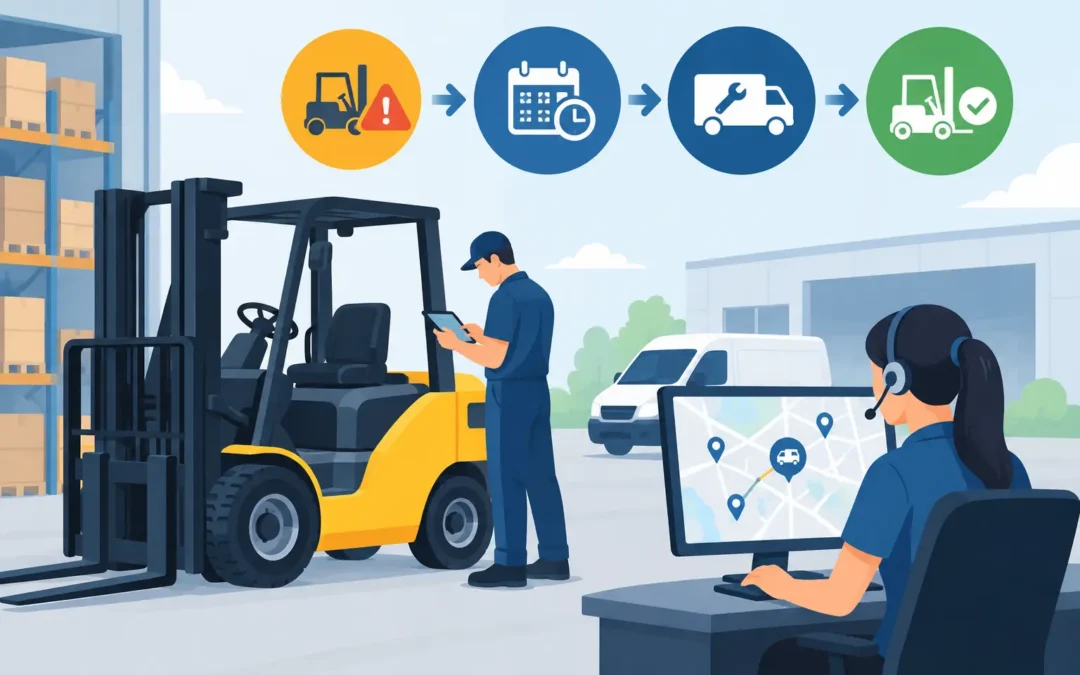
A forklift down at a dock door is not a minor maintenance issue. It can stop loading, strand labor, delay shipments, and force operators to work around equipment that should already be moving product. A good forklift service dispatch process is what turns that breakdown from a long, expensive wait into a controlled repair call.
The difference is rarely just who answers the phone. It is whether the dispatcher gets the right facts immediately, sends a technician qualified for the equipment, and keeps your team informed until the truck is back in service. For electric forklifts especially, guessing at the problem or sending a generalist can waste hours.
What a Fast Forklift Service Dispatch Process Looks Like
Dispatch starts the moment a supervisor, operator, or maintenance lead reports an issue. The goal is not to take a vague message and put it in a queue. The goal is to capture enough useful information to make the first service visit count.
That means identifying the equipment type, make and model, unit number, location, fault code if one is displayed, and the condition that caused the shutdown. Is the lift completely dead? Does it travel but not lift? Is it showing a battery, charger, hydraulic, steer, brake, or control-system issue? Is the truck blocking a production area or creating a safety concern?
Those details determine the urgency and the technician assignment. A no-start electric reach truck in a busy aisle needs a different response than a propane forklift with a slow hydraulic leak that can be safely removed from service. Both need repair. They do not always need the same technician, parts, or response window.
A capable dispatcher should also confirm access before a technician rolls. Gate procedures, receiving hours, site contacts, lift location, and required PPE are practical details that prevent a service truck from losing time at the property. It is basic field-service discipline, but it makes a real difference when your operation is already behind.
The Information That Helps a Technician Arrive Prepared
The best service calls begin with clear information from the floor. You do not need a full diagnosis from your operators, but a few specifics can narrow the problem quickly. A photo of the display code, the forklift data plate, and the damaged area can be more useful than a long description over the phone.
For electric equipment, report whether the battery is charged, whether the charger is operating, and whether the truck powers on. If the display shows a code, write it down exactly. Do not clear it repeatedly or disconnect components in an attempt to reset the machine unless your site procedure calls for it. Those actions can erase clues the technician needs.
For internal-combustion forklifts, note fuel level, starting behavior, warning lights, unusual smoke, and any hydraulic or engine-fluid leaks. For scissor lifts and boom lifts, include the platform condition, ground-control response, drive function, and whether the machine is stuck elevated. If a lift is elevated or unstable, keep personnel clear and follow your safety procedures while service is dispatched.
Triage Comes Before Travel Time
Fast service does not mean treating every call exactly the same. It means sorting calls correctly so the highest operational and safety risks get attention first.
A forklift that has stopped in a travel lane may create an immediate obstruction. A truck with a brake issue, steering failure, damaged forks, hydraulic leak, or electrical burning smell should be removed from service and treated as a safety priority. A single failed unit may be manageable in a large fleet, while the same failure in a small operation can bring shipping to a standstill. Dispatch needs to understand that difference.
This is where direct technician access matters. A technician can ask the questions that change the plan: Is the unit under load? Is there a spare truck? Is the battery room charger functioning? Did the fault appear after impact, washdown, or a battery change? A generic intake process often misses these details and sends the wrong response.
At CSC Forklift Repair, the focus is getting the right technician involved early, particularly when electric forklift faults are affecting production. That reduces the back-and-forth between an office, a sales contact, and the person who actually understands the machine.
What Dispatch Should Communicate Back to Your Team
Once the service call is scheduled, your team should know who is coming, the expected arrival window, what information or access is needed, and who will approve repairs if parts are required. Vague promises do not help a warehouse manager plan labor or manage outbound commitments.
A solid dispatch process also provides updates if circumstances change. Traffic, a prior emergency call, parts availability, and site access can affect arrival time. The point is not to pretend those issues never happen. It is to communicate early enough that you can adjust staffing, move work to another area, or put a backup unit into service.
First-Visit Repair Depends on Preparation
No service company can guarantee every repair is completed on the first visit. Some failures require special-order parts, deeper electrical testing, or manufacturer-specific components. Honest service means saying so when that is the case.
But preparation raises the odds dramatically. The right technician arrives with diagnostic tools, common electrical and hydraulic repair materials, and the details needed to identify likely parts before reaching the site. For electric forklifts, that may mean being prepared to test batteries, connectors, contactors, chargers, controllers, wiring, and safety circuits instead of simply swapping parts and hoping the problem disappears.
That matters because electrical faults can look similar from the operator seat. A truck that will not travel may have a battery problem, a charger issue, a loose connection, a seat switch fault, a failed contactor, a controller fault, or a damaged harness. A qualified technician works through the system in order. That is better workmanship, and it protects your repair budget from guesswork.
Before work begins, the technician should verify the complaint, inspect the equipment for safety concerns, and explain the recommended repair in plain terms. If additional work is needed, the approval path should be clear. Operations managers need enough information to make a decision quickly: what failed, what it will take to repair it, whether the unit can safely remain out of service, and how long the repair is expected to take.
Dispatch Does Not End When the Technician Arrives
The service call is not complete when a technician pulls into the lot. Good coordination continues through diagnosis, authorization, repair, testing, and closeout.
During the repair, the technician may need a site contact to confirm operating symptoms, approve work, locate a spare battery, or arrange access to a restricted area. Slow approval can turn a one-hour repair into a next-day problem. Designating one decision-maker for repair calls keeps that from happening.
After the repair, the unit should be function-tested for the problem reported. Depending on the failure, that can include travel, lift, tilt, steering, braking, charging, safety interlocks, and fault-code checks. A repair is not finished because the engine started or the display turned on. The machine has to perform the function that failed and do it safely.
Your documentation should show the unit serviced, complaint, findings, repair completed, parts used, and any additional recommendations. This record helps identify repeat failures and supports better fleet decisions. If the same electric truck has recurring connector damage, battery issues, or control faults, the answer may be a repair plus a change in charging practices, operator reporting, or planned maintenance.
Where Dispatch Usually Breaks Down
Most delays are avoidable. The common problem is incomplete information at the start of the call, followed by a technician arriving without the access, approval, or equipment details needed to work efficiently.
Another issue is waiting too long to call. A warning light, intermittent drive problem, slow lift, or charger issue may not stop the shift immediately, but it can become a hard failure at the worst possible time. Calling while the truck is still operating under controlled conditions often gives you more scheduling options and may prevent an emergency breakdown.
The other mistake is using the same provider for every type of equipment without asking whether they have the relevant specialty. General service may be sufficient for straightforward mechanical work. Electric forklifts, complex aerial lifts, and recurring electronic faults often call for technicians who work on those systems regularly. The cheapest hourly rate is not always the lowest-cost repair if the diagnosis takes twice as long or the problem returns next week.
Build a Better Call Process Before the Next Breakdown
Your team does not need a complicated system. Keep the unit number, make, model, serial number, and service history accessible. Train operators to report fault codes and symptoms early. Give supervisors a clear contact path for urgent repairs, and decide in advance who can approve reasonable service work.
When a lift stops working, fast action starts with a clear call and ends with a verified repair. Keep the information close, keep the approval path short, and work with a service team that understands what downtime costs you.