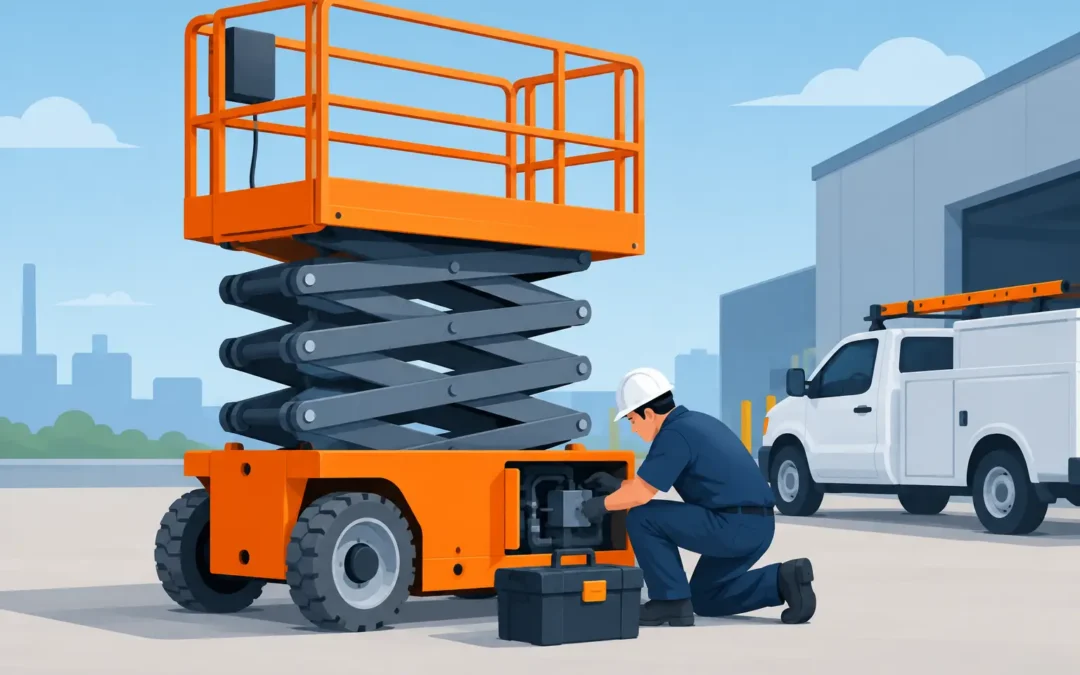
A scissor lift that will not raise, will not charge, or stops halfway through a job is not a minor inconvenience. It can stall an installation crew, block a shipping lane, delay maintenance work, and leave labor standing around waiting. Scissor lifts are built for hard daily use, but they need fast, accurate service when something goes wrong.
For a warehouse, plant, or jobsite manager, the priority is simple: get the machine diagnosed correctly, repair the actual cause, and return it to service without paying for unnecessary parts or repeat calls. That takes a technician who understands aerial equipment, electrical systems, hydraulics, and the safety interlocks that keep operators protected.
Why scissor lift downtime gets expensive fast
A lift may look like one piece of equipment, but its failure can affect an entire operation. A unit parked in a narrow aisle can disrupt picking. A lift down during overhead work can push back a contractor’s schedule. When several machines share a charging area or work zone, one problem can create a bottleneck for the whole crew.
The direct repair bill is only part of the cost. There is also lost labor, rental expense, delayed production, missed delivery windows, and the time your maintenance staff spends trying to chase an intermittent issue. Waiting days for someone to inspect the machine usually costs more than calling a qualified field technician early.
The right response depends on the failure. A lift with a damaged guardrail or obvious hydraulic leak should be removed from service immediately. A unit that occasionally faults, loses drive power, or fails to charge may still need quick attention before a small electrical issue becomes a full no-start condition. Do not let a machine’s intermittent behavior convince the team that the problem can wait.
The failures that put scissor lifts out of service
Most breakdowns fall into a few systems, but the symptoms can overlap. That is why guessing at parts is expensive. A machine that will not lift may have a weak battery, a charger problem, a low-fluid condition, a failed limit switch, a control issue, or a hydraulic fault. Replacing the first part that looks suspicious is not a repair plan.
Battery and charging problems
Electric scissor lifts depend on battery condition, cable connections, charger performance, and proper charging practices. Corroded terminals, low water levels in serviceable batteries, loose connections, damaged battery cables, or a failed onboard charger can all reduce run time or prevent operation.
A common mistake is blaming the batteries before confirming the charger and electrical connections. Another is continuing to run a lift with weak batteries until it begins throwing low-voltage faults. Low voltage can cause confusing symptoms across controls, drive functions, and lift functions. A proper inspection checks the full charging system, not just battery voltage at rest.
Hydraulic leaks and lift-function issues
Hydraulic systems make the platform move, but hoses, fittings, cylinders, valves, and pumps take constant wear. Small leaks can become large ones quickly, especially on equipment working outdoors or traveling over rough surfaces. Low hydraulic fluid may cause slow operation, inconsistent lifting, or complete loss of lift function.
Never treat a hydraulic leak as cosmetic. Beyond the risk of downtime, leaked fluid creates a slip hazard and can contaminate a warehouse floor or jobsite. A skilled technician should locate the source, inspect surrounding components, correct the repair, and verify safe operation under load.
Electrical controls and safety interlocks
Modern lifts use controls and safety circuits that will shut down functions when the machine detects an unsafe condition. Pothole protection systems, tilt sensors, emergency-stop circuits, platform controls, ground controls, limit switches, and wiring harnesses all matter. A single failed switch or damaged connector can leave a perfectly sound machine unable to move or lift.
These problems require more than a visual check. Technicians need to test inputs, outputs, wiring continuity, fault codes, and function behavior. Bypassing a safety circuit to get through the day is not an acceptable solution. It exposes the operator, the crew, and the business to a much bigger problem than a repair call.
Drive, steering, and tire damage
Scissor lifts are often moved more than people realize. That puts wear on drive motors, steering components, brakes, tires, wheels, and wheel bearings. A unit that pulls to one side, makes abnormal noise, loses travel power, or has damaged tires should be inspected before it is used near racks, walls, people, or uneven ground.
Indoor electric models and rough-terrain units have different demands, but both need regular attention. Smooth indoor floors can hide tire wear until traction and stability suffer. Outdoor jobsites add mud, debris, impact damage, and uneven terrain that can stress components much faster.
What a useful service call should accomplish
The goal is not simply to make the warning light disappear. A good field repair starts with the operator’s report, confirms the symptom, and works from test results rather than assumptions. The technician should inspect the affected system, identify what failed, explain the repair in plain language, and test the lift after the work is complete.
For equipment managers, clear communication matters. You need to know whether the machine can be returned to service, whether a part is required, whether a safety issue was found, and what should be addressed next. You should not have to decode vague notes or wait for a salesperson to relay basic technical information.
CSC Forklift Repair provides direct technician-led support for scissor lifts, electric forklifts, and boom lifts because downtime needs an answer now, not a runaround. Faster response, solid workmanship, and fair pricing are what keep a repair call from turning into a week of lost productivity.
Preventive maintenance is cheaper than an emergency stop
Planned maintenance does not eliminate every breakdown. It does catch wear before it turns into a shutdown during the busiest part of a shift. The best schedule depends on machine age, hours of use, operating environment, fleet size, and whether the lift works indoors, outdoors, or both.
At a minimum, routine service should look closely at batteries and charging, hydraulic fluid and leaks, tires and wheels, steering and brakes, safety rails and gates, emergency stops, platform and ground controls, wiring, hoses, and function testing. Inspection intervals should also follow the equipment manufacturer’s requirements and your site’s safety program.
Daily operator checks are just as important. Operators are usually the first people to hear a new noise, feel slow movement, notice a leak, or see a damaged cable. Give them a clear path to report problems, and take those reports seriously. A lift does not need to be completely dead before it deserves service.
Keep better records on every lift
Fleet records make repair decisions easier. Track the machine’s make, model, serial number, hour meter reading, battery age, prior repairs, fault history, and recurring symptoms. When you call for service, this information helps the technician arrive prepared and reduces time spent identifying the unit.
Patterns matter. If one lift repeatedly has charger failures, drive faults, hose damage, or dead batteries, the answer may be more than another replacement part. The machine may be used beyond its intended duty cycle, charged improperly, stored in poor conditions, or assigned to an application better suited to a different model. Repairing the immediate fault is necessary, but identifying the pattern protects your budget over time.
Know when to pull a lift from service
Any equipment that compromises safe operation should be tagged out until it is inspected and repaired. This includes visible hydraulic leaks, damaged guardrails, nonworking emergency stops, charging damage, severe tire or wheel problems, uncontrolled movement, unusual structural damage, or malfunctioning safety devices.
Do not ask an operator to work around a known issue. Do not make a temporary bypass part of the process. The pressure to finish a task is real, especially when crews and deliveries are waiting, but an aerial lift incident carries costs far beyond downtime.
When a scissor lift starts acting up, report the symptom early, keep the machine safe, and get a technician involved before the failure grows. Fast, competent repair is not just about getting the platform back in the air. It is about keeping your people working, your schedule moving, and your operation in control.
Forklift or Lift Down Right Now?
Talk directly to an experienced technician, not a call center. Mobile repair for electric, LP and diesel forklifts, scissor lifts and boom lifts across the Sacramento area.
📞 Call (916) 827-0510