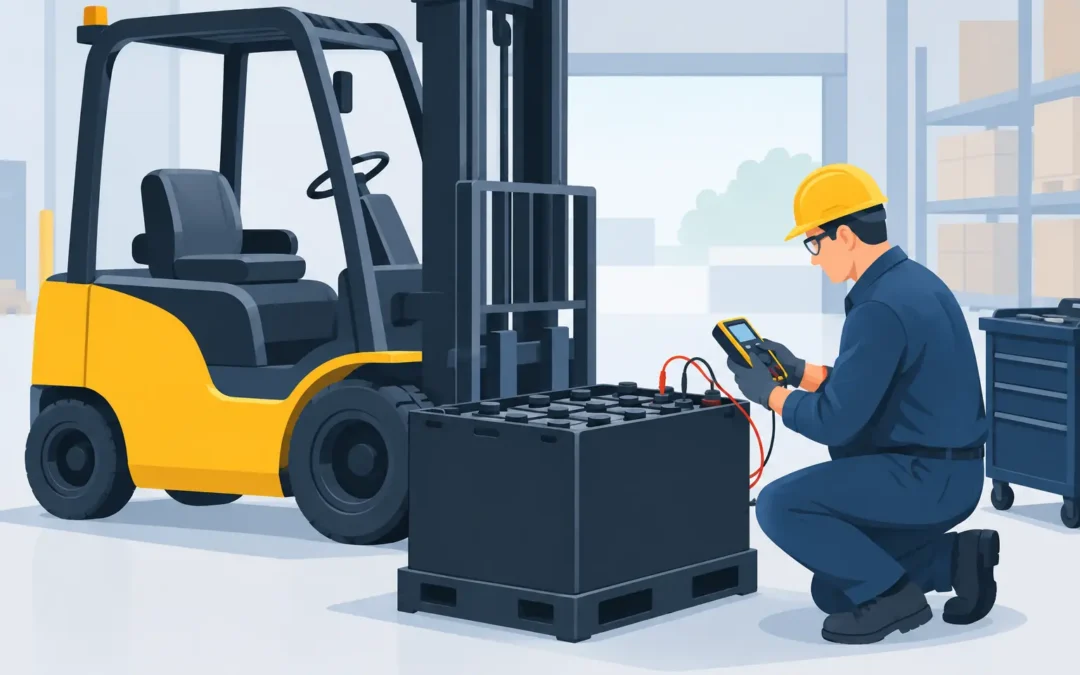
A forklift that slows down halfway through a shift is not just an inconvenience. It can hold up picks, loading, production, and labor across the floor. Knowing how to test forklift batteries gives your team a better chance of finding a weak battery before it becomes a dead truck in an aisle.
Battery testing is not one quick meter reading. A battery can show acceptable voltage at rest and still collapse under load. The right approach combines a visual inspection, charging review, voltage checks, and, for flooded lead-acid batteries, specific gravity testing. If the results are unclear, get a qualified electric forklift technician involved before repeated battery problems damage the truck’s connectors, cables, or electrical system.
Start With Safety and the Right Battery Type
Before opening a battery compartment, park the forklift on level ground, lower the forks, set the parking brake, turn the key off, and disconnect the charger. Wear safety glasses, acid-resistant gloves, and protective clothing when working around flooded lead-acid batteries. Battery acid, hydrogen gas, and high DC current are not minor hazards.
First, identify what battery you have. Most older electric forklifts use flooded lead-acid batteries with removable cell caps. Some use sealed AGM batteries, while newer equipment may use lithium-ion packs. The test method changes with the chemistry. A hydrometer is useful for flooded lead-acid cells but must never be used on sealed or lithium batteries.
For lithium batteries, follow the battery manufacturer’s procedure and use the battery management system data. The state of charge, fault history, cell balance, temperature readings, and communication faults can tell you far more than a simple voltage check. Do not open a lithium battery pack or attempt cell-level repairs in the field.
Inspect the Battery Before You Test It
A fast visual inspection often finds the problem before the meter comes out. Look for cracked cases, bulging sides, loose hold-downs, damaged cables, burned connectors, corrosion, electrolyte leaks, and signs of overheating. A strong sulfur or rotten-egg smell can point to overcharging, poor ventilation, or a failing battery.
Check electrolyte level on flooded batteries after the battery has been fully charged. The plates should be covered, but do not overfill the cells. Water should be added only as required and typically after charging, using distilled water. Overfilled cells can push acid out during charging and create corrosion, shorts, and a mess around the battery tray.
Pay close attention to the battery connector and truck-side connector. Darkened pins, melted plastic, loose terminals, or hot cables create voltage drop under load. The battery may be healthy while the connection is costing you run time and creating a fire risk.
Check Charging Habits First
Many forklift battery complaints start with charging practices, not a defective battery. Confirm that the charger matches the battery voltage and amp-hour rating. A 36-volt battery needs a 36-volt charger. A charger that is too small, incorrectly programmed, or failing to complete its cycle will leave the battery chronically undercharged.
Review how the battery is being used. Deep discharges, opportunity charging without the right battery setup, skipped equalization cycles on flooded batteries, and charging in excessive heat all shorten service life. As a general operating rule, avoid discharging a lead-acid forklift battery below roughly 20% state of charge. Running it flat regularly damages capacity and increases downtime.
After a full charge cycle, let a flooded battery rest for at least an hour before taking resting voltage or specific gravity readings. Testing immediately after charging can give misleading results because of surface charge.
How to Test Forklift Batteries With a Multimeter
Use a digital multimeter set to DC volts. Start by checking the total battery voltage at the main connector. A fully charged lead-acid battery should read approximately 2.1 volts per cell after it has rested. That means a 24-volt battery with 12 cells should generally be near 25.2 volts, a 36-volt battery near 37.8 volts, and a 48-volt battery near 50.4 volts.
These are general resting values, not a final diagnosis. Temperature, recent charging, and battery condition affect readings. A battery that is noticeably below its expected voltage after a full charge may have weak cells, an incomplete charge, or an issue with the charger.
Next, test individual cells on a flooded battery. Place the meter probes across each cell’s terminals and record the readings. Healthy cells should be close to one another. A cell that is substantially lower than the rest is the problem area. One weak cell can pull down the entire battery and cause low-voltage faults, slow lift speed, or short run time.
Voltage testing becomes more useful under load. With proper safety precautions, monitor pack voltage while the forklift is operating or during a controlled load test performed by a technician. If voltage drops sharply when lifting a rated load, accelerating, or climbing a grade, the battery may have lost capacity or have a high-resistance connection. Do not bypass safety systems or improvise a load test with unapproved equipment.
Use Specific Gravity Testing for Flooded Lead-Acid Batteries
For flooded lead-acid batteries, a temperature-compensated hydrometer gives one of the clearest indicators of cell condition. Draw enough electrolyte from each cell to float the hydrometer indicator, then record the specific gravity reading. Return the electrolyte to the same cell when finished.
A fully charged cell commonly reads around 1.265 to 1.285, depending on the battery manufacturer and temperature. What matters most is consistency. Cells should generally be within about 0.015 to 0.030 specific gravity points of each other. A cell that reads far lower than the others after charging may be sulfated, shorted, or otherwise failing.
Do not test a battery that has just been watered, and do not rely on a hydrometer reading if the electrolyte is badly contaminated or the battery has not completed a proper charge. If several cells read low and evenly, look at the charging system and charging routine. If one cell is low while the others are normal, the battery likely has an internal cell issue.
Test Capacity, Not Just Charge Level
A battery can reach full voltage and still have very little usable capacity. This is the difference between state of charge and battery health. For operations that depend on electric forklifts all day, capacity testing is often the deciding test.
A professional capacity test discharges the battery at a controlled rate and measures how long it can sustain the load before reaching its specified cutoff voltage. It is more involved than a voltage check, but it shows whether the battery can actually support a shift. This matters when operators report reduced run time even though the charger indicates a full charge.
Capacity loss is expected as a battery ages. Sulfation from chronic undercharging, overheating, poor watering practices, and deep discharges can speed it up. Replacing one bad battery is often cheaper than repeated emergency calls, lost productivity, and damage caused by forcing a weak battery to keep working.
Know When the Problem Is Not the Battery
Do not assume every no-start or low-power complaint is a battery failure. A failing charger, dirty connector, damaged cable, loose terminal, corroded contactor, poor ground, or truck electrical fault can produce the same symptoms. If the battery tests well at rest but voltage loss occurs between the battery and truck controls, the issue may be in the connection or forklift itself.
Watch for repeated charger faults, excessive battery heat, one cell using much more water than the others, or a battery that reaches full charge unusually fast and runs down quickly. Those are warning signs worth addressing early. Continuing to operate a truck with overheated cables or a compromised battery connection is not a cost-saving move.
When a test points to a weak cell, charger problem, or electrical fault, document the readings and remove the forklift from demanding service until it is checked. CSC Forklift Repair can diagnose electric forklift battery and charging issues directly at your facility, helping you avoid the longer downtime that follows a roadside-style guess.
A few minutes spent checking voltage, cell balance, charging performance, and connections can protect an entire shift. Test before the forklift is needed most, not after it has already stopped the work.
Forklift or Lift Down Right Now?
Talk directly to an experienced technician, not a call center. Mobile repair for electric, LP and diesel forklifts, scissor lifts and boom lifts across the Sacramento area.
📞 Call (916) 827-0510