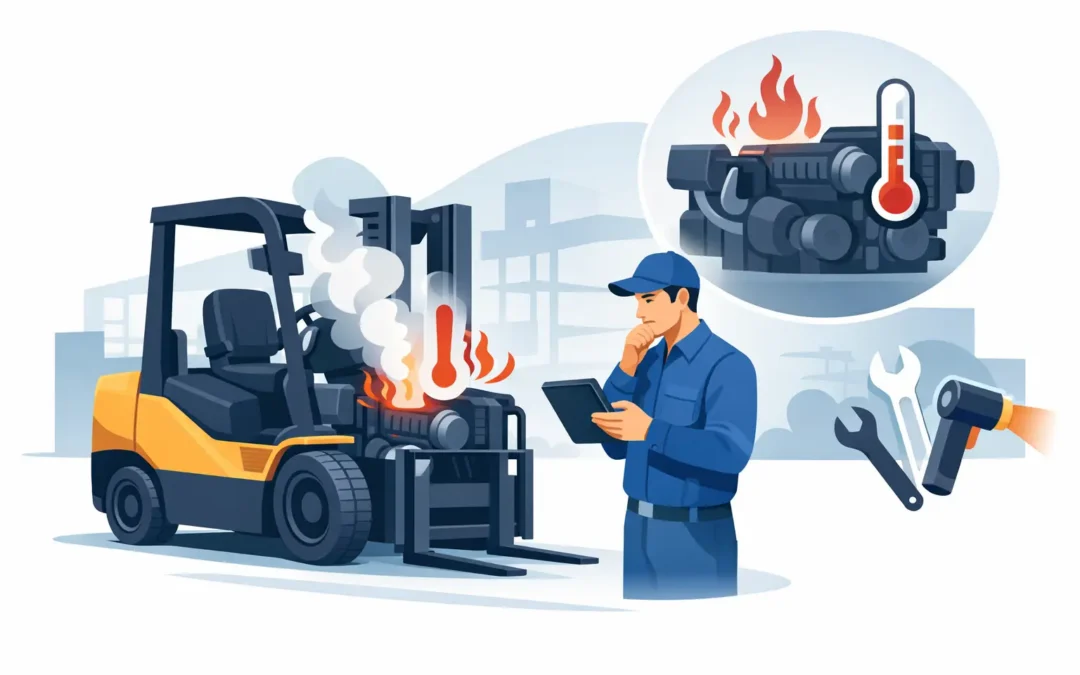
A forklift that starts running hot can turn one delayed load into a full shift of lost production. Knowing how to diagnose forklift overheating starts with identifying what is actually overheating: the engine coolant system on an internal-combustion truck, or the battery, motor, controller, and hydraulic components on an electric forklift. The wrong assumption wastes time. The right diagnosis gets the truck out of danger and back to work faster.
Do not keep operating a forklift that is showing an over-temperature warning, steaming, losing power, smelling hot, or shutting down under load. Park it in a safe area, lower the forks, set the brake, and let it cool. Continued operation can turn a clogged radiator or weak cooling fan into engine damage, a failed controller, or an expensive battery replacement.
Start With the Warning Signs
Overheating does not always mean the same thing. On a propane, gasoline, or diesel forklift, the most obvious signs are a temperature gauge in the red, coolant odor, steam, a visible coolant leak, or a loss of engine power. You may also hear the cooling fan running constantly or see coolant pushed out near the overflow reservoir.
Electric forklifts show heat problems differently. The truck may reduce travel speed, lift slowly, display an error code, shut down after repeated cycles, or become hot around the battery compartment, drive motor, hydraulic motor, or controller. A hot electrical smell, discoloration at battery connectors, or unusually warm cables needs immediate attention.
Before taking anything apart, record the conditions when the issue occurs. Does the truck overheat only under a heavy load? After 20 minutes of use? Only outdoors in hot weather? Only while charging? That pattern helps separate a cooling-system failure from an airflow, electrical, battery, or operating-condition problem.
How to Diagnose Forklift Overheating on Engine-Powered Trucks
Begin with a cold engine. Never remove a radiator cap from a hot forklift. Pressurized coolant can cause serious burns.
Check coolant level and visible leaks
Inspect the radiator, hoses, hose clamps, water pump area, reservoir, and heater lines if equipped. Low coolant is one of the most common causes of forklift overheating, but it is a symptom, not always the root cause. Repeatedly topping off coolant without finding the leak only delays the repair.
Look for wet connections, crusty residue, split hoses, a damaged radiator core, or coolant on the ground. Check the coolant condition as well. Rust-colored coolant, oil contamination, or heavy sediment can point to neglected maintenance, internal corrosion, or a more serious engine issue.
Inspect radiator and airflow blockage
Forklifts work in dust, cardboard debris, lint, sawdust, plastic film, and outdoor dirt. That debris packs into radiator fins and prevents heat from leaving the coolant. A radiator can look acceptable from one side while being fully blocked on the other.
Inspect the radiator, oil cooler, transmission cooler, and any protective screens. Use the proper low-pressure cleaning method for the equipment. High-pressure water or air used too close to the core can fold fins over and make airflow worse. Also check that the fan shroud is secure and that nothing is blocking air intake or exhaust paths.
Test the fan, belt, and thermostat
A loose or cracked belt can prevent the water pump and fan from doing their job. Check belt condition and tension according to the manufacturer specification. On trucks with electric cooling fans, confirm the fan comes on when operating temperature rises and that its wiring, relay, fuse, and connector are intact.
A thermostat stuck closed restricts coolant flow and can make the temperature rise quickly. A weak water pump, damaged impeller, restricted radiator, or collapsed lower radiator hose can create a similar result. These failures require more than a visual inspection. A technician may need to pressure-test the system, verify coolant circulation, and check actual temperature with a scan tool or infrared thermometer.
Rule out an engine or fuel-related issue
If the cooling system checks out but the forklift still runs hot under load, look deeper. Incorrect ignition timing, a lean fuel condition, restricted exhaust, or a failing head gasket can all increase operating temperature. Propane forklifts can also develop fuel-system issues that show up when the engine is working hard.
Watch for white exhaust, bubbling in the coolant reservoir, unexplained coolant loss, oil that looks milky, or persistent overheating after the radiator and fan have been verified. Those are not problems to run through until the next service interval.
Diagnose Overheating on Electric Forklifts Differently
Electric forklift overheating is often a thermal-protection issue, not a coolant issue. The truck may protect itself by limiting performance or shutting down. That protection is doing its job. Bypassing it or repeatedly cycling the key will not fix the cause.
Check the battery before blaming the truck
A failing battery creates heat and forces the rest of the electrical system to work harder. Inspect battery cables, connectors, and terminals for corrosion, looseness, burn marks, or damaged insulation. High resistance at a connection produces heat, voltage drop, and intermittent performance problems.
Check electrolyte levels only if the forklift uses a serviceable lead-acid battery and the battery has cooled. Low water levels expose plates and create excess heat during use and charging. Do not add water to a hot battery, and do not overfill it. Lithium-ion battery systems have different service requirements and should be diagnosed using the manufacturer-approved process.
Battery charging habits matter. An incorrect charger, poor charging location, blocked ventilation, frequent opportunity charging on a battery not designed for it, or a charger that is overcharging can cause temperature problems. If the battery gets hot primarily during charging, stop using that charger until the battery and charger are checked.
Inspect motors, controllers, and cooling paths
Electric drive and hydraulic motors generate heat when a forklift is overloaded, run continuously, or operates with restricted airflow. Dust buildup around motor housings, cooling fans, heat sinks, and controller compartments traps heat. Inspect these areas with power isolated and using the manufacturer’s safety procedure.
A controller fault, failing motor bearing, worn brushes on applicable motor types, shorted wiring, or excessive hydraulic demand can also trigger an over-temperature code. If a truck heats up mostly while lifting, the hydraulic motor, pump, relief setting, valve issue, or a mechanical binding condition may be the real problem. If it heats up during travel, focus first on the drive motor, brakes dragging, tire condition, controller codes, and load weight.
Do not assume an error code identifies the failed part. Codes identify the system that detected an abnormal condition. A qualified technician still needs to test current draw, voltage drop, temperatures, wiring integrity, and the truck’s operating load before replacing components.
Separate Equipment Failure From Operating Conditions
Not every hot forklift has a broken part. A truck working beyond its capacity, traveling long distances with a heavy load, operating on grades, or running in a hot and dirty area may overheat even when every component is functional. That does not mean the warning can be ignored. It means the solution may include changes to the work cycle, truck selection, ventilation, or maintenance schedule.
Check the data plate and confirm the actual load, load center, attachment weight, and operating surface. A load that appears acceptable can still exceed capacity once an attachment or extended load center is factored in. For electric forklifts, make sure the battery capacity matches the shift demand. For engine-powered forklifts, confirm the truck is not idling for long periods with compromised airflow or operating with a blocked counterweight intake.
When to Stop Troubleshooting and Call for Service
Field checks can catch obvious issues, but overheating is not the place for guesswork. Call for service immediately if there is steam, a coolant leak, a hot battery, melted connectors, repeated fault codes, sudden power loss, coolant and oil contamination, or an engine that overheats again after cooling down.
A technician can test the system under the conditions that create the problem. That includes cooling-system pressure, fan operation, thermostat performance, battery condition, charger output, controller data, motor current draw, and hydraulic pressure. Replacing parts based on suspicion can cost more than a proper diagnosis, especially on electric lift equipment.
CSC Forklift Repair provides direct technician-led service for forklifts and lift equipment when downtime is already affecting the operation. The goal is simple: find the real failure, make the repair correctly, and avoid paying for parts that did not need replacement.
A forklift that runs hot is giving you a warning before it becomes a bigger outage. Take it out of service, document the conditions, check the basics safely, and get a qualified diagnosis before the next shift turns a manageable repair into lost equipment time.
Forklift or Lift Down Right Now?
Talk directly to an experienced technician, not a call center. Mobile repair for electric, LP and diesel forklifts, scissor lifts and boom lifts across the Sacramento area.
📞 Call (916) 827-0510