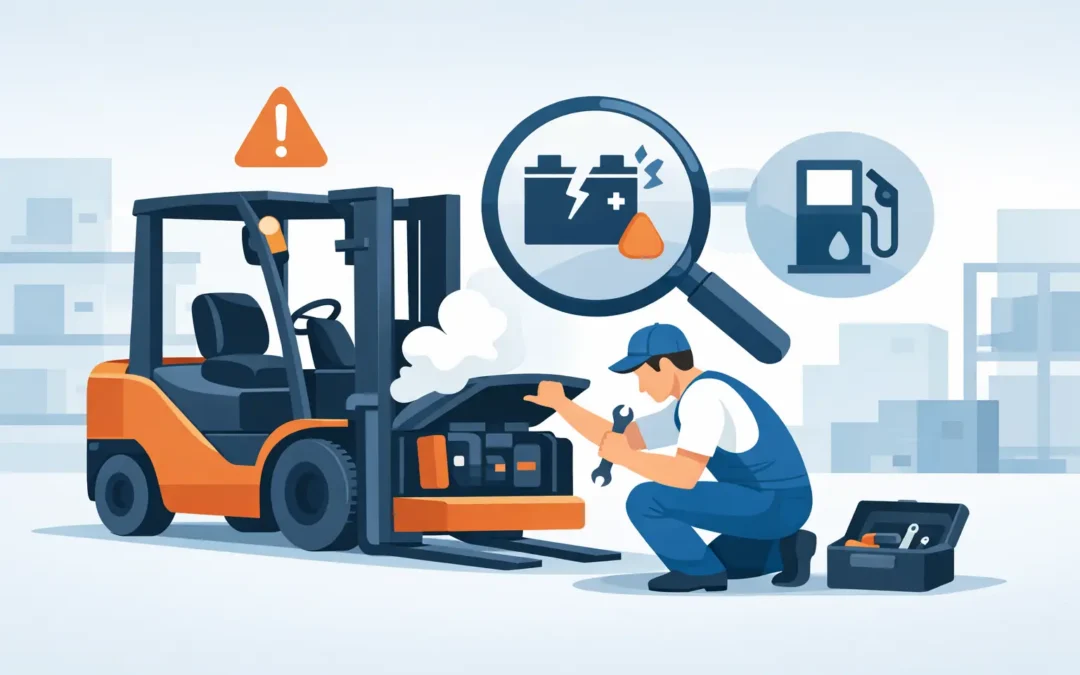
A forklift that starts then dies is not a minor annoyance. It can stop a loading crew, delay outbound orders, leave a pallet in the wrong place, and turn one piece of equipment into an expensive bottleneck. The quick restart may tempt an operator to keep trying, but repeated cranking can drain the battery, flood an engine, or hide the actual fault.
The cause is usually tied to fuel delivery, electrical power, air intake, safety interlocks, or a control-system fault. The right repair depends on the truck. A propane forklift, diesel forklift, and electric forklift can show the same symptom for very different reasons. Start with safe, basic checks, then bring in a technician before a small failure becomes a longer downtime event.
Why a Forklift Starts Then Dies
An engine needs the right amount of fuel, air, spark or compression, and stable electrical power to keep running. If it fires for a second and stalls, one of those systems is dropping out after startup. On an electric forklift, the equivalent problem may be a contactor that pulls in briefly and then opens, a weak battery under load, or a controller that detects a fault and shuts the truck down.
The timing of the shutdown matters. Does it die immediately after releasing the key? Does it run for 10 seconds, then quit? Does it stall only when you shift into gear, raise the mast, or turn the steering wheel? Those details give a repair technician a much faster path to the fault.
Do not assume the problem is an empty tank or weak battery simply because the truck restarts. Intermittent failures are common with worn connections, damaged wiring, contaminated fuel, failing sensors, and aging electrical components.
Start With the Safe Checks
Before anyone works around the truck, park it on level ground, lower the forks, set the parking brake, and keep the area clear. If the forklift has a fuel smell, visible leak, damaged battery cable, smoke, or hot electrical odor, take it out of service immediately. Do not keep restarting it to see if the problem goes away.
Operators and maintenance staff can check a few items without dismantling components:
- Confirm there is adequate fuel or battery charge and that the correct fuel is installed.
- Check whether the emergency stop is released and the seat switch, parking brake, and directional controls are in their proper startup positions.
- Look for loose battery cables, corrosion, damaged connectors, blown fuses, or obvious wire damage.
- Check propane tank valve position, hose condition, and whether the tank is properly seated.
- Note dashboard warnings, fault codes, unusual beeps, exhaust smoke, or changes in sound before the stall.
These checks are useful because they provide information, not because they replace diagnosis. Bypassing a seat switch, safety interlock, fuse, or controller protection is not a repair. It can create an injury risk and cause more equipment damage.
If It Is a Propane Forklift
Propane forklifts often start then stall because fuel flow is restricted or the fuel-air mixture is wrong. A nearly empty tank can still allow the engine to fire, especially after the truck has been sitting, but may not provide enough flow to keep it running. A closed or partially closed service valve, a damaged hose, a frozen regulator, or a failing lockoff can produce the same symptom.
Cold conditions can make regulator problems more noticeable. So can contaminated fuel, poor tank connections, or an engine that has been cranked repeatedly. If the truck smells strongly of propane, shut it down, keep ignition sources away, and call for service. Leak checks and fuel-system repairs need to be handled correctly.
Air intake problems can also cause a propane unit to stall shortly after startup. A badly clogged air filter, damaged intake hose, or throttle-body issue may prevent the engine from maintaining the correct mixture. If the engine starts only with throttle input, hunts for idle, or dies when the accelerator is released, the fuel and air systems both need attention.
If It Is a Gasoline or Diesel Forklift
On a gasoline forklift, common suspects include a restricted fuel filter, weak fuel pump, contaminated fuel, carburetor or injector problems, and ignition faults. A failing ignition coil may produce enough spark to start the engine, then lose output as it warms or as voltage changes. Loose battery terminals and poor grounds can create similar symptoms.
Diesel forklifts are less dependent on spark, but they still need clean fuel and sufficient pressure. Water in the fuel, a plugged filter, air entering the fuel line, or a failing lift pump can let the engine start and then starve it. In colder weather, fuel gelling and intake heater issues can add another layer to the diagnosis.
Pay attention to smoke. Black smoke can point toward restricted air or excess fuel. White smoke may suggest unburned fuel, cold combustion, or other engine issues. No smoke at all during a stall can indicate that fuel delivery stopped. Smoke alone is not a diagnosis, but it helps narrow the service call.
Electric Forklift Starts Then Dies: Common Causes
Electric forklifts are a CSC Forklift Repair specialty, and their shutdown symptoms deserve a different approach. A truck may power up normally, show a charge level, and then die when the key is released, when travel is selected, or when hydraulic demand increases. That does not automatically mean the battery is bad.
A weak or failing battery can show a normal voltage reading at rest but collapse under load. This is common with aging lead-acid batteries, damaged cells, low electrolyte levels, poor charging practices, or loose cables. A battery that has not been fully charged can also make a truck appear healthy until the drive motor or hydraulic pump draws current.
Battery connections matter just as much. Heat, corrosion, loose terminals, worn connectors, and damaged cables increase resistance. Under load, that resistance can cause a voltage drop large enough for the controller to shut the forklift down. A hot connector, melted housing, or discolored cable is a clear warning sign. Take the truck out of service rather than trying to finish a shift with it.
The issue may also be in the contactor, key switch, seat switch, brake switch, controller, or wiring harness. Electric forklifts use safety circuits that prevent travel or hydraulics when a required condition is not met. A failing switch can work intermittently, which is why the forklift may start one time and die the next.
Modern electric trucks often store fault codes. Recording the code before cycling power can save time. A code points a technician toward the affected circuit, but it still needs proper testing. Replacing parts based only on a code can waste money when the actual cause is a poor connection, low battery voltage, or damaged wire.
When It Dies Only in Gear or Under Load
A forklift that idles but stalls when shifted into forward or reverse has a different failure pattern than one that dies immediately. On internal-combustion trucks, the engine may have an idle, governor, transmission, or fuel-delivery problem that appears when demand increases. On electric trucks, the battery may be dropping voltage under load, or the drive circuit may be detecting an overcurrent or safety fault.
If the truck dies when lifting, check whether it also dies during steering or travel. Hydraulic functions create high current demand on electric units and place load on the engine in internal-combustion models. That comparison helps isolate whether the failure is tied to one function or to the truck’s overall power supply.
Do not continue testing with a loaded pallet or elevated load. A stall can leave the truck in an unsafe position, and a weak power system may not have enough reserve to lower or move equipment as expected.
Information That Speeds Up the Repair
When you call for forklift service, give the technician the make, model, serial number, power type, and any fault code on the display. Describe exactly when the stall occurs and whether the truck restarts right away. Mention recent battery charging, fuel changes, prior repairs, impacts, water exposure, or wiring damage.
That information prevents guesswork. It also helps ensure the technician arrives prepared with the right diagnostic equipment and common parts. Fast service is not just about getting someone on-site quickly. It is about finding the failure correctly the first time and avoiding unnecessary parts replacement.
A forklift that starts and then dies is telling you something is failing under startup conditions or load. Put safety first, capture the symptoms, and get a qualified technician involved before the truck turns one stalled shift into a larger repair bill.
Forklift or Lift Down Right Now?
Talk directly to an experienced technician, not a call center. Mobile repair for electric, LP and diesel forklifts, scissor lifts and boom lifts across the Sacramento area.
📞 Call (916) 827-0510