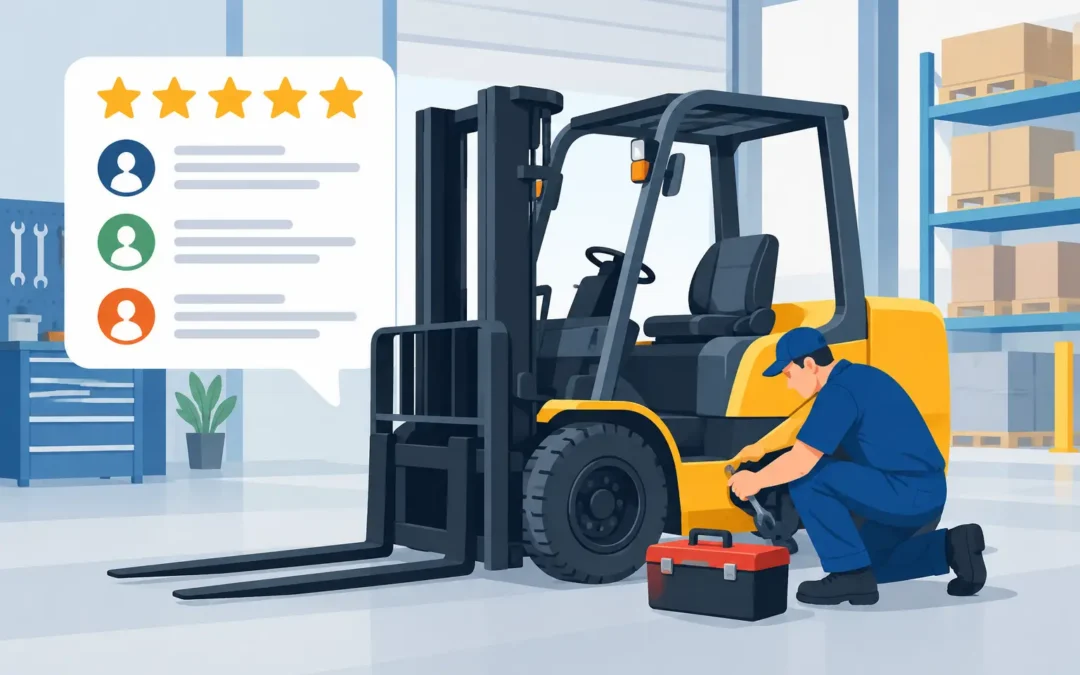
A forklift stopped in a busy aisle is not a minor inconvenience. It can hold up receiving, picking, production, deliveries, and labor across an entire shift. That is why forklift repair company reviews deserve more than a quick glance at a star rating. The right reviews tell you whether a service company answers when equipment fails, sends a capable technician, explains the repair, and gets the machine safely back to work without turning a breakdown into a budget problem.
What Forklift Repair Company Reviews Should Tell You
A five-star average is useful, but it is not enough. Industrial equipment service is different from ordering office supplies or booking a restaurant. You need evidence that the company can perform under pressure, work on your type of equipment, and communicate clearly while your operation is losing time.
Read the written comments first. Look for details about the equipment involved, such as electric forklifts, reach trucks, pallet jacks, scissor lifts, or boom lifts. A review that says a technician diagnosed a no-start condition, hydraulic leak, charger problem, mast issue, or intermittent electrical fault carries more weight than a one-line comment saying the service was “great.”
The best reviews also describe what happened after the call. Did the company respond promptly? Did the technician arrive prepared? Were the findings explained in plain terms? Did the repair hold up after the equipment returned to service? Specific answers to those questions matter because they reflect the work your team actually needs.
Look Past the Star Rating
Star ratings can hide the details that make or break a repair experience. A company with a slightly lower average but recent, detailed feedback from warehouse managers and contractors may be a better choice than one with a perfect score and little useful information.
Pay attention to review volume, recency, and consistency. A handful of strong reviews from several years ago does not prove a company is responsive today. Equipment fleets change, technicians change, and service capacity changes. Recent comments are more likely to reflect current dispatch practices, parts access, and workmanship.
Consistency matters, too. One unhappy customer does not automatically disqualify a repair company. Service calls can involve discontinued parts, damage caused by misuse, and machines with years of deferred maintenance. What matters is whether the same complaint appears repeatedly. If several customers mention missed appointments, surprise charges, poor communication, or repairs that failed soon after the technician left, take that seriously.
On the other hand, repeated comments about fast callbacks, honest recommendations, clear invoices, and experienced technicians are strong signals. Those are the basics of a dependable repair partner.
Find Evidence of Fast Response
When a forklift is down, response time affects more than convenience. It affects labor utilization, throughput, customer commitments, overtime, and safety. A repair company may advertise emergency service, but reviews can show whether that promise holds up when customers need help.
Look for language such as “called back right away,” “had a technician out the same day,” “kept us updated,” or “got us running before the shift ended.” These comments show the company understands downtime. Be cautious with reviews that praise a company generally but never mention speed, scheduling, or communication. They may still do good work, but they may not be the best fit for an operation that cannot wait days for a diagnosis.
Fast service does not always mean an instant completed repair. Some failures require ordered parts, battery testing, controller programming, or a deeper inspection. A good company will not make empty promises. It will give you a realistic status, explain the next step, and help you decide whether a temporary solution is possible.
Check for Expertise With Your Equipment
Not every forklift repair company has the same capabilities. Internal combustion forklifts, electric counterbalance trucks, narrow-aisle equipment, scissor lifts, and boom lifts each bring different service needs. Electric lift equipment, in particular, requires technicians who can work through batteries, chargers, contactors, controllers, wiring faults, and drive or hydraulic systems without guessing.
Reviews can reveal whether a company has that depth. Search the feedback for references to electric forklift repairs, charging problems, battery concerns, lift controls, error codes, or intermittent electrical failures. A technician who understands electric equipment can often diagnose the root cause faster, which helps prevent repeat calls and unnecessary parts replacement.
Also consider the age and mix of your fleet. Some service providers are strongest with newer, brand-specific machines. Others are more practical with mixed fleets, older equipment, and hard-to-source parts. Neither approach is automatically better. The right fit depends on what you operate and how much downtime your facility can absorb.
Read Pricing Comments Carefully
No operations manager wants a cheap repair that fails next week. At the same time, no one wants a vague invoice padded with labor, travel, and parts charges that were never discussed. Reviews about price are useful when they provide context.
Positive pricing feedback often mentions fair rates, accurate estimates, no unnecessary repairs, or technicians who explained options before proceeding. Those are better indicators than a simple claim that a company is “the cheapest.” The lowest initial quote can become expensive if the diagnosis is wrong, the repair is incomplete, or downtime continues.
Look for a company that balances cost control with sound workmanship. Sometimes the proper repair requires more time or a higher-quality replacement part. Sometimes a quick adjustment or targeted repair is all that is needed. A service partner should tell you the difference and let you make an informed decision based on safety, budget, and operational need.
Questions to Ask After Reading Reviews
Once you narrow the field, a short phone call can confirm what reviews cannot. Ask whether you can speak directly with a technician or dispatcher who understands your equipment. Find out how service requests are handled, what the typical response window looks like, and whether the company works on your make and model.
Ask how estimates are approved and how the technician communicates additional findings. If your fleet includes electric forklifts or aerial lifts, ask directly about experience with those machines. You are not looking for a sales script. You are looking for clear, confident answers from people who understand the work.
A good repair company will also ask questions about your problem: what the machine is doing, any fault codes, whether it is safe to move, when the issue started, and whether it has had recent repairs. That is a good sign. It means the conversation is moving toward diagnosis rather than a generic promise.
Watch How the Company Handles Negative Feedback
Every service business eventually receives a negative review. The response can tell you a lot. A professional company addresses the concern without getting defensive, provides relevant facts when appropriate, and shows a willingness to resolve the issue.
Be skeptical of businesses that argue with every unhappy reviewer or blame the customer in public. That behavior can become a problem when a repair takes longer than expected. But also use common sense. A complaint that demands a warranty on pre-existing damage or criticizes a company for not having an obsolete part on the truck is not the same as a pattern of poor service.
The goal is not to find a company with a flawless internet reputation. The goal is to find one that takes responsibility, communicates clearly, and stands behind its work.
Turn Reviews Into a Better Service Decision
Before the next breakdown, keep a short list of repair companies that match your equipment and operating needs. Save their phone numbers where supervisors and maintenance staff can find them. Document your forklift make, model, serial number, battery voltage, and recurring issues so the technician starts with useful information when you call.
If your operation relies heavily on electric forklifts, choose a partner with proven electrical troubleshooting experience rather than a general service provider that treats every issue the same. CSC Forklift Repair focuses on practical, technician-led support for electric forklifts and lift equipment because fast diagnosis matters when the floor is waiting.
Reviews should help you choose before the emergency, not while a truck is blocking an aisle and the shift is falling behind. Read the details, ask direct questions, and keep the number of a capable repair team ready before downtime forces the decision.
Forklift or Lift Down Right Now?
Talk directly to an experienced technician, not a call center. Mobile repair for electric, LP and diesel forklifts, scissor lifts and boom lifts across the Sacramento area.
📞 Call (916) 827-0510