A mast problem rarely starts with a complete failure. It starts with a lift that sounds wrong, a carriage that hesitates, chains that no longer track evenly, or an operator who says the truck feels rough under load. That is when forklift mast repair needs to happen – before a small issue turns into a safety event, a damaged load, or a forklift parked in the corner for days.
For warehouses, plants, and jobsites, mast issues are expensive in two ways. First, the truck is out of service. Second, the risk climbs every time someone tries to keep using it. A mast is not just another wear component. It is the main lifting structure of the forklift, and when it is damaged, worn, or out of alignment, everything from load handling to operator safety is affected.
What forklift mast repair actually covers
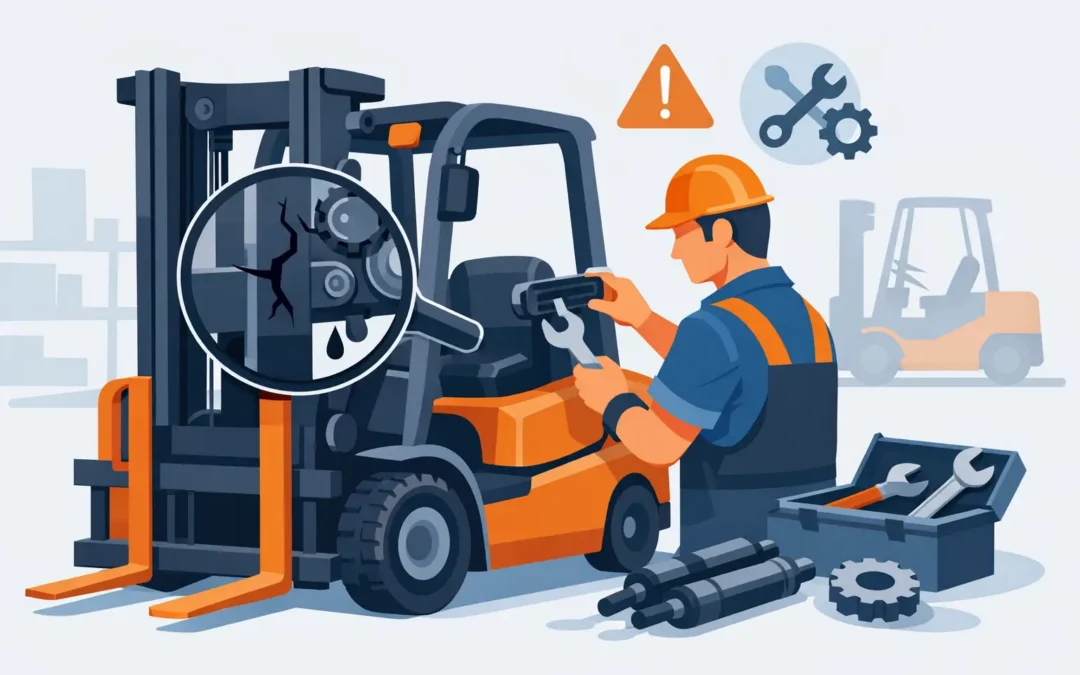
Forklift mast repair can involve several different systems working together. The mast rails, rollers, chains, chain anchors, bushings, carriage, lift cylinders, hose routing, and mounting points all need to stay in proper condition and proper alignment. If one part wears unevenly or shifts out of spec, it puts extra stress on the rest of the assembly.
That is why a real repair is more than swapping a visible broken part. A good technician checks how the mast travels, how the carriage moves under load, whether the chains are stretching unevenly, whether the rollers are flat-spotted or loose, and whether the weldments are still sound. On electric forklifts especially, smooth mast function matters because operators often use them in tighter spaces, inside buildings, and around racks where precision matters.
Common signs your mast needs attention now
Most mast failures give warnings first. The problem is that those warnings get ignored when production is backed up and operators just need one more shift out of the truck.
A few signs should move the forklift out of service quickly. One is jerky lifting or lowering. Another is visible side play in the carriage or mast channels. You may also see uneven fork height, chain slack on one side, binding during travel, leaks at the lift cylinders, cracked welds, or metal shavings around rollers and channels.
Noise matters too. Grinding, popping, or heavy clunking during lift cycles usually means wear is already advanced. If the mast leans unexpectedly or the carriage does not stay level under load, that is not a wait-and-see issue. It needs inspection right away.
Why forklift mast repair problems happen
Most mast damage comes from a short list of causes. Impact is a big one. Hitting rack beams, dock plates, trailers, or uneven loads can twist components, crack welds, or knock the carriage out of alignment. Overloading does the same thing, even if the damage builds slowly instead of showing up in one event.
Deferred maintenance is another major cause. Chains need proper inspection and adjustment. Rollers and wear surfaces do not last forever. Cylinder leaks that look minor at first can contaminate surfaces and affect mast movement over time. When those issues are left alone, the repair usually gets larger and more expensive.
Operator habits also matter. Fast direction changes with a raised load, carrying loads too high, side-loading the forks, and repeated hard contact with stacks or racking all accelerate mast wear. In busy operations, these patterns are common. That is why regular inspection matters just as much as repairing what already failed.
The biggest repair question: fix it or replace it?
This is where experience matters. Not every mast issue means full replacement, and not every visible crack should be patched and sent back to work. The right decision depends on the extent of the damage, the age of the truck, parts availability, and how critical the forklift is to your operation.
If the issue is limited to chains, rollers, bushings, hose routing, anchors, seals, or cylinder service, repair is often the better move. If the channels are heavily worn, the weldments are compromised, or the mast is bent from impact, replacement may be the safer and more cost-effective path.
There is also a middle ground. Sometimes a repairable mast has been neglected long enough that the labor and parts stack up fast. In that case, the cheapest invoice is not always the cheapest outcome. If the truck is going to keep coming back off the floor, you have not really saved anything.
What a proper mast inspection should include
A real mast inspection is hands-on. It should include checking chain condition and stretch, verifying equal tension, inspecting rollers and bearings, measuring wear in channels and thrust points, examining welds and structural members, checking hydraulic cylinders for leaks and scoring, and confirming carriage alignment.
The technician should also look for evidence of impact that may not be obvious at first glance. A mast can still move while being slightly twisted or misaligned. That does not mean it is safe. Under load, small structural problems become bigger ones very quickly.
For operations managers and maintenance supervisors, the key is speed with accuracy. You do not need guesswork. You need someone who can tell you what failed, what else it affected, what is urgent, and what the best repair path looks like without wasting a day getting there.
Forklift mast repair and safety are tied together
A bad mast does more than slow down a forklift. It changes how the truck handles a load. That affects visibility, stability, fork leveling, and lifting control. If the carriage sticks or the chains do not track evenly, the operator may compensate without realizing it. That is when loads shift, pallets get damaged, and near misses start happening.
This is one of those repairs that should never be delayed to squeeze out another week. A worn tire or a weak battery can still create problems, but a mast issue hits the core lifting function of the truck. Once structural integrity or lifting control is in question, the risk is immediate.
Why fast service matters on mast repairs
Mast problems stop work fast. If the truck is used on receiving, line feeding, outbound staging, or rack put-away, one failure can ripple across the shift. Labor stands around. Loads back up. Another truck gets overused. Deliveries slip. That is why response time matters just as much as technical skill.
A slow repair process usually costs more than the repair itself. Waiting for callbacks, waiting for approvals, waiting for someone to “take a look” tomorrow – that is where downtime gets expensive. The better move is direct access to a technician who understands forklift structures, can diagnose the issue quickly, and can tell you whether the mast can be repaired safely in the field or needs a larger shop-level correction.
For companies running electric forklifts, that specialist knowledge matters even more. Electric units are often used in high-density indoor operations where smooth lifting and tight handling are critical. When the mast starts acting up, production feels it right away.
How to reduce future mast repairs
You cannot prevent every mast problem, especially in high-cycle operations. You can reduce the big ones.
Regular inspections catch chain wear, roller damage, and cylinder leaks before they become structural issues. Operator reporting helps too, but only if complaints are taken seriously. “It feels rough” is often the first warning. Load practices matter as well. Keeping loads within rated capacity, training against side-loading, and watching for rack and trailer impacts all make a difference.
The other factor is choosing repair partners who know what they are looking at. A mast assembly is not the place for shortcuts or vague diagnoses. The repair needs to be right the first time. Faster. Better. Cheaper. That only works if the workmanship is solid.
When to make the call
If your forklift is lifting unevenly, binding, leaking at the mast, showing chain issues, or carrying visible structural damage, stop using it and get it inspected. Waiting usually turns a repairable problem into a longer outage.
CSC Forklift Repair works with operations that cannot afford to let that happen. The goal is simple: get a technician on the problem fast, diagnose it clearly, and restore safe operation without wasting time or money.
A forklift mast does not need to collapse to become a serious problem. If it is talking to you through noise, drift, jerking, or uneven lift, listen early – because the fastest repair is the one you make before failure takes the truck out of service.
Forklift or Lift Down Right Now?
Talk directly to an experienced technician, not a call center. Mobile repair for electric, LP and diesel forklifts, scissor lifts and boom lifts across the Sacramento area.
📞 Call (916) 827-0510