A forklift that will not stop cleanly is not a minor issue you put on tomorrow’s list. It is a safety risk, a productivity problem, and a fast way to lose money on a shift that is already behind. Forklift brake repair needs to happen quickly, but it also needs to be done right. A rushed guess can leave you with the same problem an hour later, or worse, a truck that should never have gone back into service.
For operations managers, warehouse supervisors, and fleet owners, the real question is not whether the brakes matter. It is how fast the issue can be diagnosed, how much downtime you are about to absorb, and whether the repair is going to hold. That is where experienced service makes the difference. Good brake work is not just parts replacement. It is accurate diagnosis, proper adjustment, and catching the related wear that causes repeat failures.
When forklift brake repair cannot wait
Some failures are obvious. The pedal goes soft. The truck pulls hard to one side. Stopping distance gets longer. The parking brake stops holding on an incline. Those are immediate service issues.
Other warning signs are easier to ignore until they turn into a bigger job. Squealing, grinding, brake fluid loss, a pedal that feels inconsistent, or a forklift that creeps when it should be held in place all point to brake trouble. On electric forklifts, operators sometimes assume regenerative braking means the service brakes are fine. That is a mistake. Regenerative systems can reduce wear in some conditions, but they do not replace the need for properly functioning mechanical or hydraulic braking components.
If your operators are reporting anything unusual, take it seriously. Brake complaints are not the kind of problem that improves with more use. They usually get worse, and they often get more expensive when the truck keeps running.
What causes forklift brake problems
Brake issues do not all come from one source. Wear is common, especially on trucks used hard in multi-shift operations, ramps, dock work, or stop-and-go travel. Brake shoes, pads, drums, rotors, and related hardware wear down over time. That part is expected.
The more expensive problems tend to come from what gets missed. Contaminated brake components, leaking wheel cylinders, damaged seals, worn master cylinders, sticking calipers, broken linkage, and poorly adjusted parking brakes can all create symptoms that look similar from the operator seat. The wrong diagnosis wastes time and parts.
Usage conditions matter too. A forklift working in dust, moisture, debris, or corrosive environments will often need brake attention sooner than a truck in a clean indoor aisle. Load weights, operator habits, floor conditions, and incline use all affect service life. There is no honest one-size-fits-all schedule for brake repair because it depends on the truck and how it is being used.
Electric forklifts have their own brake service issues
Electric units bring some advantages, but they also need technicians who know the equipment. Brake complaints on an electric forklift can overlap with drive system behavior, regenerative braking response, control settings, or operator perception of deceleration. That does not mean every issue is electronic. It means the technician needs to separate braking system faults from other operating characteristics quickly.
This is where specialist experience matters. A broad equipment shop may treat every brake call the same way. A technician who works regularly on electric forklifts is more likely to catch the real cause early and avoid replacing parts that were not the problem.
What a proper forklift brake repair should include
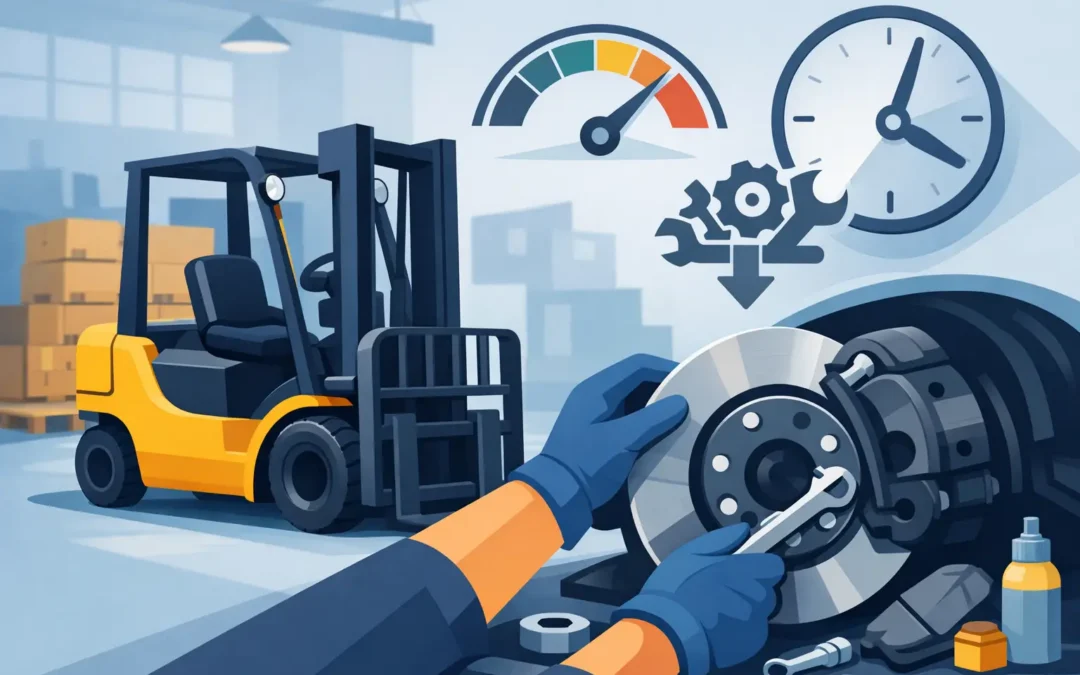
A real brake repair starts with inspection, not assumptions. The technician should check the complaint, test the truck safely, inspect wear components, and look for leaks, contamination, heat damage, weak holding force, and adjustment issues. On hydraulic systems, fluid condition and pressure response matter. On mechanical parking brake systems, cable condition, linkage movement, and proper engagement matter just as much.
If the truck needs parts, quality and fit matter. So does the condition of related components. Replacing brake shoes without addressing a leaking cylinder or damaged drum is not a complete repair. It is a callback waiting to happen.
After repair, the system should be adjusted and tested under actual operating conditions as much as possible. A forklift that stops fine when unloaded in a service area may behave differently under a working load. The point is not to make the problem look fixed. The point is to return the truck to safe, reliable service.
The real cost of delaying brake repair
Most companies do not call for service because they enjoy spending money. They call because downtime is already costing more than they want to admit. Brake problems are a good example.
One out-of-service forklift can back up loading, receiving, production, and order movement. If operators start sharing trucks, you lose efficiency. If a truck stays in circulation with weak brakes, you risk product damage, rack impacts, injuries, and compliance issues. The repair bill is only part of the cost. The lost hours around it are often worse.
There is also a budget trade-off. Early repair is usually cheaper than waiting for secondary damage. A worn brake component is one thing. A worn component that damages drums, rotors, cylinders, tires, or nearby hardware turns into a bigger invoice fast. Delaying service rarely saves money for long.
In-house fix or field technician?
It depends on your team, your tools, and the fault. Some maintenance departments can handle basic brake inspection and straightforward component replacement. If you have trained people, the right parts, and time to do the work correctly, that may make sense on certain trucks.
But many brake problems are not straightforward. When the symptom could be caused by hydraulic loss, contamination, adjustment failure, uneven wear, parking brake issues, or an electric truck behavior that mimics brake trouble, speed matters less than accuracy. A field technician who sees these failures every day can often diagnose and repair the issue faster than an internal team that has ten other priorities.
That is especially true when operations cannot afford a truck sitting apart while someone tests theories. Fast response is not just convenience. It protects uptime.
Choosing the right service partner for forklift brake repair
If you are calling for brake work, you do not need a sales runaround. You need a technician who can respond, diagnose the problem, explain what failed, and get the forklift back in service at a fair rate.
Look for a service company that understands industrial equipment use, not just generic repair. Ask how quickly they can dispatch. Ask whether they work regularly on electric forklifts if that is part of your fleet. Ask how they approach diagnosis and whether they check for related failures instead of swapping the obvious part and leaving.
Price matters, but so does workmanship. Cheap brake work that fails again next week is not cheap. The best value usually comes from fast, accurate service that fixes the problem once and keeps your operation moving. That is the standard CSC Forklift Repair is built around – faster response, better workmanship, and pricing that makes sense for working fleets.
Preventing repeat brake failures
Brake problems will never disappear entirely in a working fleet, but repeat failures can be reduced. Operator reporting helps. If drivers are trained to flag soft pedals, noise, poor stopping, or weak parking brake performance early, repairs stay smaller. Routine inspections help too, especially on trucks running heavy shifts or harsh conditions.
The bigger point is consistency. Brake service should not happen only after a near miss. It should be part of keeping equipment dependable. That does not mean overspending on unnecessary work. It means paying attention before a manageable repair becomes a shutdown.
Signs your fleet needs a closer look
If more than one truck is showing slow stopping, parking brake complaints, uneven wear, or frequent adjustments, the issue may be larger than a single repair call. Fleet-wide usage patterns, operator habits, or maintenance gaps may be shortening component life. In that case, fixing one forklift helps today, but reviewing the fleet helps next month too.
A good service partner will tell you when a problem is isolated and when it points to a broader issue. That kind of honesty matters when you are responsible for both safety and budget.
Brake problems do not care how busy the day is. If a forklift is not stopping the way it should, get it checked before the delay turns into damage, injury, or a longer outage than you can afford.
Forklift or Lift Down Right Now?
Talk directly to an experienced technician, not a call center. Mobile repair for electric, LP and diesel forklifts, scissor lifts and boom lifts across the Sacramento area.
📞 Call (916) 827-0510