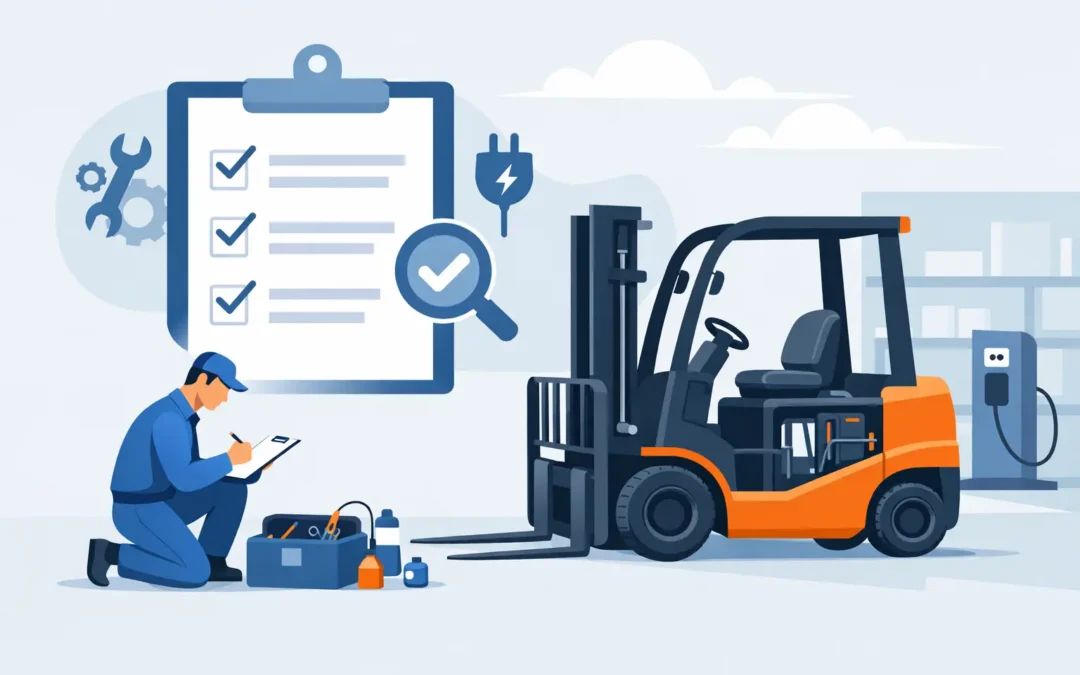
A dead electric forklift in the middle of a shift does more than slow one operator down. It backs up pallets, throws off labor, delays outbound loads, and turns a small maintenance miss into an expensive problem. That is why an electric forklift service checklist matters. It gives your team a clear way to catch wear, damage, and performance issues before the truck is parked for repairs.
If you manage a warehouse, plant, or jobsite fleet, the goal is not paperwork for its own sake. The goal is uptime. A good checklist keeps inspections consistent, helps operators report real problems faster, and gives maintenance teams a better shot at fixing issues before they become breakdowns.
What an electric forklift service checklist should actually do
A useful checklist is not a generic form copied from a manual and forgotten in a binder. It should match the way your equipment is used, the number of shifts it runs, and the environment it works in. A forklift running indoors on smooth concrete has different wear points than one working long shifts around dock plates, ramps, and debris.
The best checklist does three things. First, it catches safety issues before the truck goes into service. Second, it flags gradual wear that leads to downtime later. Third, it creates a record that helps a technician diagnose recurring problems faster. That last point matters more than most operations realize. Repeat battery faults, charging complaints, and steering issues are easier to solve when there is a clean service history.
Daily electric forklift service checklist items
Daily checks are the front line. They do not replace scheduled maintenance, but they catch the obvious failures and the small warning signs operators notice first.
Start with the battery. On an electric forklift, battery condition drives everything. Check the charge level, cable condition, connectors, and any visible corrosion. Look for heat damage, loose terminals, and cracked insulation. If the truck has been underperforming, slow lifting, reduced run time, or fault codes may point to battery, charger, or connection issues rather than the hydraulic system itself.
Next, look at the tires. Cushion tires with chunking, flat spots, or excessive wear change handling and stability. Pneumatic tires with low pressure or sidewall damage need attention immediately. Uneven tire wear can also point to steering or alignment problems, so it is not just a tire issue.
Brakes need a quick check before every shift. Operators should pay attention to stopping distance, pedal feel, noise, and whether the parking brake holds properly. Small brake issues rarely stay small for long, especially in high-cycle operations.
Hydraulics deserve a walk-around, too. Check for leaks around hoses, fittings, cylinders, and the mast. Watch the lift and tilt functions for jerky movement, unusual noise, or slow response. Electric forklifts often hide hydraulic problems until performance drops enough to affect production.
The forks and mast should be inspected for cracks, bent sections, worn heels, and damaged chains or rollers. If the mast binds or the chains look uneven, stop there and get it checked. Structural and lifting components are not areas for guesswork.
Controls and safety equipment round out the daily inspection. Test the horn, lights, backup alarm, seat belt, display panel, and emergency functions. Steering should feel consistent. If the truck shows warning lights, do not let them ride until the next service window. Fault codes are early warnings, not suggestions.
Weekly and monthly service points
A stronger electric forklift service checklist goes beyond what the operator sees at the start of a shift. Weekly and monthly checks help your maintenance team catch developing problems before they shut a truck down.
Battery maintenance is a big one. Depending on battery type, this may include checking water levels, cleaning the battery top, inspecting for acid residue, and reviewing charging habits. Poor charging practices shorten battery life fast. Overcharging, undercharging, and opportunity charging without a clear plan all create problems. Lithium-ion systems reduce some maintenance needs, but they still need regular inspection of connectors, cooling, software alerts, and charger communication.
Drive motors, lift motors, and wiring should be checked for heat, contamination, and wear. Loose electrical connections can cause intermittent faults that waste hours in troubleshooting. A truck that cuts out occasionally, loses power under load, or throws random codes may have a connection issue long before a major component fails.
Brake systems should be inspected more closely on a scheduled basis. This is where you look at wear levels, adjustment, and any sign that regenerative braking and mechanical braking are not working together properly. On newer electric units, electronic control issues can show up as brake complaints, so the service approach has to be more precise than just replacing worn parts.
Hydraulic fluid levels and condition matter, even on electric equipment where people tend to focus mostly on the battery. Dirty fluid, internal leaks, or failing hoses will eventually show up as slow cycles and inconsistent lifting. The same goes for steer axle components, mast rollers, chains, and pins. Lubrication and adjustment are simple compared to the cost of replacing neglected assemblies.
Common problems a checklist helps prevent
The value of a checklist is not that it looks organized. The value is that it prevents failure patterns your operation has probably seen before.
Battery neglect is one of the biggest examples. Corroded terminals, poor watering practices, bad charging habits, and ignored warning signs can take a good truck out of service early. The same goes for worn connectors and damaged cables. A battery issue often looks like a forklift issue until a technician traces it back.
Brake wear is another. If operators report weak braking, squealing, or inconsistent response and nobody follows up, the repair usually grows. The same pattern happens with hydraulic leaks. A damp fitting today can become a parked forklift next week.
Tire wear, mast problems, and electrical faults also build slowly. A checklist creates accountability. It gives operators a simple way to report issues and gives maintenance teams a basis for deciding what needs immediate repair versus what can be scheduled.
Why generic checklists fall short
Not every fleet needs the same checklist. That is where a lot of maintenance programs go off track. A lightly used stand-up rider in a clean warehouse does not need the same inspection focus as a multi-shift sit-down forklift moving heavy loads all day.
Age matters too. Older electric forklifts need closer attention on wiring, connectors, contactors, and component wear. Newer units may have fewer mechanical problems but more electronic diagnostics to manage. Brand and model matter as well. Some trucks have known weak points in steering, braking, battery retention, or display systems.
This is where working with a technician who knows electric equipment pays off. A real service checklist should reflect actual failure patterns, not just manufacturer basics. It should help you reduce downtime, not create more forms for your staff to fill out.
When inspection turns into a service call
A checklist is not a repair strategy by itself. It tells you when to stop using the truck and get a technician involved.
If the forklift loses power under load, shows recurring fault codes, leaks hydraulic fluid, has weak brakes, overheats during charging, or develops steering issues, that is no longer a routine inspection item. That is a service call. Waiting usually means a longer outage and a larger invoice.
The same goes for repeated issues that seem to disappear and come back. Intermittent electrical faults are common on electric forklifts, and they waste time fast. Good records from your checklist help, but at that point you need someone who can diagnose the system correctly, not just swap parts.
For operations that depend on every truck being available, speed matters as much as technical ability. When a unit is down, you need direct access to a technician who understands electric forklifts and can get to the real problem quickly. That is where a specialist service company like CSC Forklift Repair stands apart from general equipment repair outfits.
Build a checklist your team will actually use
If the checklist takes too long, operators will rush through it. If it is too vague, you will get bad information. Keep it practical. Use plain language. Focus on the failure points that affect safety, performance, and uptime.
It also helps to train operators on what matters. They do not need to diagnose the truck. They do need to know the difference between normal wear and a sign that the forklift should come out of service. That small investment saves money.
A strong electric forklift service checklist is not about slowing work down. It is about keeping trucks moving, controlling repair costs, and catching problems while they are still manageable. If your fleet has recurring issues or your current inspections are not preventing downtime, that is your sign to tighten up the process and get experienced service support behind it.
The best time to fix an electric forklift problem is before your schedule is built around it.
Forklift or Lift Down Right Now?
Talk directly to an experienced technician, not a call center. Mobile repair for electric, LP and diesel forklifts, scissor lifts and boom lifts across the Sacramento area.
📞 Call (916) 827-0510