Last Updated: November 14, 2026
Quick Summary
Scheduled equipment maintenance services machines at set intervals before they fail, which reduces unplanned downtime and lowers repair costs. It also extends equipment life, makes maintenance spending easier to forecast, and catches safety defects early. Compared with waiting for breakdowns, it gives operations managers far more control over timing and budget.
- Scheduled maintenance catches warning signs such as worn brakes or low hydraulic levels before costly failures occur.
- Planned service lets managers pull equipment during quiet windows instead of during peak shipping.
- Well-maintained components like mast chains, tires and batteries last longer under consistent service.
- Reactive repairs usually cost more, including emergency labor and expedited parts.
- Track schedule completion closely, because set schedules that are not enforced deliver little uptime.
Table of Contents
- Why Scheduled Equipment Maintenance Matters for Operations
- Key Benefits of Scheduled Equipment Maintenance
- Scheduled Maintenance vs. Reactive Maintenance
- Building an Equipment Maintenance Schedule That Works
- Preventive Maintenance Checklist for Forklifts and Lifts
- The Long-Term ROI of Planned Maintenance
- Scheduling Your Next Service Visit With CSC Forklift Repair
- Frequently Asked Questions
Why Scheduled Equipment Maintenance Matters for Operations
Scheduled equipment maintenance is the practice of servicing machines at set intervals before they fail. For operations managers in Sacramento’s manufacturing, warehouse and construction sectors, it is the difference between planned work and a forklift that dies mid-shift.
The stakes are real. Every hour a lift sits idle is an hour of labor, dock time and orders that cannot move. Scheduled maintenance turns that unpredictable cost into a line item you can plan around.
Below, we cover the core benefits, how scheduled and reactive maintenance compare, how to build a schedule that holds up, and what a preventive checklist should include for forklifts and lifts.
Key Benefits of Scheduled Equipment Maintenance
Regular service pays off in several connected ways. The sections below cover the two benefits that show up first on the shop floor and in the budget.
Fewer Breakdowns and Less Unplanned Downtime
Breakdowns rarely come from nowhere. A worn brake, a loose battery connector or a low hydraulic level usually gives warning signs first. A scheduled inspection can catch these early, before they turn into a more costly emergency repair.
Planned service also lets you choose when the lift comes out of rotation. Work scheduled in a quiet window costs less than a failure during peak shipping. Watch out: schedules that are set but never enforced give you the paperwork of maintenance without the uptime, so track completion as closely as you track the calendar.
Longer Equipment Life and Lower Replacement Spending
Components wear predictably when they are lubricated, cleaned and adjusted on time. Mast chains, tires, batteries and drive motors all last longer under a consistent service routine. Regular battery and charging checks help electric forklifts keep their capacity over time.
The financial effect shows up later, when you decide whether to replace or rebuild. Well-kept equipment holds its resale value and pushes back the date you need a capital purchase. That gives you more control over budget timing.
Scheduled Maintenance vs. Reactive Maintenance
Reactive maintenance means repairing equipment only after it fails. Scheduled maintenance means servicing it at planned intervals. The difference is mostly about cost predictability and control.
| Factor | Scheduled Maintenance | Reactive Maintenance |
|---|---|---|
| Timing | Planned during low-demand windows | Unplanned, often during peak operations |
| Downtime | Short, predictable | Long and disruptive |
| Repair cost | Lower, smaller fixes | Higher, including emergency labor |
| Component life | Extended through care | Shortened by running to failure |
| Safety risk | Lower, defects caught early | Higher, operators work with faulty equipment |
| Budgeting | Easy to forecast | Difficult to forecast |
Reactive repair still has a place for genuinely random failures. The problem is when it becomes the default strategy for an entire fleet.
Building an Equipment Maintenance Schedule That Works
A schedule that survives contact with a busy floor is built in four steps: inventory the fleet, choose a trigger for each asset, assign ownership, and set a review cadence. Most failed programs skip steps three and four.
Step 1: Inventory every asset. Record make, model, age, hour meter reading, duty cycle and the manufacturer’s recommended service interval for each forklift, scissor lift and boom lift. The manufacturer’s interval is your baseline, it is not a suggestion, and deviating from it without records to justify the change is how warranties get disputed.
Step 2: Match the trigger to the asset. Most fleets combine three approaches, but the right mix depends on how each machine wears:
- Time-based: Service every 250 hours or every quarter, whichever comes first. Best for assets on steady, predictable duty cycles and for tasks the manufacturer ties to calendar time, such as battery watering checks or annual inspections.
- Usage-based: Set intervals by hours run, load weight or shift count. A lift running two shifts under heavy loads accumulates wear roughly twice as fast as a single-shift unit, so a fixed quarterly interval will either over-service the light unit or under-service the heavy one.
- Condition-based: Trigger work on measured signals, rising hydraulic temperature, uneven tire wear, vibration, or oil analysis results. This is the most efficient approach but requires either onboard telematics or a disciplined inspection routine that actually records readings.
A practical default for a mixed fleet: time-based intervals for safety-critical items (brakes, restraints, horns, alarms), usage-based intervals for wear items (tires, chains, hydraulic fluid), and condition-based triggers for high-value components where failure is expensive (drive motors, controllers, lift cylinders).
Step 3: Assign ownership. Every task needs a named owner, the operator who performs the pre-shift check, the technician who completes the service, and the manager who confirms the work order closed. Schedules that are set but never enforced give you the paperwork of maintenance without the uptime, so track completion as closely as you track the calendar.
Step 4: Review on a fixed cadence. Once a quarter, pull the work-order history and ask three questions: Which units generated the most unplanned repairs? Did any component fail before its scheduled service? Are any intervals consistently finishing with life left on the part? Adjust intervals from evidence, not habit.
The implementation trade-offs. A formal schedule is not free. Budget for technician labor, planned downtime windows, spare parts held on hand, and the administrative time to build and maintain the schedule. Planned downtime is the trade-off most managers underestimate: pulling a lift for a two-hour service during peak shipping costs real throughput, which is why the schedule should place routine work in known low-demand windows.
Keep every work order in one place regardless of the tool. A simple log of date, hours, task, technician and parts used lets you spot which units fail most often and whether your intervals are too long or too short, and it is the raw material for the ROI measurement covered below.
Preventive Maintenance Checklist for Forklifts and Lifts
Use this checklist as a starting point for each scheduled service. Adjust items to match the manufacturer’s manual and your operating conditions.
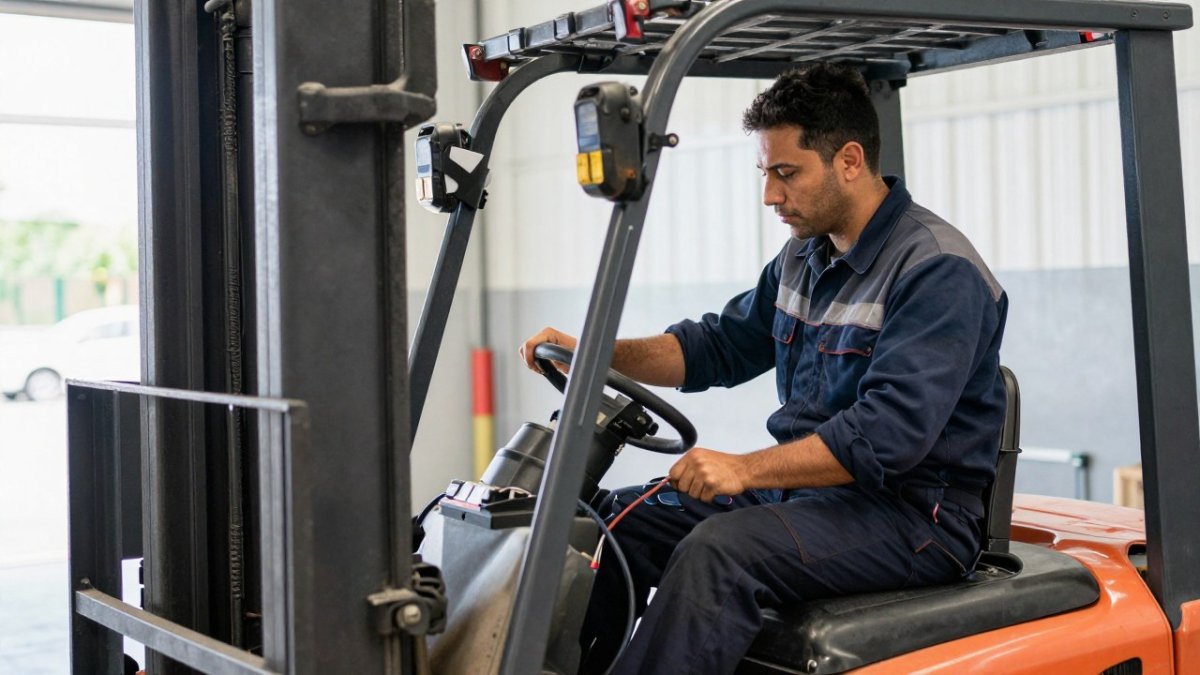
- Inspect forks for cracks, bends and wear at the heel
- Check mast chains for stretch, lubrication and even tension
- Test brakes, including parking brake holding force
- Verify steering response and check for play in the linkage
- Check hydraulic fluid level, hoses and fittings for leaks
- Inspect tires or wheels for cuts, flat spots and uneven wear
- Test battery water levels, terminal connections and charger output (electric units)
- Confirm horn, lights, backup alarm and operator restraints function
- Review the operator’s record of reported faults since the last service
For scissor and boom lifts, add platform guardrail checks, outrigger or drive-function tests and inspection of the lift cylinders and pivot pins.
The Long-Term ROI of Planned Maintenance
Measuring the return on a maintenance program makes it easier to defend the budget, and it turns a benefits list into numbers a finance team will accept. The framework below uses four KPIs, a baseline period, and a simple savings calculation.
The four KPIs to track:
- Unplanned downtime hours per month, total hours each asset sits idle due to failure, tracked per unit and fleet-wide.
- Emergency repair count and spend, number of after-hours or breakdown calls and the total invoiced cost, separated from scheduled service spend.
- Asset availability, the percentage of scheduled operating hours each asset is actually available to run. This is the number operations feels most directly.
- Maintenance spend per unit, total maintenance cost divided by units in the fleet, split into planned and unplanned categories.
Establish a baseline first. Pull six to twelve months of history before the formal schedule starts. If records are thin, reconstruct what you can from repair invoices, operator reports and hour-meter readings, and note where the data is estimated. Comparing against a documented baseline is what makes the after-numbers credible; comparing against memory is not.
The savings calculation. A workable formula:
Annual savings = (Reduced downtime hours × hourly cost of idle equipment) + (Emergency repair spend avoided) + (Replacement deferred × annual cost of capital) − (Added planned maintenance spend)
The last term matters. A program that cuts breakdowns but doubles routine service spend has not necessarily saved money, and showing the net figure is what separates a real ROI case from a hopeful one. Your own numbers will differ by facility; the goal is a clear before-and-after comparison, not a precise forecast.
Isolate the effect. Maintenance programs rarely run alone, a facility may also change staffing, routing or equipment mix in the same period. Where possible, compare a scheduled group of assets against a control group still on reactive service, or at minimum note the other operational changes in the same window so the savings are not overstated.
What the numbers usually show. Many operations managers find the downtime line alone justifies the program, because a single lost shift can cost more than a season of routine inspections. The emergency repair line is typically the second-largest contributor, since breakdown labor and expedited parts carry premiums that scheduled work avoids. Replacement deferral is real but slower to appear, it shows up in capital planning two to four years out, not in the first quarter.
Tie ROI back to safety. Early defect detection reduces the chance of an operator being hurt by a failing brake or a cracked fork. Injury costs, lost time, claims, and the operational disruption that follows, are difficult to quantify in advance but belong in the qualitative side of the business case, alongside the direct savings above.
Scheduling Your Next Service Visit With CSC Forklift Repair
Scheduled maintenance works best when the service provider can respond quickly, whether for routine work or an unexpected fault. CSC Forklift Repair handles electric forklifts, scissor lifts and boom lifts, with a service dispatch process designed to cut downtime. Contact CSC Forklift Repair to arrange a technician visit or set up a routine service plan for your fleet.
Ready to get your fleet on a schedule? Contact CSC Forklift Repair for current availability and a quote.
Frequently Asked Questions
What are three benefits of planned maintenance?
Planned maintenance reduces unplanned downtime because problems are found and fixed during scheduled windows instead of during a shift. It can also extend the service life of forklifts, scissor lifts and boom lifts by catching wear early, such as worn brakes, low fluid levels or battery issues. Third, it can make costs more predictable, since planned service reduces the number of emergency repairs, which often carry rush charges. Pricing for specific services depends on the equipment and the work required, so request a quote from CSC Forklift Repair for current figures.
How often should equipment be maintained?
Service intervals depend on the equipment type, hours of use and the manufacturer’s recommendations, which should always be your starting point. Many operations schedule inspections monthly or quarterly and full service at set operating-hour intervals. High-use fleets running multiple shifts usually need more frequent checks than equipment used a few hours a week. Review your maintenance records each quarter and adjust intervals if you see repeat issues. CSC Forklift Repair can help you set intervals that match your fleet.
What should be included in an equipment maintenance schedule?
A solid equipment maintenance schedule lists each asset, its service interval, the tasks to complete and the person responsible. For electric forklifts, include battery condition and watering checks, charger inspection, tire and mast inspection, brake checks and electrical testing. Scissor and boom lifts need hydraulic fluid checks, control system tests, platform and safety device inspections, and structural checks. Keep records of every completed task so you can spot patterns and plan future work.
What is the difference between scheduled and preventive maintenance?
The two terms are often used together. Scheduled maintenance refers to any service planned in advance on a calendar or usage schedule, such as a 250-hour service. Preventive maintenance is the broader approach of performing that work to stop failures before they happen. In practice, a preventive maintenance program is built from scheduled tasks. Both aim to reduce unplanned downtime and repair costs compared with waiting for equipment to fail.

Forklift or Lift Down Right Now?
Talk directly to an experienced technician, not a call center. Mobile repair for electric, LP and diesel forklifts, scissor lifts and boom lifts across the Sacramento area.
📞 Call (916) 827-0510