Last Updated: November 10, 2026
Quick Summary
Yes, forklift maintenance is worth it for small businesses because a single dead truck can stall an entire operation when the fleet is small. Regular daily, weekly and hour-based checks catch wear early, which costs far less than missed shipments, overtime and emergency repairs.
- Losing two of eight forklifts is a 25% capacity hit for a small fleet.
- Operators should complete a short daily check of tires, forks, brakes, hydraulics and leaks before first lift.
- Schedule service by hour meter readings, such as every 250 hours or quarterly.
- Track maintenance cost per operating hour for each truck to budget against real numbers.
- Repair instead of replace unless the repair is a large share of value or the truck fails repeatedly.
Table of Contents
- Why Forklift Maintenance Matters More for Small Fleets
- Forklift Maintenance Checklist: Daily, Weekly and Monthly Inspections
- Forklift Service Schedule: Tracking Hours and Intervals
- How Preventive Maintenance Cuts Unplanned Downtime
- Forklift Maintenance Cost for a Small Fleet: Budgeting and Total Cost of Ownership
- In-House Maintenance or an Outside Service Provider?
- Booking Your First Service Visit with CSC Forklift Repair
- Frequently Asked Questions
Why Forklift Maintenance Matters More for Small Fleets
Most small businesses treat forklift maintenance as a cost to cut. That’s backwards. With only a handful of lift trucks, one machine sitting dead in the back of a warehouse can stall an entire shipping day. When you run eight forklifts, losing two of them is a 25% capacity hit, not a rounding error.
Small fleets feel downtime more sharply than large ones. A large distribution center can shuffle work between dozens of trucks. A small operation usually cannot. Every lift has a job, and every job has a deadline.
Here’s what tends to drive the real cost of neglect:
- Missed shipments when a truck fails during peak hours
- Overtime pay to make up for lost productivity
- Emergency repair premiums when a breakdown forces a rush call
- Operator injuries from brakes, forks or hydraulics that were never checked
- Shorter equipment life from wear that goes unaddressed
Skipping a single brake or steering check can turn a small repair into a costly one.
Forklift Maintenance Checklist: Daily, Weekly and Monthly Inspections
Most small operations do not need a longer checklist. They need one that is short enough to actually get done and structured so the right person owns each task. The practical approach is to split inspections into three tiers: operator daily checks, weekly checks that a lead or supervisor can handle, and monthly or hour-based checks that belong to a qualified technician.
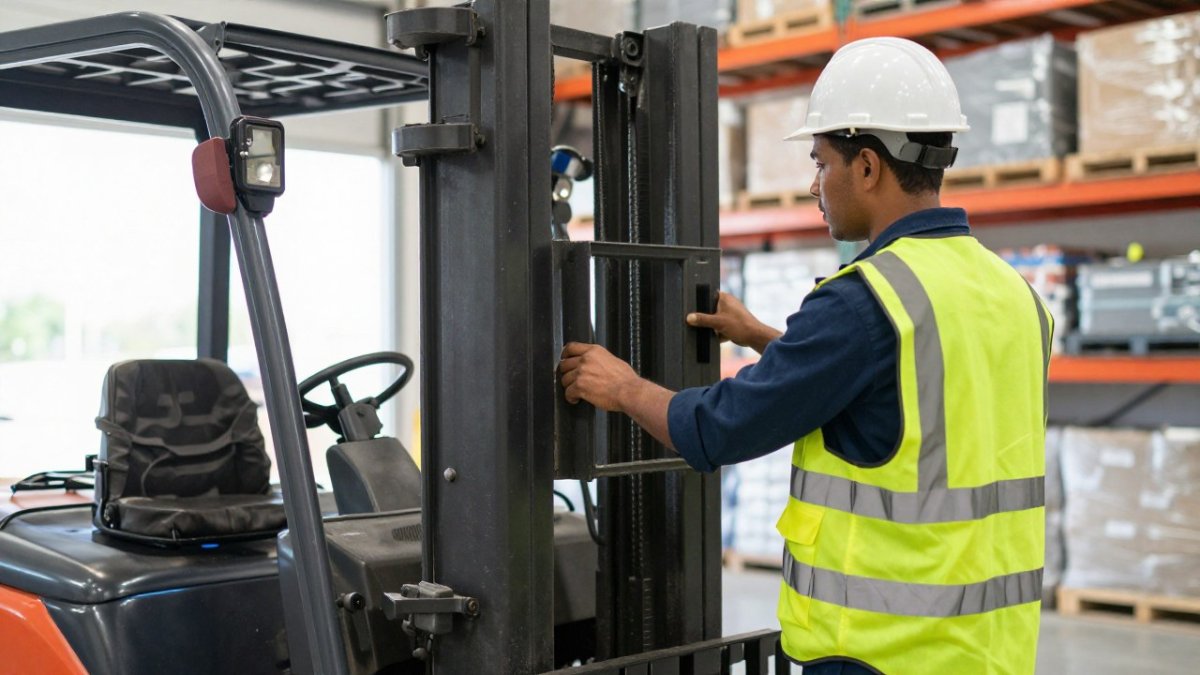
A ready-to-use workflow looks like this:
- Daily (operator, about 5 minutes, before first lift): tires, forks, mast, hydraulic hoses, brakes, steering, horn, fluid levels, leaks under the truck, battery charge and connector condition on electric units. The operator signs or initials a daily log.
- Weekly (lead or supervisor, 15-20 minutes): chain stretch and rust, debris in the mast and under the overhead guard, cracked welds, seat belt condition, and a walk-around for loose bolts on attachments.
- Monthly (qualified technician or trained in-house mechanic): hydraulic fluid condition, battery water levels on flooded-cell units, brake performance under load, and a review of the daily and weekly logs for repeat defects.
- Hour-based (per manufacturer interval): the scheduled service items in the next section, triggered by the hour meter rather than the calendar.
Keep the daily checklist on a clipboard at the charging station or posted at the shift start point. A shared spreadsheet works for the weekly and monthly tiers, with columns for truck number, hour meter reading, defect found, action taken, and date closed. That single log becomes your maintenance history.
Watch out: a checklist that is not signed and dated is nearly worthless in an inspection and gives you no pattern data when a truck keeps failing.
Fork, Mast and Attachment Checks
Forks are the most overlooked safety item on any lift truck. Look for cracks near the heel, bent tips, and uneven wear between the two blades. Forks worn beyond the manufacturer’s specified limits should come out of service. Check mast chains for stretch and rust, and confirm the rollers move freely. Attachments such as clamps and side-shifters need the same attention. Any loose bolt or hydraulic drip on an attachment is a reason to tag the truck and call for service.
Hydraulic Fluid, Hoses, Brakes and Tires
Hydraulic fluid should be clear and free of water or metal particles. Dark or gritty fluid usually means the system is breaking down internally. Inspect every hose for bulges, abrasion and weeping fittings. A hose that fails under load can drop a load in seconds. Brakes and tires are safety-critical. Pneumatic tires need proper inflation and tread. Cushion tires should show no chunking or deep cuts. Test brakes at low speed in an open area before any lift handles a loaded pallet.
Forklift Service Schedule: Tracking Hours and Intervals
Most manufacturers set service intervals by operating hours, not calendar months. A forklift that runs two shifts a day will hit 250 hours much faster than one used occasionally. Track hours from the hour meter and log each service against that number.
A simple schedule for many small fleets looks like this:
- Every 250 hours or quarterly: Oil and filter change, lubrication, full brake and steering check
- Every 500 hours or semi-annually: Hydraulic fluid review, battery service, electrical connection inspection
- Every 1,000 hours or annually: Detailed mast and chain inspection, full safety audit, component replacement as needed
Keep inspection records in a shared log or spreadsheet. Records help a technician spot patterns, such as a truck that keeps losing hydraulic pressure.
How Preventive Maintenance Cuts Unplanned Downtime
Preventive maintenance replaces guesswork with a schedule. Instead of waiting for a truck to fail, you catch wear early, when the repair is cheaper and quicker.
Consider a practical example. A worn hydraulic hose costs little to replace during a planned service. The same hose failing during a shift can take the truck out of service for a day, plus the cleanup and any damaged goods. Planned work also lets you schedule repairs during slow periods rather than peak season.
Operators play a role too. Trained operators report odd noises, slow lifts and pulling steering before they become breakdowns. Make reporting easy and expected.
Forklift Maintenance Cost for a Small Fleet: Budgeting and Total Cost of Ownership
Pricing for forklift service depends on the truck type, the work required, and how urgently it is needed. Get a written quote before any work begins, and ask whether it covers parts, labor and travel. For current rates, contact CSC Forklift Repair directly.
Rather than budgeting around a single visit, build a maintenance budget from four categories and track actual spending against each one:
- Scheduled preventive service: the hour-based services in the previous section, priced per visit or per contract.
- Wear items: tires, forks, chains, hoses, batteries and brake components that fail on a predictable cycle.
- Unscheduled repairs: the emergency calls that preventive maintenance is meant to reduce.
- Operator time and downtime: the cost of a truck sitting idle and the labor hours lost while it is down.
A practical way to size the budget is cost per operating hour. Divide total maintenance spend over a period by the hours the truck ran in that period. Track it per truck, not just for the fleet, because one problem unit can hide behind a healthy average. After a full year of records you will have a real number to budget against instead of a guess.
Repair-versus-replace guidance for a small fleet usually turns on three questions: Is the repair cost a large share of the truck’s current value? Is the truck down repeatedly for the same system? And does the repair require a long lead time on parts? If the answer to two of those is yes, the cheaper long-run move is often to replace rather than keep repairing.
Electric and internal-combustion forklifts carry different maintenance profiles. Electric trucks need battery care and charger inspection but usually have fewer fluid changes. Internal-combustion trucks need engine and exhaust attention. Build your budget around the fleet you actually run, and review it whenever you add or retire a truck.
In-House Maintenance or an Outside Service Provider?
Some small businesses employ a mechanic who handles routine checks. That works well when there is enough volume to keep that person busy and when the fleet is mostly one truck type. An in-house tech also responds instantly to small problems.
An outside provider makes sense when you run mixed equipment, when repairs need specialized diagnostic tools, or when your fleet is too small to justify a full-time hire. Outside service also brings a second set of eyes on safety-critical systems.
Many operations land on a hybrid: daily checks handled by trained operators, and periodic service and major repairs handled by a provider. Whichever route you choose, confirm the technician is qualified to work on your specific brand and power type.
Booking Your First Service Visit with CSC Forklift Repair
If your lifts are overdue for service or a truck is down right now, the fastest route is to call. CSC Forklift Repair specializes in electric forklifts and offers scissor and boom lift repair as well, with a dispatch process designed to cut downtime.
Before your first visit, gather your truck model, serial number, current hour meter reading and any recent symptoms. That information speeds up diagnosis and helps the technician arrive prepared. For pricing and scheduling, contact CSC Forklift Repair directly.
Forklift down? Call us right away.
Frequently Asked Questions
How much does it cost to get a forklift serviced?
Service costs depend on the forklift type, its age and hours, the scope of the work, and whether repairs are needed beyond routine service. Routine inspections and maintenance are usually far cheaper than emergency breakdown repairs, which also carry the cost of lost productivity while the truck is down. For current pricing on your equipment, contact CSC Forklift Repair for a quote based on your fleet and service needs.
How often does a forklift need to be serviced?
Most forklifts need a daily pre-operation inspection by the operator, plus scheduled professional service at intervals set by hours of use or calendar time, commonly around every 250 operating hours or every 90 days for many fleets. Heavier-use trucks in multi-shift operations need more frequent attention. Always follow the manufacturer’s service interval for your specific model and keep records of each visit.
What should be included in a daily forklift inspection?
A daily inspection should cover the forks for cracks and wear, the mast and chains for smooth movement, hydraulic fluid levels and visible leaks in hoses, tires for damage, brakes and steering response, horn, lights and warning devices, and the battery connections on electric trucks. Any defect should be reported and the truck tagged out of service until it is repaired and cleared.
Is it better to repair a forklift in-house or hire a service provider?
In-house repair works for small shops with trained mechanics and the right tools, but most small businesses are better served by a qualified outside provider for hydraulic, electrical and safety-critical repairs. A provider with electric forklift and fault-diagnosis experience can help identify the cause of a fault. Many businesses combine daily in-house inspections with professional scheduled service.

Forklift or Lift Down Right Now?
Talk directly to an experienced technician, not a call center. Mobile repair for electric, LP and diesel forklifts, scissor lifts and boom lifts across the Sacramento area.
📞 Call (916) 827-0510