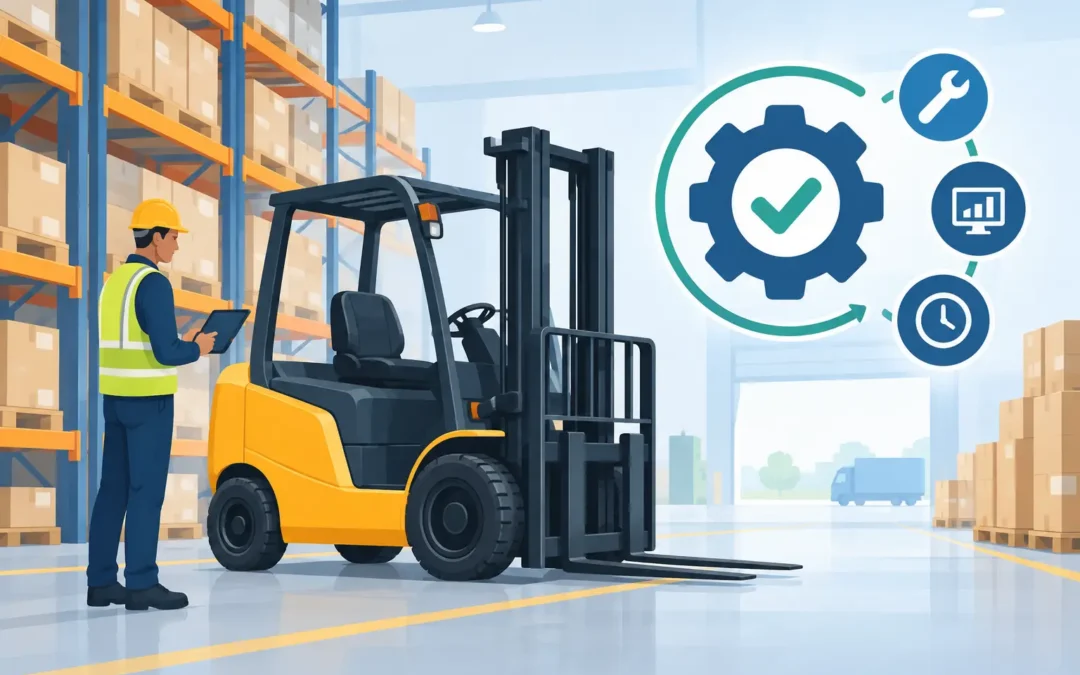
A forklift down at the wrong dock door can back up receiving, put pickers on standby, delay outbound loads, and force overtime before the shift is over. The top warehouse equipment uptime strategies are not complicated. They come down to catching problems early, using equipment correctly, and getting qualified repair help fast when a machine does fail.
For warehouse managers, uptime is not a maintenance metric on a report. It is labor productivity, shipping performance, safety, and cost control. A fleet that runs reliably lets supervisors plan the day. A fleet that breaks down without warning turns every shift into a scramble.
Top Warehouse Equipment Uptime Strategies for Busy Facilities
The best uptime plan matches the size of the fleet, the type of work, and how hard the equipment is used. A single-shift operation has different needs than a distribution center running electric forklifts across two or three shifts. But every operation benefits from the same operating discipline.
Start with daily operator inspections
Operators see a forklift or lift truck before anyone else. That makes the pre-shift inspection the first line of defense against downtime. It should be a real check, not a form filled out after the fact.
Have operators report issues while they are still small: weak braking, steering play, hydraulic leaks, damaged forks, warning lights, unusual noise, loose battery connections, or a charger that is not completing a cycle. On electric forklifts, a machine that slows under load or loses charge too quickly may be warning you about battery condition, cable damage, charging problems, or a drive-system fault.
A good inspection process must make reporting easy. If operators think reporting a problem will leave them without a truck or get them blamed for lost production, problems stay hidden. Give them a clear process for tagging unsafe equipment out of service and notifying the person who can act on it.
Build preventive maintenance around actual use
Calendar-based maintenance has a place, but it is not enough by itself. Equipment that runs six hours a week should not be managed the same way as equipment moving pallets for 16 hours a day. Track operating hours, lift cycles, battery cycles, load types, and the working environment.
Dusty manufacturing areas, freezer environments, rough yards, ramps, and long travel distances all increase wear. So do overloaded trucks and operators who regularly use equipment outside its intended application. Your service interval should reflect those conditions.
Preventive maintenance should cover the basic failure points before they become emergency calls: brakes, tires, steering, hydraulics, lift chains, mast rollers, forks, electrical connections, safety devices, fluid levels where applicable, and battery or charging systems. The goal is not to replace parts early without reason. The goal is to identify wear while repair is planned, controlled, and less expensive.
Keep the service records simple enough to use. For each machine, track the unit number, hours, repair history, recurring complaints, parts replaced, and the next service due date. That record helps identify whether you have a one-time repair or a truck that is becoming a repeat expense.
Give electric forklifts the attention they require
Electric forklifts are dependable workhorses, but their uptime depends heavily on battery and charger practices. Poor charging habits can shorten battery life, reduce run time, and create failures that look like truck problems.
Use the correct charger for the battery type and voltage. Keep battery connectors clean and secure. Check cables for heat damage, corrosion, broken insulation, and loose ends. Make sure the charging area is clean, ventilated as required, and protected from damage by traffic.
Battery watering, cleaning, and equalization requirements depend on the battery type and manufacturer guidance. Do not use a one-size-fits-all schedule. Lead-acid batteries, lithium-ion batteries, and different charger systems have different needs. The practical rule is straightforward: follow the battery and charger requirements, then watch actual performance. A truck that used to finish a shift but no longer does needs attention before it becomes a dead unit in the aisle.
Train operators for uptime, not just certification
Certification is required, but good operator training goes beyond passing a test. Operators should know how their daily driving habits affect repair costs and availability.
Hard impacts with rack uprights, dock plates, curbs, and trailer floors damage tires, wheels, steer components, forks, masts, and electrical systems. Carrying loads too high, turning sharply under load, or operating on damaged floors adds stress that shows up later as an avoidable repair.
Training should also cover what abnormal operation feels like. An experienced operator can often tell you when a lift truck is pulling to one side, losing hydraulic power, braking differently, or making a new noise. That information gives the technician a better starting point and can reduce diagnostic time.
Reduce damage at the source
Some downtime is caused by equipment condition. A large share comes from the facility itself. Poorly maintained floors, tight travel lanes, damaged dock equipment, blind intersections, and congested staging areas create repeated impacts and operator mistakes.
Walk the warehouse with an uptime mindset. Look for broken concrete, rack damage, transitions that bottom out equipment, standing water, loose debris, and battery-charging areas exposed to forklift traffic. Fixing a rough threshold or changing a traffic pattern may cost far less than repeated tire, wheel, and steer-axle repairs.
This is also where fleet sizing matters. If trucks are constantly waiting for charging, covering too many travel miles, or being used for jobs they were not selected to handle, breakdowns will increase. Buying or renting another unit is not always the answer. Sometimes the better answer is adjusting routes, staging, shift handoffs, or charging coverage.
Keep critical spares and backup capacity practical
A warehouse does not need to stock every part that could fail. That ties up cash and can leave you with obsolete inventory. But keeping selected consumables and damage-prone items available can prevent a minor issue from becoming a multi-day delay.
The right stock depends on your fleet and repair history. High-use tires, common wheels, forks, battery connectors, fuses, lights, and other frequently replaced items may be worth having on hand. Review your last year of repairs. If the same inexpensive part repeatedly delays work, it is a candidate for stocked inventory.
Backup equipment matters too, especially for mission-critical positions such as receiving, shipping, freezer work, or high-bay storage. A spare truck is an expense, so the decision depends on the cost of downtime and whether rental support is available quickly. For some operations, cross-training employees and having a short-term rental plan is more economical than owning an idle backup unit.
Set a clear response plan for breakdowns
Even well-maintained equipment fails. The difference between a short interruption and a lost shift is what happens in the first 30 minutes.
Every supervisor should know who can approve repairs, who contacts the service provider, where the unit number is located, and what information to provide. A useful service call includes the make, model, serial number if available, fault code, symptoms, location, and whether the machine is blocking an active work area. Photos or a short video can help when the issue is visible, such as a leak, damaged cable, or mast problem.
Avoid the trap of running a questionable truck until it stops completely. If a machine has intermittent steering, braking, lift, or electrical problems, take it seriously. Continuing to operate can turn a manageable repair into a larger failure, create a safety risk, and increase the chance of collateral damage.
For urgent forklift, scissor lift, or boom lift issues, working with a technician-led repair team matters. CSC Forklift Repair focuses on direct access to experienced technicians, helping facilities get clear answers and faster field service instead of losing time in a generic call queue.
Measure Downtime So You Can Fix the Pattern
Do not judge uptime only by the number of repair invoices. Track downtime by unit and cause. Separate planned maintenance from unplanned failures, operator damage, battery or charger problems, and parts delays. Then look for repeat issues.
If one forklift has three electrical calls in two months, investigate the operating environment, charging setup, prior repairs, and operator feedback. If multiple trucks have tire damage, inspect the floors and travel paths. If failures spike during a certain shift, look at workload, handoff practices, and whether inspections are actually being completed.
The useful numbers are simple: hours out of service, repair cost per unit, repeat failures, and the number of breakdowns that interrupt production. You do not need a complicated software system to find costly patterns. A consistent spreadsheet or maintenance log can show where the money and lost time are going.
Treat Small Warnings Like Operating Problems
Uptime improves when equipment issues are handled before the machine quits in the middle of the shift. A warning light, a weak battery, a leaking cylinder, or a rough steering complaint is not just a maintenance item waiting for next month. It is a chance to schedule a repair on your terms, protect the crew, and keep freight moving.
Forklift or Lift Down Right Now?
Talk directly to an experienced technician, not a call center. Mobile repair for electric, LP and diesel forklifts, scissor lifts and boom lifts across the Sacramento area.
📞 Call (916) 827-0510