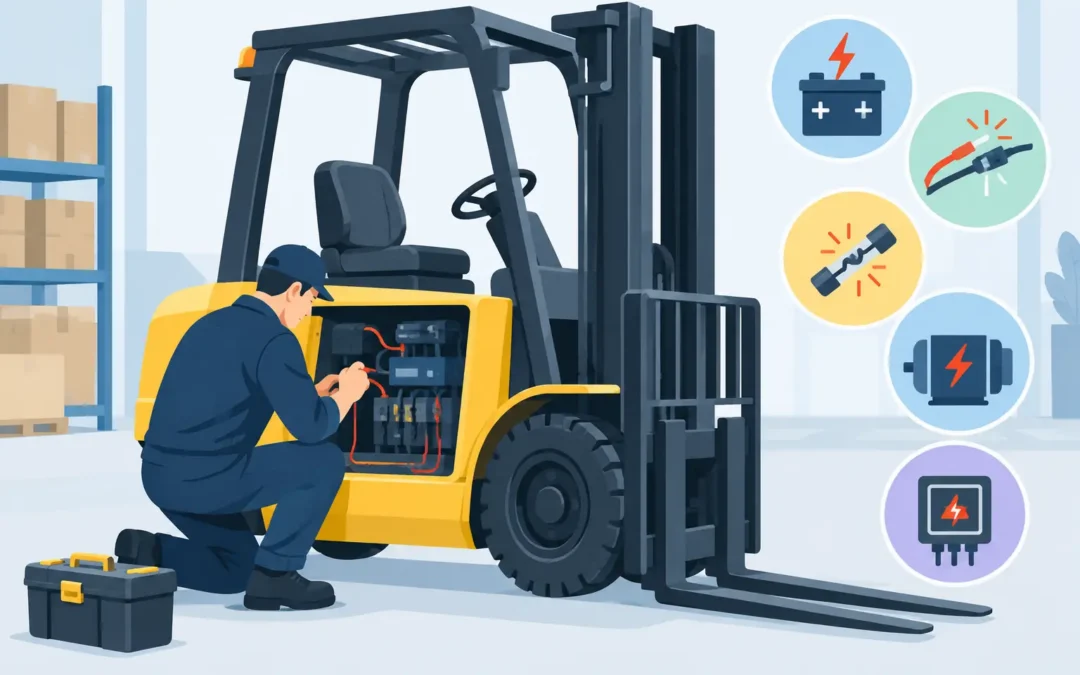
A forklift that will not start at the beginning of a shift is not a minor inconvenience. It holds up loading, puts labor on standby, and can quickly turn into missed shipping windows. These five common forklift electrical faults cause a large share of electric forklift service calls. Knowing the warning signs can help your team report the problem clearly and avoid damage from repeated failed starts or improvised repairs.
Electric forklifts are efficient, quiet, and well suited to indoor work, but their electrical systems need proper maintenance. Batteries, cables, connectors, switches, controllers, and safety circuits all need to work together. A problem in one area can look like a failure somewhere else. That is why fast, accurate diagnosis matters.
1. Weak, Damaged, or Improperly Charged Battery
The battery is the first place to look when an electric forklift loses power, struggles under load, or will not power on. Common symptoms include slow lift and travel functions, dim displays, warning lights, reduced run time, or a truck that works briefly after charging and then dies.
Not every battery issue is simply a dead battery. A battery may be undercharged because of a charger fault, poor charging practices, corroded connections, low electrolyte levels in a lead-acid battery, or a failing cell. Lithium-ion systems have different requirements, but they can also shut down when battery management systems detect a voltage, temperature, or communication issue.
Operators should not keep cycling the key or repeatedly attempting to lift a heavy load when the truck is losing power. That can create additional strain on contacts, cables, and the controller. A technician should test battery voltage under load, inspect the battery condition, verify charger output, and check the connections before recommending replacement. Replacing a battery without finding the reason it failed to charge can waste money and leave the same problem in the fleet.
2. Corroded or Loose Battery Cables and Connectors
High-current battery connections take a beating. They are exposed to vibration, heat, acid residue on lead-acid applications, and frequent connect-disconnect cycles. A loose terminal or damaged connector may cause intermittent power loss, excessive heat, burning smells, melted connector housings, or a forklift that shuts off when traveling over a rough floor.
This is one of the five common forklift electrical faults that can look simple but become expensive fast. Resistance at a poor connection produces heat. Heat damages cable insulation, terminals, contactors, and nearby components. In severe cases, it can create a fire risk.
A visual check is useful, but it is not enough to confirm the repair. A connector can look acceptable and still fail under load. A qualified technician can perform voltage-drop testing, inspect crimp quality, check cable flexibility, and identify heat damage that needs correction. Never bypass a damaged connector or make a temporary repair with undersized cable, tape, or makeshift hardware.
3. Failed Contactor, Key Switch, or Safety Interlock
If the forklift has a charged battery but will not power up, move, or lift, the issue may be in the control circuit rather than the battery itself. Key switches, seat switches, brake switches, emergency disconnects, direction switches, and other interlocks are designed to prevent unsafe operation. When one fails or falls out of adjustment, the truck may act completely dead or display a fault code.
Contactors are another frequent failure point. These heavy-duty electrical switches connect battery power to major circuits. Worn contacts, burned coils, or heat damage can prevent power from reaching the drive or hydraulic system. You may hear clicking without operation, hear no click at all, or experience intermittent performance.
The trade-off here is clear: safety systems should not be bypassed just to get through the shift. A bypass may get the truck moving, but it can defeat a critical protection and create liability if someone is injured. Proper service means tracing the circuit, confirming switch operation, checking wiring continuity, and replacing the failed component with the correct part.
4. Wiring Harness Damage and Blown Fuses
Forklift wiring is routed through areas exposed to movement, vibration, moisture, debris, and accidental impact. Over time, harnesses can rub through near mast components, under floor plates, around battery compartments, or near steering and hydraulic assemblies. Rodent damage can also be a factor in equipment stored in certain facilities or jobsites.
A damaged wire can cause an intermittent fault that only appears during travel, when the mast is raised, or after the truck warms up. Blown fuses are a related warning sign, but a fuse is not usually the root cause. It blows to protect the circuit from an overload or short.
Replacing the same fuse repeatedly without testing the circuit is a bad repair strategy. Using a larger fuse is worse. It can allow excessive current to damage wiring or expensive electronics before the fuse opens. The right repair is to locate the short, damaged insulation, pinched harness, or failed component creating the overload.
Good technicians inspect the entire affected circuit, not just the fuse box. They look for abrasion points, moisture intrusion, loose terminals, incorrect previous repairs, and signs of heat. That approach takes a little more care upfront, but it prevents repeat downtime.
5. Controller, Sensor, or Communication Faults
Modern electric forklifts depend on electronic controllers to manage travel, lift functions, steering, braking, battery usage, and safety features. Sensors and communication wiring feed information to those controllers. When a controller loses a signal or detects a condition outside its programmed limits, it may reduce performance or lock out the truck.
Symptoms can include a forklift that powers on but will not travel, erratic acceleration, no lift or tilt function, steering warnings, fault codes, or a truck that runs normally until a specific operating condition occurs. Sometimes the problem is the controller. Just as often, the controller is reporting a bad sensor, weak battery voltage, damaged wiring, or a poor ground.
Controller replacement should be the last step after proper testing, not the first guess. These components can be costly and may require programming or calibration. A technician with electric forklift experience can pull fault codes, review live data, test inputs and outputs, verify voltage and grounds, and determine whether the controller itself has failed.
What Your Team Should Record Before Calling for Service
Clear information shortens diagnosis time. When a forklift goes down, have the operator report when the problem began, whether it happened during travel or lifting, any warning lights or fault codes, whether the battery was recently charged, and whether the truck was exposed to impact, water, or an unusual load.
Also note whether the fault is constant or intermittent. A truck that fails only after running for an hour points technicians in a different direction than one that will not power up at all. If safe to do so, take a photo of the display and the battery connector. Do not open high-voltage components or attempt live electrical testing unless your personnel are trained and authorized.
Reduce Electrical Downtime Before It Stops a Shift
Electrical faults are less likely to become emergency calls when inspections are part of routine maintenance. Operators should check battery connections, inspect cables for visible damage, watch for warning lights, and report changes in run time or performance early. Maintenance teams should keep battery compartments clean, service lead-acid batteries correctly, inspect charger cables, and address recurring fuse or connector issues before they become larger failures.
The right maintenance interval depends on the forklift’s age, duty cycle, battery type, operating environment, and how many shifts it runs. A clean, climate-controlled warehouse puts different demands on equipment than a dusty manufacturing floor or a busy loading dock with frequent temperature changes.
When an electric forklift is down, fast service starts with accurate diagnosis. CSC Forklift Repair provides direct technician-led support for electric forklift problems, so you can get a clear answer, a practical repair plan, and equipment back where it belongs: working. If a fault is affecting your operation now, stop guessing and get an experienced technician involved before a small electrical problem turns into a longer outage.
Forklift or Lift Down Right Now?
Talk directly to an experienced technician, not a call center. Mobile repair for electric, LP and diesel forklifts, scissor lifts and boom lifts across the Sacramento area.
📞 Call (916) 827-0510