
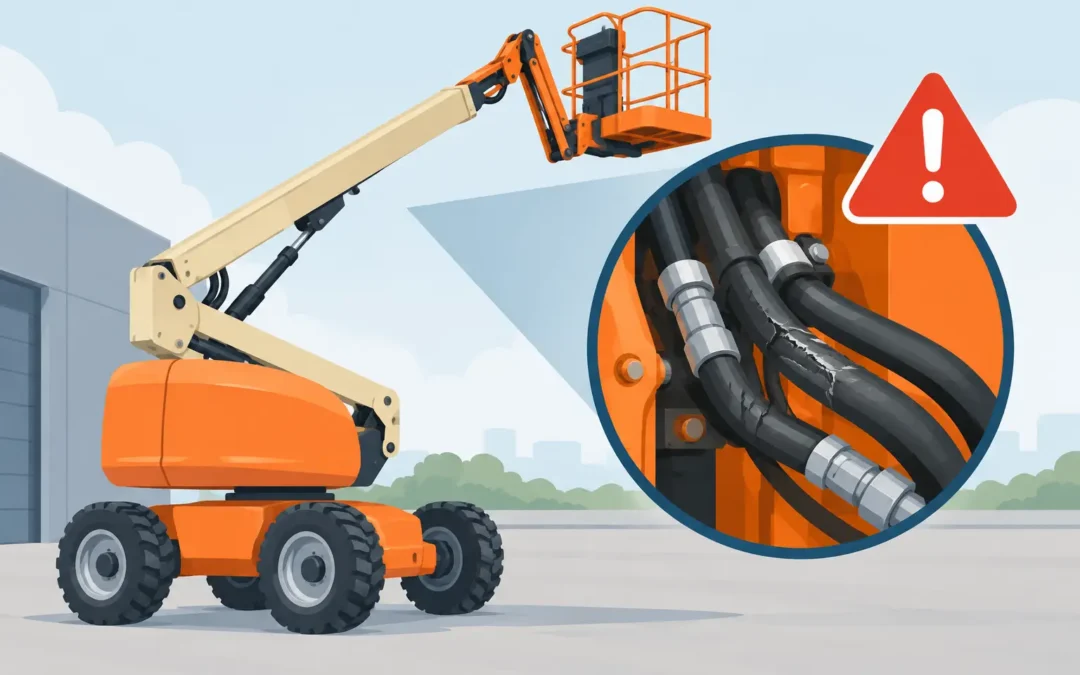
A boom lift can look fine from the ground and still be one hose failure away from a shutdown. If your team is asking, “when replace boom lift hoses,” the answer is not based on age alone. Hose condition, operating pressure, routing, damage history, and the work environment all matter. Waiting for a hose to burst is the expensive way to make the decision.
A failed hydraulic hose can put a boom lift out of service immediately, create a slip hazard, damage components, and expose operators or nearby workers to high-pressure fluid. Catching hose problems early protects uptime, repair budgets, and jobsite safety.
When to Replace Boom Lift Hoses
Replace a boom lift hose when it shows damage, leakage, deterioration, improper routing, or repeated performance issues. A hose does not need to be completely ruptured before it is unsafe or unreliable. Small defects can become major failures once the machine is lifting, extending, or operating at full hydraulic pressure.
For fleet managers, the practical rule is simple: inspect hoses regularly, remove damaged hoses from service before they fail, and replace suspect assemblies with the correct pressure-rated hose and fittings. A cheap or rushed hose repair can cost far more if it causes another breakdown days later.
Visible hydraulic fluid leaks
A wet hose, oily fitting, or hydraulic fluid collecting around the boom is a service issue, not normal wear. Leaks may come from a damaged hose cover, a cracked fitting, a loose connection, or an internal hose problem that has worked its way to the outside.
Do not run your hand along a pressurized hose to find the leak. Hydraulic fluid can penetrate skin at high pressure and cause a serious injection injury. Shut the equipment down, relieve pressure according to the manufacturer’s procedure, and have a qualified technician inspect the system.
Cracked, cut, or worn outer covers
The outer cover protects the hose reinforcement from abrasion, weather, oil, and physical damage. Once that cover is cut through, deeply gouged, blistered, or badly rubbed, the internal reinforcement may be exposed to moisture and wear. The hose might still hold pressure today, but its service life is no longer predictable.
Pay close attention to hoses where the boom articulates, telescopes, folds, or passes through clamps and guides. These are the areas most likely to rub against steel, pinch during movement, or flex beyond their intended bend radius.
Bulges, bubbles, or soft spots
A swollen section, bubble, or unusually soft spot is a red flag. It can indicate that the hose layers have separated internally or that the reinforcement has been compromised. Replace the hose assembly immediately. Do not tape it, clamp it, or keep using it until the next scheduled maintenance visit.
A bulge is not a cosmetic problem. Under load, it can turn into a sudden rupture.
Rusted, damaged, or leaking fittings
The hose may be sound while the fitting is not. Corrosion, cracked ferrules, stripped threads, damaged sealing surfaces, or bent fittings can lead to leaks and pressure loss. Fittings that have been repeatedly tightened to stop a leak also deserve a closer look. Overtightening can damage threads, distort a sealing surface, or hide the real problem.
Replace the complete hose assembly when a fitting is damaged. Reusing an old fitting on a new hose is not the cost-saving move it appears to be, especially on a boom lift that operates at significant hydraulic pressure.
Age Matters, but Condition Matters More
There is no single calendar date that tells every operation when to replace boom lift hoses. A machine used indoors on smooth warehouse floors will age differently than one operating daily on a dusty construction site, in extreme heat, around salt air, or in freezing conditions.
Manufacturers may provide inspection intervals and replacement guidance, and those requirements should always come first. Beyond that, consider the lift’s hours, duty cycle, storage conditions, service records, and prior hose failures. Hoses exposed to frequent flexing, abrasion, chemical contact, or severe temperature swings deserve more frequent inspection.
A hose that is several years old but properly routed, clean, flexible, and free of damage may not require immediate replacement. On the other hand, a newer hose with deep abrasion or a leaking fitting may need replacement now. Condition wins over age when making the call.
Symptoms That Point to Internal Hose Failure
Some hose problems are not visible from the outside. A boom lift that moves slowly, responds inconsistently, loses function when warm, or has intermittent hydraulic performance may have an internal restriction or deteriorating hose liner.
Internal hose failure can release particles into the hydraulic system. That contamination can damage valves, pumps, cylinders, and other expensive components. If a hose has collapsed internally or is shedding material, replacing the hose is only part of the repair. The system may need to be inspected for contamination before the lift goes back to work.
Do not assume every slow boom is a hose issue. Low fluid, weak pumps, valve problems, electrical faults, battery condition on electric units, and control issues can produce similar symptoms. A proper diagnosis prevents unnecessary parts replacement and gets the machine fixed faster.
What to Check During a Boom Lift Hose Inspection
A visual walk-around before use can catch obvious problems, but it should not replace scheduled maintenance. During a thorough inspection, check hose covers, fittings, clamps, routing, and clearance through the full range of boom movement.
Look for these conditions:
- Hydraulic fluid on hoses, fittings, cylinders, or the ground
- Abrasion marks where hoses contact boom sections, guards, or cable tracks
- Cracks, cuts, exposed reinforcement, blisters, or flattened hose sections
- Kinked hoses or hoses bent tighter than their rated bend radius
- Missing, loose, or broken clamps and protective sleeves
- Corrosion or impact damage at fittings and connection points
- Hoses that stretch, twist, or pull tight as the boom moves
Inspect with the boom in the positions where the hoses work hardest. A hose can look normal while the boom is stowed, then bind or rub when the machine is fully extended or articulated. That is why routing and movement checks matter.
Replace the Right Hose, Not Just Any Hose
Hydraulic hose replacement is not a place to substitute whatever is available in the shop. The replacement hose must meet the machine’s pressure, temperature, fluid compatibility, size, fitting, and routing requirements. The wrong hose may fit physically but fail early, restrict flow, or create a new rubbing point.
Correct hose length matters too. A hose that is too short can pull tight during boom movement. One that is too long may loop, snag, rub, or kink. Protective sleeves, clamps, and routing hardware should be restored during the repair, not left off because the lift is needed quickly.
For machines with multiple hoses routed through boom sections, replacing one failed hose may reveal that adjacent hoses are worn in the same area. It does not always make sense to replace every hose at once. But when several hoses show similar abrasion, age-related cracking, or heat damage, planned replacement can reduce repeat service calls and unplanned downtime.
Do Not Ignore Repeat Hose Failures
If the same hose location keeps failing, the problem may not be the hose itself. Repeated failures often point to poor routing, a missing clamp, a sharp edge, excessive movement, incorrect hose length, pressure spikes, or a boom section alignment issue.
Replacing the hose without correcting the cause only resets the clock. A qualified lift technician should identify where the hose is being damaged and make the routing or hardware correction needed to prevent another failure. This is especially important on older machines that have had prior repairs, modifications, or missing protective components.
Keep a Hose Problem From Becoming a Down Day
The best time to replace a suspect boom lift hose is before the machine is parked in the middle of a shift with the platform down or the boom stuck in the air. Train operators to report leaks, rubbing, unusual movement, and changes in hydraulic response immediately. Then make sure those reports reach maintenance before the next job starts.
If you find a damaged or leaking hose, take the boom lift out of service and get it inspected. CSC Forklift Repair provides direct technician-led service for boom lifts, scissor lifts, electric forklifts, and other critical equipment when downtime cannot wait. The right repair protects your crew, your machine, and your schedule.
A hose is a relatively small part of a boom lift. Treat it like the high-pressure safety component it is, and replace it before a warning sign becomes a breakdown.