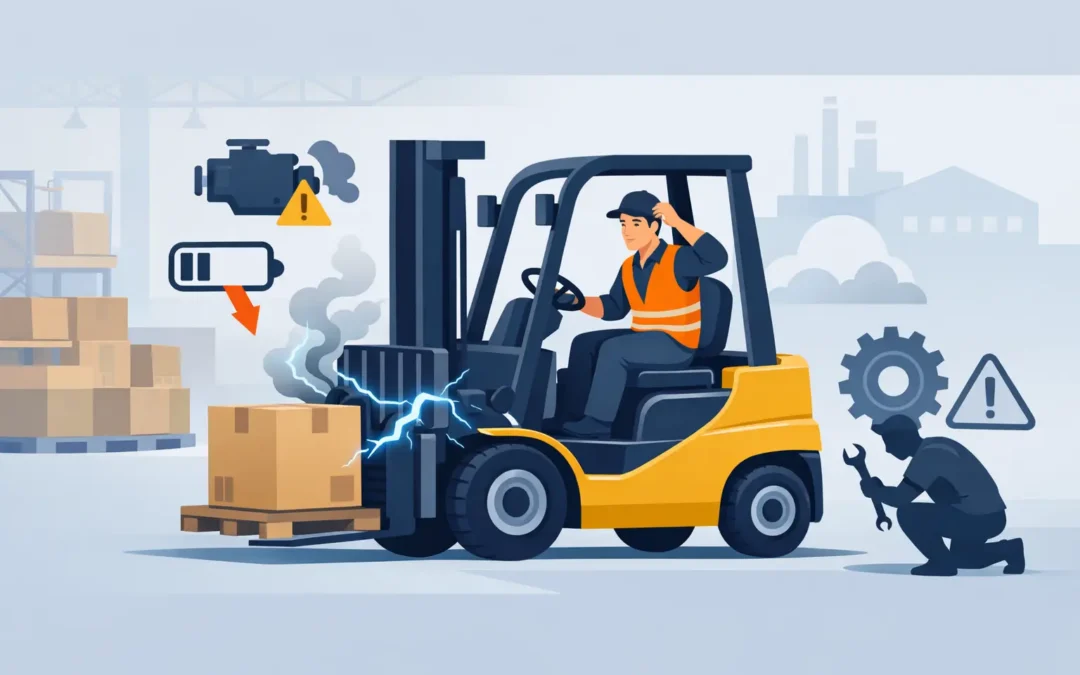
A forklift that starts normally but slows down under load, struggles on an incline, or loses lift speed is already costing you time. If you are asking, why is my forklift losing power, the answer is usually not one mystery part. It is a system problem involving power supply, fuel delivery, hydraulics, electrical controls, or drag in the drivetrain.
Do not keep pushing a weak forklift through a shift. Low power can turn into a no-start, a dropped production schedule, or a safety issue when the truck cannot travel, stop, or lift as expected. The faster you identify the pattern, the faster a technician can make the right repair.
Why Is My Forklift Losing Power During Operation?
Start by identifying when the power loss happens. Does the forklift lose travel speed only when lifting a load? Does it run well for 20 minutes, then fade? Does the lift function feel weak while travel remains normal? Those details narrow the diagnosis fast.
On an electric forklift, the battery and its connections are common causes, but they are not the only causes. A weak battery may be the visible symptom while a failed charger, corroded cable, worn contactor, overheated controller, or dragging brake is the real issue. On an internal-combustion truck, fuel, air, ignition, and exhaust restrictions are high on the list.
Battery charge and battery condition
Electric forklifts lose power when battery voltage drops under load. A battery can show an acceptable charge at rest and still collapse when the operator accelerates, climbs a ramp, or raises a pallet. That is especially common with aged batteries, damaged cells, low electrolyte levels in flooded lead-acid batteries, or batteries that were repeatedly discharged too deeply.
Check the charge indicator, but do not rely on it alone. Look for a battery that gets unusually hot, needs water frequently, has visible corrosion, or will not hold a charge through a normal shift. If the truck has a lithium-ion battery, the battery management system may limit output when temperature, charge level, or a fault condition reaches its protection limits.
A battery that is near the end of its service life cannot be fixed by charging it longer. It needs proper load testing and, depending on the results, repair or replacement. Continuing to run it weak can damage contactors, cables, and the control system.
Loose, damaged, or corroded battery connections
High-current forklift cables work hard. A loose battery connector, damaged cable, burned terminal, or corrosion at a connection creates resistance. Resistance creates heat, and heat reduces available power. Operators may notice intermittent power loss, a hot connector, slow acceleration, or a truck that cuts out when it hits a bump.
Never attempt to tighten or repair high-voltage battery connections unless you are trained and the forklift is properly isolated. A forklift battery can deliver enough current to cause severe burns, arc flash, or component damage. This is a quick inspection for a qualified technician, not a shortcut repair.
Charger problems that look like battery problems
Many electric forklift power complaints begin at the charger. If the charger is undercharging, terminating too early, or failing to equalize a flooded battery when required, the truck may begin every shift with less usable capacity than expected. Operators then blame the forklift because it loses power halfway through the day.
Review charging habits as well. Opportunity charging can work well with the right battery and charger setup, particularly lithium-ion equipment. It can also shorten battery life when the equipment, battery type, and operating schedule are not matched correctly. Your service technician should evaluate the complete charging system, not only the battery.
Electrical and Control Faults on Electric Forklifts
Electric forklifts use controllers, contactors, sensors, motors, and wiring to manage travel and hydraulic functions. When one of those components fails, the truck may enter reduced-power mode to protect itself. A warning light, fault code, clicking contactor, or intermittent response from the accelerator can point in this direction.
A failing travel motor may lose torque as it heats up. Worn brushes, damaged armatures, bearing problems, or insulation breakdown can create a gradual loss of performance. AC motor systems have different failure points, including encoder, wiring, controller, and sensor issues. The symptoms can feel similar, but the test procedures are not.
Control-system diagnostics require the correct equipment and experience. Replacing parts based on a guess gets expensive fast. A technician should retrieve fault codes, test voltage drop under load, inspect connectors and wiring, and confirm whether the problem is in the battery, motor, controller, or another part of the system.
Overheating protection
If your forklift runs normally at the start of a shift and loses power after extended use, overheating is a real possibility. Controllers and motors can reduce output when temperatures rise too high. Restricted cooling, excessive loads, frequent ramp travel, a dragging brake, or electrical resistance can all contribute.
The truck may recover after it sits for a while, which can make the issue seem random. It is not random. That pattern is valuable diagnostic information. Record how long the forklift runs before power drops and what work it was doing at the time.
Fuel, Air, and Exhaust Problems on IC Forklifts
For propane, gasoline, or diesel forklifts, a loss of power often comes down to the engine not receiving the right amount of clean fuel and air or not being able to exhaust properly. A restricted fuel filter, contaminated fuel, failing fuel pump, or regulator problem can starve the engine under load.
Propane forklifts may run poorly because of a faulty vaporizer, regulator, lockoff, hose issue, or an improperly functioning tank connection. Cold conditions can make propane delivery issues more noticeable. Diesel forklifts can lose power from clogged fuel filters, water contamination, injector issues, turbocharger problems, or emissions-system faults.
Air filters matter too. A badly restricted filter limits airflow and makes the engine feel weak, especially when lifting or accelerating. So can exhaust restrictions. If the engine sounds strained, smokes excessively, or will not reach normal RPM, stop treating it as an operator issue. It needs diagnosis before a minor restriction becomes a larger engine repair.
Hydraulic Problems That Make a Forklift Feel Weak
Sometimes travel power is fine, but lifting is slow, jerky, or weak. That points toward the hydraulic system. Low hydraulic oil, the wrong fluid, a clogged filter, a failing hydraulic pump, internal cylinder leakage, or a sticking control valve can all reduce lifting performance.
Hydraulic issues do not always mean the forklift cannot lift at all. Internal wear may show up first as slower lift speed, poor performance when hot, or trouble handling loads that the forklift normally manages. Do not compensate by overloading the truck or increasing engine speed beyond normal operation. That creates a safety risk and can multiply repair costs.
If both travel and lift functions are weak on an electric forklift, the power source or main electrical system becomes more likely. If only lift is weak, hydraulic diagnosis moves higher on the list. The same logic applies to internal-combustion trucks, although engine performance can affect both systems.
Mechanical Drag and Load-Related Power Loss
A forklift can also lose usable power because something is physically holding it back. Dragging brakes, seized wheel bearings, tire damage, transmission problems, or a parking brake that does not fully release can make the truck feel underpowered. These problems also create heat and accelerate wear.
Check whether the forklift is being asked to do more than its rating allows. Capacity changes with load center, attachment weight, mast height, tire condition, ramps, and surface conditions. A truck that handles a pallet easily on smooth warehouse concrete may struggle with the same pallet on an incline or uneven jobsite surface.
That does not mean the forklift is necessarily defective. But if the truck used to handle the same work and now cannot, there is a service issue worth finding. Document the load weight, attachment, grade, and operating conditions before calling for repair.
What Operators Should Check Before Calling for Service
A quick, safe review can help speed up repair. Check the battery charge indicator or fuel level, look for warning lights, note any fault codes, and watch for fluid leaks, hot connectors, unusual smoke, or burning smells. Listen for clicking, whining, grinding, or a change in engine sound.
Also note whether the problem affects travel, lifting, steering, or all functions. Tell the technician if it occurs only under load, after the forklift warms up, while turning, or on a ramp. Those details can prevent wasted time and unnecessary parts replacement.
Do not bypass safety switches, keep operating through warning alarms, or attempt electrical repairs with improvised tools. A weak forklift is not just slower. It can become unpredictable.
Get the Right Repair Before Downtime Spreads
Power loss rarely improves on its own. A battery issue can damage connectors. A small hydraulic leak can turn into a failed pump. A controller that is overheating can leave a truck dead in an aisle when you need it most.
CSC Forklift Repair helps commercial operators identify the real cause, make the repair, and get equipment back to work without the runaround. Speak directly with a technician, explain the symptoms clearly, and get a practical answer based on the forklift in front of you. Fast service, experienced troubleshooting, and fair rates matter when every idle truck is holding up the operation.
Forklift or Lift Down Right Now?
Talk directly to an experienced technician, not a call center. Mobile repair for electric, LP and diesel forklifts, scissor lifts and boom lifts across the Sacramento area.
📞 Call (916) 827-0510