
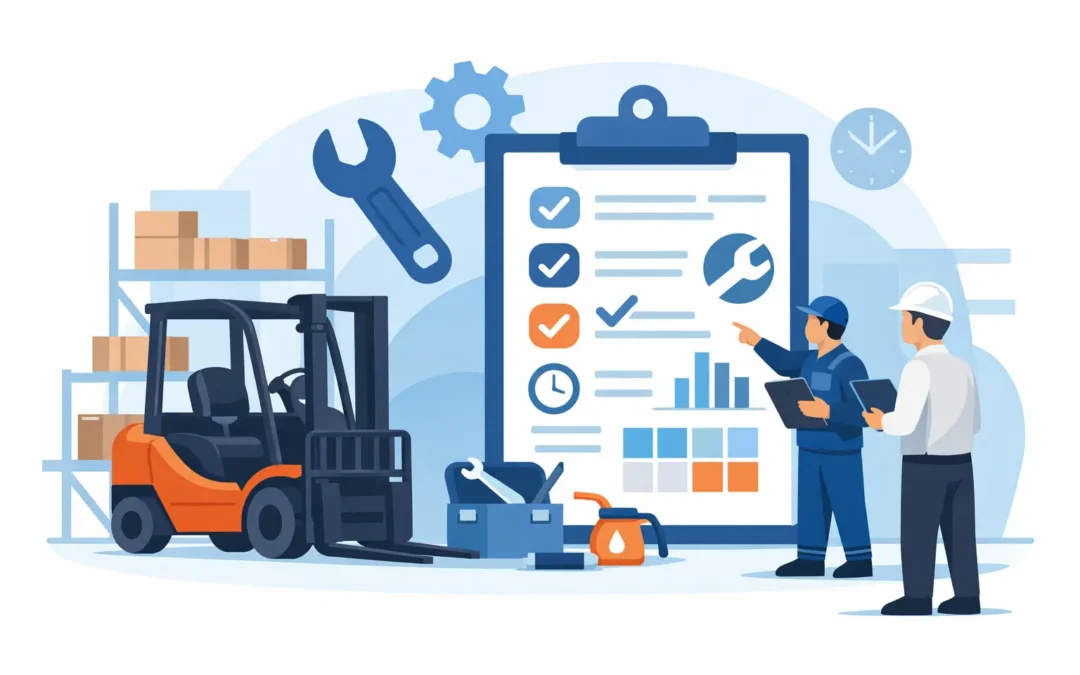
A forklift that quits at the loading dock does not create a minor maintenance task. It stops a truck, ties up labor, puts deliveries behind, and forces someone to find a replacement before the next shift loses more time. Warehouse forklift maintenance planning is how you prevent that chain reaction instead of paying for it after the fact.
The goal is not to service equipment more often than necessary. It is to catch wear, battery problems, leaks, and safety issues early enough to schedule repairs around the workday. A practical plan keeps each truck safe, available, and within budget.
Start With the Work Your Forklifts Actually Do
Do not use the same maintenance schedule for every truck just because they are the same model. A forklift moving light pallet loads on a clean day shift has a different workload than one running two shifts in a freezer, crossing dock plates, or hauling heavy product over rough concrete.
Start by listing every unit, its model and serial number, power type, rated capacity, typical hours per week, and primary work area. Include attachments. A side shifter, clamp, rotator, or carton attachment changes both the load on the truck and the items that need inspection.
Then identify the conditions that shorten service intervals. Dust, cold storage, wet floors, outdoor use, long travel distances, heavy loads, and multi-shift operation all increase wear. Electric forklifts also deserve close attention to battery condition, charging practices, cables, connectors, and water levels where applicable. A truck can look fine at the start of a shift and still lose power or develop a charging issue that brings the operation to a halt later.
Manufacturer recommendations are the baseline. Your operating conditions determine whether the baseline is enough. If a lift is consistently running hard, plan service by operating hours and condition, not just by the date on the calendar.
Build Warehouse Forklift Maintenance Planning Around Three Layers
The strongest plans separate operator checks, scheduled preventive maintenance, and repair response. When these layers get mixed together, small problems are often ignored until they become expensive ones.
1. Operator inspections at the start of every shift
Operators are closest to the equipment. Give them a simple, consistent inspection process and make it clear that reporting a problem is expected, not punished. A rushed inspection form that nobody reviews is paperwork, not maintenance.
Before operation, the check should cover the items most likely to affect safe use or cause immediate downtime:
- Forks, carriage, mast chains, rollers, hoses, and visible hydraulic leaks
- Tires, wheels, steering response, brakes, horn, lights, alarms, and seat belt
- Battery charge level, cables, connectors, charging condition, and damage on electric units
- Fluid levels, warning lights, unusual noise, vibration, smoke, or odors
- Data plate readability, controls, guards, and any attachment used on the truck
The exact inspection form should match the truck and your facility’s requirements. What matters most is the response process. If an operator finds a brake issue, damaged fork, hydraulic leak, or steering problem, the unit needs to be removed from service until a qualified person clears it. Do not let production pressure turn a known defect into an incident.
2. Planned preventive maintenance
Preventive maintenance is where you replace guesswork with service intervals. Set each truck up on a schedule based on hours, usage conditions, and manufacturer requirements. For many fleets, that means recurring service at defined operating-hour intervals, with a calendar backstop for lower-use equipment.
A quality PM visit should be more than an oil change or a quick look under the hood. It should include a detailed inspection of safety systems, braking, steering, lift functions, hydraulics, tires, mast components, electrical connections, and the overall condition of the truck. For electric equipment, battery and charger performance belong in the conversation every time.
Ask your service provider to document what was inspected, what was adjusted, what needs attention soon, and what must be repaired now. That distinction helps you plan parts and downtime instead of receiving a surprise bill after a failure.
3. Fast corrective repair
Even a well-maintained forklift can fail. A broken hose, failed contactor, damaged charger cable, or worn mast component can happen between PM visits. Your plan needs a clear path for those calls: who can take equipment out of service, who contacts the repair technician, where the truck is parked, and how the issue is described.
Good information speeds up diagnosis. Report the make, model, serial number, hour meter reading, fault code, symptoms, and whether the truck will move or lift. On electric forklifts, describe the battery charge status and what happened before the failure. That gives the technician a better chance of arriving with the right parts and tools.
Treat Electric Forklift Batteries as Production Equipment
Electric forklifts are often the right choice for indoor warehouses, but they are not maintenance-free. Battery care has a direct effect on runtime, performance, and service life. Poor charging habits can create the same operational pain as a mechanical breakdown.
Keep charging areas clean, ventilated as required, and free of damaged cables or connectors. Train operators not to force connectors, run over charging leads, or ignore heat, corrosion, or burn marks. A hot connector is not normal. Neither is a battery that suddenly loses runtime after a routine shift.
The right charging routine depends on the battery and charger type. Lead-acid batteries, lithium-ion systems, and opportunity-charging setups have different needs. Follow the battery and charger manufacturer’s instructions rather than relying on habits from older equipment. A plan built for lead-acid batteries may be wrong for a lithium fleet.
Track battery-related service separately. If the same truck repeatedly comes back with low runtime, intermittent power loss, or charger faults, the problem may be the battery, the charger, the connection, or the way the equipment is being used. Replacing parts without identifying the pattern wastes money.
Use Records That Help You Make Decisions
Maintenance records should answer simple operational questions: Which truck costs the most to keep running? Which one has repeat issues? Which repairs are coming due? Which units are down too often during peak shipping hours?
You do not need a complicated system to get value from the data. A fleet spreadsheet, maintenance log, or equipment management system can work if it captures service date, hour meter, work performed, parts used, repair cost, downtime, and recommended follow-up. The key is consistency.
Review the records monthly. Look for repeat brake adjustments, tire damage, mast wear, charger failures, hydraulic leaks, or operator-reported impacts. Repeated issues may point to a truck problem, but they can also reveal dock conditions, poor charging practices, overloaded pallets, or operator training gaps.
Replacement decisions also become clearer with records. There is no fixed point where every forklift should be replaced. It depends on reliability, repair cost, available parts, safety condition, and the cost of downtime. A truck with an occasional reasonable repair may still make sense. A truck that repeatedly disrupts shipping and consumes repair dollars may not.
Schedule Service Without Creating a Bottleneck
The best time for PM is usually not when the forklift is already needed. Coordinate service around slow periods, shift changes, weekends, or planned equipment rotation. If you have only one truck for a critical area, schedule maintenance when a backup unit or rental is available.
Do not wait until several trucks are overdue and try to service the entire fleet at once. Stagger intervals so you do not create your own equipment shortage. This is especially important for operations with a small fleet, where one disabled forklift can change the whole day’s plan.
Give the technician room to work. A clean, designated service area with access to the truck, charger, maintenance history, and a contact who knows the issue reduces delays. If a unit must stay in the aisle until the technician arrives, make sure operators know it is tagged out and unavailable.
Make Accountability Simple
A maintenance plan only works when each person knows their part. Operators inspect and report. Supervisors remove unsafe equipment from service and confirm reports are addressed. Maintenance leadership tracks due dates, approves repairs, and watches recurring costs. Your service partner performs the work, explains findings clearly, and helps prioritize what cannot wait.
Avoid the common mistake of treating every recommendation the same. Some work is a safety issue and needs immediate attention. Some repairs can be scheduled during the next maintenance window. A trustworthy technician should explain the difference in plain language, including the cost of waiting.
When a truck starts showing warning signs, act before it becomes a blocked dock door or missed shipment. CSC Forklift Repair can help warehouse teams build practical service schedules, diagnose electric forklift issues quickly, and keep repair decisions focused on uptime, safety, and fair cost.