
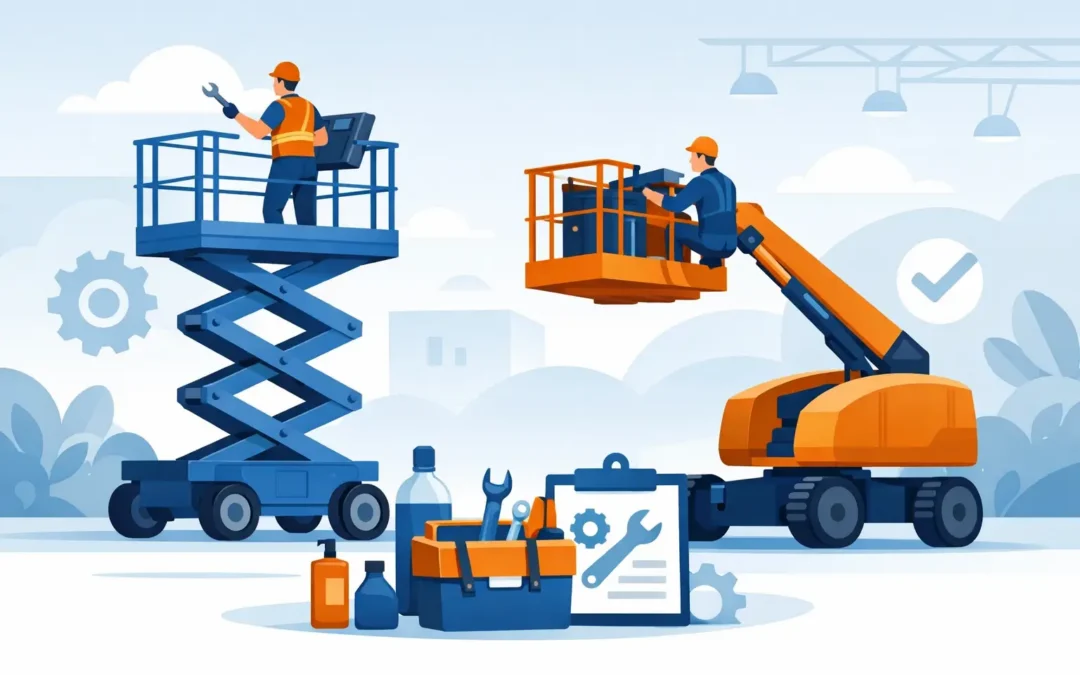
A lift that quits 20 feet in the air is not a minor maintenance issue. It is a safety concern, a delayed job, and a crew standing around waiting for answers. This aerial lift maintenance guide covers the checks that keep scissor lifts and boom lifts working, the warning signs that require service, and the maintenance habits that prevent expensive downtime.
The goal is not to turn your operator into a repair technician. The goal is to catch problems early, keep unsafe equipment out of service, and call for qualified help before a small issue becomes a dead machine on a busy shift.
Start Every Shift With a Real Pre-Use Inspection
The fastest way to avoid a field failure is to find the issue before the lift is put to work. A pre-use inspection should happen at the beginning of every shift, after a transfer between operators, and whenever a lift has been parked for an extended period.
Operators should walk around the machine before climbing in. Look for leaks under the chassis, damaged hoses, loose hardware, cracked welds, worn tires, and anything that appears bent, missing, or out of place. On electric lifts, check battery condition, cable connections, and signs of corrosion. A loose or overheated battery cable can create intermittent power problems that look like a larger electrical failure.
A proper functional check should cover more than whether the machine drives. Test the emergency stop buttons, ground controls, platform controls, horn, alarms, steering, brakes, lift functions, and descent system. On boom lifts, inspect the boom sections, wear pads, turntable area, and platform rotation functions. On scissor lifts, pay close attention to the scissor arms, pivot points, guardrails, pothole protection system, and platform extension.
Do not use a lift with a known safety defect just because the job is behind schedule. Tag it out, document the issue, and get it evaluated. Running damaged equipment is how a repairable problem turns into an injury, a major component failure, or a much larger invoice.
Keep Batteries and Electrical Systems Clean
Electric scissor lifts and boom lifts are reliable workhorses, but only when their batteries and electrical systems are maintained correctly. Battery neglect is one of the most common causes of avoidable lift downtime.
Check battery water levels on flooded lead-acid batteries according to the battery manufacturer’s instructions. In most cases, water should be added after charging, not before. Overfilling can cause acid overflow during charging. Underfilling exposes the plates and shortens battery life.
Keep battery tops clean and dry. Dirt, moisture, and acid residue can create a path for electrical discharge between terminals. That reduces available run time and can leave the lift slow, weak, or unable to complete a shift. Clean corrosion from terminals, inspect cables for damaged insulation, and make sure connections are tight.
Charging habits matter just as much. Let batteries complete a full charge cycle when possible. Repeated short charging cycles, using the wrong charger, or interrupting charge cycles can reduce capacity over time. If a lift that once ran all day now loses power after a few hours, do not assume the batteries are the only issue. The charger, cable connections, battery condition, controller settings, and parasitic electrical draws may all need to be checked.
Lithium battery systems require a different approach. Do not treat them like traditional lead-acid batteries. Follow the machine and battery manufacturer requirements for charging, storage, temperature, and diagnostics. If the battery management system reports a fault, get the code checked rather than trying to work around it.
Watch Hydraulic Components Before They Fail
Hydraulic leaks are easy to ignore when they start small. That is a mistake. A slow leak can become a pressure loss, a platform drift problem, contaminated components, or a sudden function failure.
Inspect hydraulic hoses, fittings, cylinders, and valve areas for wetness, abrasion, cracking, and rubbing. Hoses should not be pinched, kinked, or rubbing against moving structure. Look at cylinder rods for pitting, scoring, or oil residue. Damaged rods can tear seals and lead to repeat cylinder failures.
Check hydraulic oil levels with the lift in the manufacturer-recommended position. Low fluid can introduce air into the system, causing jerky operation, slow functions, or noisy pumps. Fluid that looks milky may have water contamination. Fluid with a burnt smell or unusual discoloration may point to overheating or internal wear.
Never use your hand to search for a pressurized hydraulic leak. High-pressure fluid can penetrate skin and cause a serious injury. Use proper inspection methods and get a technician involved when there is an active leak, inconsistent lift speed, platform drift, or a function that will not hold position.
Lubricate Moving Points on Schedule
Aerial lifts have many moving points that work under load. Pins, bushings, slide pads, steer linkages, axles, and pivot points need the right lubrication at the right interval. Skipping grease service increases friction, accelerates wear, and can make normal machine movement rough or noisy.
Follow the equipment manufacturer’s lubrication chart for the exact machine model. Over-greasing is not a substitute for proper service. Excess grease collects dirt and debris, especially on equipment used outdoors or around concrete dust, metal shavings, and demolition material.
Lubrication is also an inspection opportunity. If a grease fitting will not take grease, a pin has excessive movement, or a pivot area is making noise, the lift may already have wear that needs attention. Catching it at this stage is usually far cheaper than replacing damaged structural components later.
Tires, Wheels, and Ground Contact Matter
A lift can have a good battery and strong hydraulics but still be unsafe because of its tires or wheels. Inspect tires for cuts, chunks, flat spots, excessive wear, and embedded debris. On foam-filled or solid tires, look for separation and deep damage. On pneumatic tires, maintain the recommended pressure and inspect for sidewall damage.
Wheel lug nuts should be checked at the proper interval and torque. Loose wheel hardware can damage hubs, studs, and drive components. For rough-terrain lifts, inspect the condition of the tires and axles before sending the machine onto uneven ground. Poor traction or damaged tires can affect stability, braking, and safe travel.
Keep in mind that replacing tires is not always a simple one-for-one decision. Tire type, size, load rating, and machine configuration affect stability. Use approved replacements and do not mix tire types unless the manufacturer allows it.
Follow a Maintenance Schedule, Not Just Breakdowns
Pre-use inspections catch visible problems, but scheduled maintenance catches the wear that operators cannot see. Service intervals vary by manufacturer, machine age, operating environment, and hours of use. A lift working indoors on smooth warehouse floors will not wear the same way as one used daily on a dusty construction site.
A practical maintenance program should include regular inspections and documentation of fluid levels, filters, batteries, charger performance, hydraulic components, brakes, steer systems, structural wear points, safety devices, and fault codes. Annual inspections are also required for aerial lifts under ANSI standards, with additional inspections required after certain repairs, extended storage, or unusual events.
Keep service records with the machine or in a fleet maintenance system. Record operating hours, inspection dates, repairs, parts replaced, recurring faults, and technician findings. This helps identify patterns. If the same lift repeatedly has battery failures, hydraulic hose damage, or drive faults, there is usually an underlying cause that needs to be corrected.
Know When to Call a Lift Technician
Some tasks belong to an in-house team. Cleaning batteries, checking fluids, reporting leaks, and completing daily inspections are part of responsible operation. Electrical diagnosis, hydraulic repairs, control system faults, structural concerns, and safety-system failures require trained service support.
Call for service when the lift displays recurring fault codes, loses power unexpectedly, drifts when elevated, moves erratically, makes unusual grinding or hydraulic noises, fails a safety function, or has visible structural damage. Do not clear a code repeatedly and send the machine back out without finding the cause. The fault may be intermittent today and a complete shutdown tomorrow.
Fast response matters when a machine is down, but good workmanship matters just as much. A rushed repair that does not address the real failure only creates another service call. CSC Forklift Repair provides technician-led service for electric lift equipment, scissor lifts, and boom lifts when your crew needs clear answers and a repair that holds.
A well-maintained aerial lift does more than avoid repair bills. It keeps operators safer, jobs moving, and your equipment budget under control. Make inspections routine, act on warning signs early, and do not wait for a complete failure to get a qualified technician involved.