
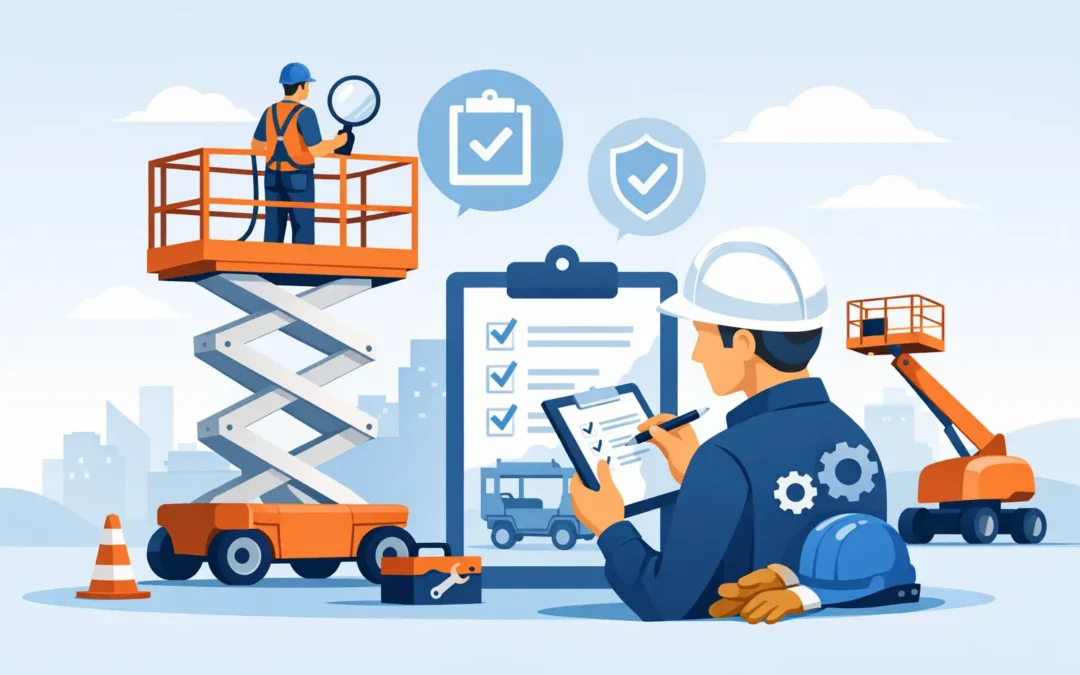
A boom lift or scissor lift that fails 20 feet in the air is not a minor maintenance issue. It can stop a job, put an operator at risk, damage property, and bring an OSHA inspection to your site. Aerial lift inspection requirements exist to catch hydraulic leaks, worn controls, bad tires, battery problems, structural damage, and safety-device failures before they become expensive incidents.
For equipment managers, the goal is straightforward: inspect the lift at the right interval, document what was found, and remove unsafe equipment from service immediately. A quick walk-around is not enough if the machine has a warning light, damaged guardrail, drifting platform, or control issue. The inspection must match the equipment, its use, and the manufacturer’s instructions.
What Aerial Lift Inspection Requirements Cover
OSHA requirements, ANSI standards, and the lift manufacturer’s manual all affect how an aerial lift should be inspected and maintained. The manufacturer’s manual is the operating baseline for the specific machine in your fleet. It identifies inspection points, service intervals, approved parts, fluid specifications, capacity limits, and the safe operating conditions for that model.
Aerial lift inspection requirements generally fall into four working categories: pre-start inspections, function tests, frequent inspections, and annual inspections. A fifth category matters just as much in the field: inspections after an event that could have damaged the equipment. That includes a tip-over, collision, overload, lightning exposure, major repair, long storage period, or suspected structural damage.
Do not treat an inspection sticker as permission to use a lift with an active defect. Annual certification does not override a problem found this morning. If a safety-related component is not working correctly, tag the unit out and get it evaluated by a qualified technician.
Pre-Start Inspection: Every Shift, Every Operator
The operator should conduct a visual pre-start inspection before using the lift each shift. If multiple operators take over the machine, the incoming operator should not assume the previous check covers them. Conditions change fast on construction sites, loading areas, and busy warehouse floors.
The pre-start inspection should look for obvious damage, leaks, loose or missing parts, and signs that the lift was abused or struck. Check the platform, guardrails, entry gate, chains, fasteners, decals, tires, wheels, batteries or fuel system, hydraulic hoses, cylinders, drive components, and emergency-lowering equipment. On boom lifts, inspect the boom sections, turntable, wear pads, pins, and hose routing for damage or binding.
Pay close attention to hydraulic oil. A wet fitting may look minor at ground level, but it can turn into a sudden loss of pressure under load. Look beneath the machine as well. Fresh oil on the slab, dirt collecting around a hose fitting, or a puddle under a cylinder needs attention before the lift goes back into service.
Electric scissor lifts require additional focus. Inspect battery cables for corrosion, loose connections, damaged insulation, and overheating. Confirm the batteries are properly secured, electrolyte levels are maintained where applicable, and the charger cable and plug are not damaged. A weak battery pack can create more than a runtime problem. Voltage drop may affect drive performance, lift speed, and fault codes.
Function Tests Confirm the Safety Systems Work
A visual inspection finds what you can see. A function test finds what the machine does. Before elevating a worker, test the lift in a clear area with no people, equipment, or overhead obstructions in the path.
Operate the ground controls and platform controls. Check lift and lower functions, steering, drive, brakes, horn, alarms, emergency stop buttons, emergency lowering, tilt alarm, limit switches, and interlocks. On a boom lift, test the rotation, extension, retraction, articulation, and platform leveling functions as equipped.
The machine should respond smoothly and predictably. Jerky movement, drifting, delayed control response, unusual noise, excessive vibration, or a platform that will not level properly are not issues to monitor later. They are reasons to stop using the machine.
Also verify that the emergency controls work from both locations. If the operator becomes incapacitated in an elevated platform, ground personnel must be able to lower the lift. That is why a nonfunctioning ground control panel is a serious defect, even if the platform controls appear normal.
Frequent and Annual Aerial Lift Inspections
Frequent inspections go beyond the daily operator check. The exact interval depends on the manufacturer’s instructions, lift type, hours of use, site conditions, and applicable standards. As a practical rule, heavily used equipment needs more attention than a lift that sits indoors and runs occasionally.
A qualified person should perform frequent inspections at the interval specified for the unit, often based on operating hours or a set time period. This inspection typically includes a closer check of structural components, hydraulic and electrical systems, control functions, wear items, safety devices, and maintenance records. It is where a technician may identify chain wear, internal hose deterioration, loose turntable bolts, worn brake components, or battery issues that are easy to miss during a walk-around.
Annual inspections are more comprehensive and should be completed by a qualified person according to the manufacturer and applicable regulations. The inspection needs to be documented and retained with your fleet records. In many operations, the annual inspection date is tracked with a decal on the machine, but the paperwork matters too. A decal can be damaged, removed, or overlooked. The service record shows what was inspected, what failed, what was repaired, and when the unit was cleared for use.
If a lift has been out of service for an extended period, returned from rental, or repaired after a major component failure, do not put it directly back into production. Conduct the required inspection and function test first. The right level of inspection depends on what happened and what was repaired.
Documentation Keeps Small Defects From Becoming Big Problems
Inspection paperwork is not just for compliance. It gives your maintenance team a usable history of the machine. Repeated notes about slow lifting, charger faults, tire damage, or intermittent controls can reveal a pattern before the lift fails during a critical shift.
A useful record identifies the lift by make, model, serial number, and fleet number. It should include the inspection date, operating hours when available, inspector name, defects found, corrective action, parts used, and the date the machine returned to service. Keep daily inspection forms accessible to operators and keep service records organized for management, safety reviews, and any regulatory inquiry.
Paper forms work. Digital inspections can work even better for fleets with multiple sites because they make overdue inspections and repeat defects easier to track. The format matters less than consistency. An inspection that is completed from memory at the end of the week is not a real pre-use inspection.
Know When to Remove a Lift From Service
Some defects clearly require immediate removal from service: damaged or missing guardrails, failed emergency stops, leaking hydraulic lines, cracked welds, bent booms, faulty brakes, nonworking tilt alarms, failed interlocks, damaged fall-protection anchor points, or control malfunctions. Do not let production pressure turn a known defect into an operator risk.
Other issues may depend on the manufacturer’s limits and a qualified technician’s evaluation. A worn tire, a small battery concern, or cosmetic damage is not automatically a shutdown condition. But guessing is not a maintenance plan. When the lift’s safe operation is in question, park it, tag it, and get a clear answer.
Operators should be trained to report defects immediately and should never make unauthorized repairs or bypass a safety device. A taped switch, blocked alarm, improvised hydraulic fitting, or defeated interlock may keep a machine moving for an hour. It can also create an injury, equipment damage, and a far more expensive shutdown.
Make Inspections Part of Uptime Planning
The best time to find a lift problem is before the morning crew needs it. Build inspections into shift startup, schedule preventive service around actual usage, and address repeat issues before they become breakdown calls. This is especially critical for electric lifts, where battery condition, charging practices, and electrical faults can quietly reduce performance long before the machine stops completely.
CSC Forklift Repair helps commercial operations diagnose and repair scissor lifts, boom lifts, and electric equipment without the runaround. When a lift fails an inspection or starts showing warning signs, speak directly with a technician and get a practical path back to service.
A clean inspection record will not prevent every failure. But a disciplined inspection process gives your team the best chance to catch the problem on the ground, where it can be repaired safely, quickly, and at a manageable cost.