A lift that cannot reach the work area is wasted rental or fleet cost. A lift that is too large can block aisles, damage finished floors, or create a safety problem before work even starts. In the scissor lift vs boom lift decision, the right machine comes down to how high you need to work, where the platform must sit, what is under the tires, and what the crew needs to carry.
For warehouses, plants, distribution centers, and jobsites, this is not just an equipment preference. It affects labor time, access, safety, transport, and downtime. Pick the lift that matches the job, then keep it inspected and serviced so it is ready when the work starts.
Scissor Lift vs Boom Lift: The Basic Difference
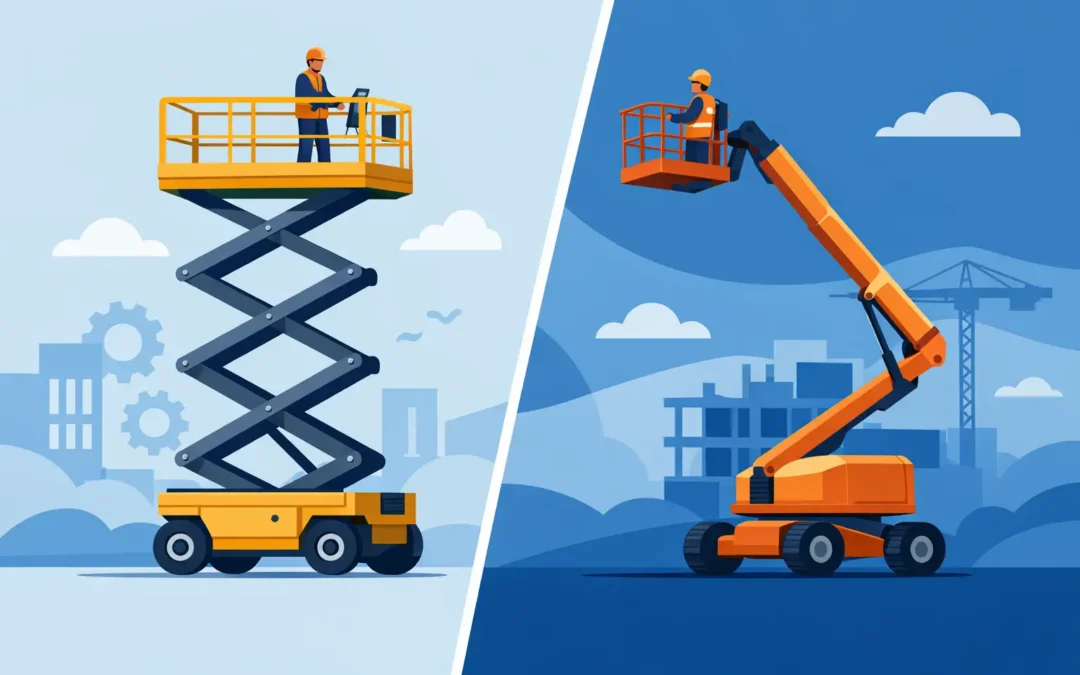
A scissor lift raises its work platform straight up. Its crossed metal supports extend vertically, creating a stable platform with a broad work area. The machine must be positioned directly beneath or very close to the work location.
A boom lift uses an extendable or articulated arm to move the platform upward and outward. It can reach over obstacles, around structures, and into places where the machine cannot sit directly below the work.
That difference sounds simple, but it drives nearly every buying, renting, and operating decision. A scissor lift is usually the practical choice for straightforward vertical access. A boom lift earns its higher cost and larger footprint when horizontal outreach matters.
When a Scissor Lift Is the Better Tool
Scissor lifts are built for vertical work on firm, level surfaces. They are common in warehouses, manufacturing facilities, retail buildings, aircraft hangars, and indoor construction projects. If workers need to replace overhead lighting, install racking, run conduit, service ceiling equipment, or handle inventory at height, a scissor lift often makes the most sense.
The platform is a major advantage. Scissor lifts generally provide more usable deck space than boom platforms, and many models have extension decks. That gives technicians room for materials, tools, parts, and more than one worker. For maintenance tasks that require repeated trips up and down with supplies, that space can save real time.
Electric scissor lifts are especially useful indoors. They are quieter, have no engine exhaust, and are often compact enough for tight warehouse aisles. Non-marking tires help protect finished floors. Their lower overall cost can also make them a better fit for routine facility maintenance.
The limitation is access. A scissor lift does not reach sideways in any meaningful way. If ductwork, machinery, mezzanines, racks, piping, or a roof overhang sits between the lift and the task, the platform may not get where the crew needs it. Trying to force the issue by working outside guardrails or moving the machine while elevated is not a solution. It is a safety risk.
When a Boom Lift Is Worth the Extra Cost
Boom lifts are for access problems that vertical-only equipment cannot solve. A telescopic boom lift provides long, direct outreach. An articulating boom lift has multiple joints, allowing the operator to go up, over, and around obstacles.
On a construction site, a boom lift can reach the side of a building from a setback area. In a plant, it can work above equipment that cannot be moved. At a distribution center, it may access exterior lighting, rooftop units, loading dock structures, or high areas blocked by racking and conveyors.
Boom lifts also come in electric and engine-powered versions. Electric articulating booms are often used indoors or on smooth slabs where clean, quiet operation matters. Diesel or other engine-powered models are common outdoors, particularly where rough terrain, higher platform heights, and longer outreach are needed.
The trade-off is platform size and machine complexity. Boom platforms are typically smaller than scissor decks, and most are better suited to one or two workers with a controlled amount of material. They also require more room to maneuver and a careful review of swing clearance. The counterweight swings as the boom turns, which can create hazards near walls, equipment, traffic lanes, and people on the ground.
Match the Lift to the Ground and the Work Area
Before choosing either machine, assess the travel path and the work area. A lift that works on paper can still be a poor choice if it cannot pass through a doorway, fit on an elevator, clear an aisle, or safely cross the surface conditions at the site.
For finished concrete floors and indoor use, an electric scissor lift is often the cleanest, most efficient option. For outdoor slab work, a larger slab scissor may provide the deck space a crew needs. For uneven ground, grades, gravel, or muddy conditions, rough-terrain scissor lifts and rough-terrain boom lifts offer stronger traction and stability features, but they still have limits. Rough terrain does not mean any terrain.
Ground slope matters with both types of aerial lifts. Machines have specific allowable operating slopes, and those limits are not suggestions. A tilt alarm, pothole protection system, or interlock is there to prevent a dangerous operating condition. Crews should inspect the route for drop-offs, soft spots, drains, ramps, debris, and overhead obstructions before moving the lift.
Also consider weather. Wind ratings vary by machine and configuration. An outdoor-rated boom lift may still need to be taken out of service when wind speed rises beyond the manufacturer limit. Never assume a larger lift is automatically safe in stronger wind.
Capacity, Height, and Outreach Are Not the Same Thing
Many equipment decisions go wrong because the focus stays on platform height alone. The working height, platform capacity, horizontal outreach, machine width, and stowed height all matter.
A 32-foot scissor lift may be ideal for an indoor task directly overhead, but it cannot reach a fixture that is 10 feet out from the aisle. A 45-foot articulating boom may reach that fixture easily, but its base may be too wide for the aisle or its platform may not carry the crew’s full load of parts and tools.
Check the platform capacity against the actual load, not a rough guess. Include workers, tool bags, pipe, cable, replacement parts, and any material brought up with the crew. Do not exceed capacity or use guardrails as material racks. Load limits and platform-use rules are tied directly to machine stability.
The same goes for reach charts on boom lifts. Outreach changes with platform height and machine position. Review the operating envelope for the specific model instead of assuming its maximum numbers apply to every task.
Service Needs Differ, but Downtime Hurts the Same
Scissor lifts and boom lifts share many maintenance needs: battery condition, charging systems, hydraulic hoses, cylinders, controls, drive motors, brakes, tires, safety alarms, and emergency lowering functions. Both need routine inspections and prompt repairs when a fault appears.
Electric lifts deserve particular attention. Weak batteries, corroded connections, charger failures, damaged battery cables, and control faults can leave a machine dead in an aisle or stuck at a job. Ignoring slow travel, intermittent controls, warning lights, hydraulic leaks, or a lift that will not charge usually turns a manageable repair into longer downtime.
Boom lifts add more components to inspect. Their booms, wear pads, articulating joints, turntable systems, boom cables or hoses, and platform leveling functions all need qualified attention. A boom that drifts, jerks, will not rotate, or displays an active fault should be removed from service until the cause is identified.
Daily operator inspections are essential, but they do not replace planned maintenance. Operators should report issues early. Fleet managers should keep service records, schedule inspections, and avoid running equipment until it fails completely. That approach costs less than an emergency breakdown during a shift or a critical job.
Choose for the Job, Not the Highest Number
Choose a scissor lift when the work is directly overhead, the surface is suitable, and the crew benefits from a larger platform. Choose a boom lift when obstacles, setbacks, or horizontal outreach make vertical access impossible.
If the answer is still unclear, measure the work area before the equipment arrives. Record the required working height, horizontal distance, doorway and aisle widths, ground conditions, material load, and nearby obstructions. Those details make the choice clear and prevent expensive lost time.
When a scissor lift or boom lift starts acting up, do not let a small electrical, hydraulic, or control issue shut down the job. CSC Forklift Repair provides direct technician-led service for electric lift equipment, scissor lifts, and boom lifts. The right lift gets the crew to the work. Fast, qualified repair keeps it there.
Forklift or Lift Down Right Now?
Talk directly to an experienced technician, not a call center. Mobile repair for electric, LP and diesel forklifts, scissor lifts and boom lifts across the Sacramento area.
📞 Call (916) 827-0510