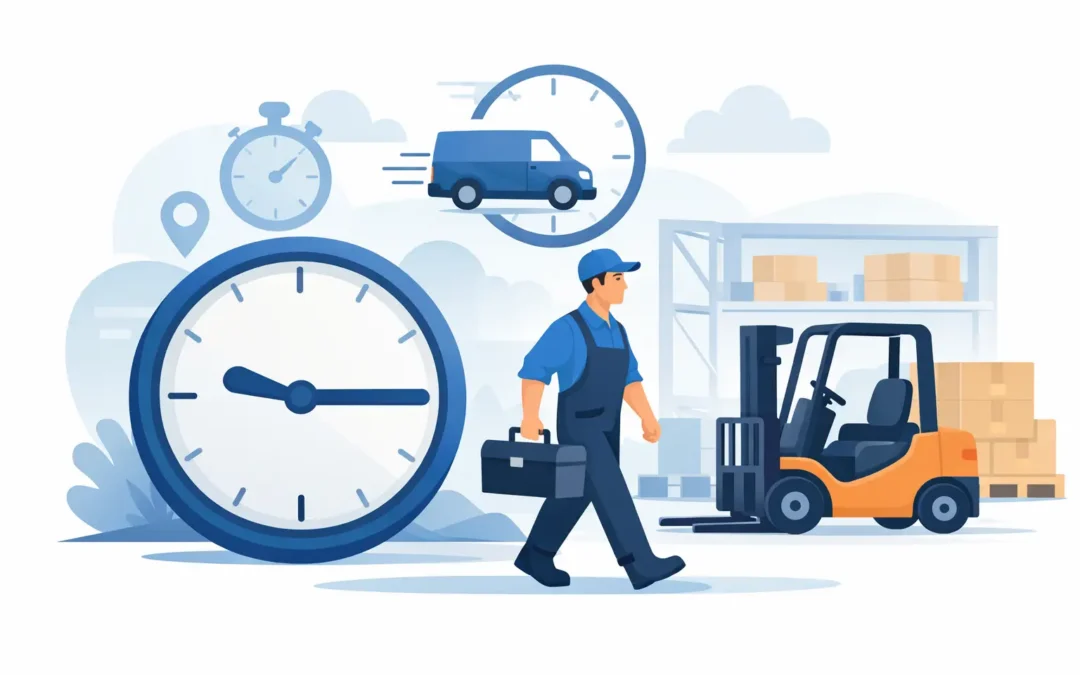
A dead forklift at a loading dock is not a minor maintenance issue. It can stop receiving, delay outbound trucks, leave labor standing by, and put delivery commitments at risk. Forklift technician arrival time matters because every hour of downtime has a real cost – and the fastest repair starts before the technician pulls into your lot.
When equipment is down, the right question is not just, “How soon can someone get here?” Ask what information the technician needs, whether the problem can be diagnosed quickly on arrival, and whether the service provider is equipped to handle your machine. Fast dispatch is valuable. Fast, accurate repair is what gets your operation moving again.
What Affects Forklift Technician Arrival Time?
No honest service company can promise the same arrival window for every breakdown. Travel distance, current call volume, technician availability, time of day, and the severity of other active equipment failures all affect dispatch timing. A forklift down at a single-shift facility may be urgent. A disabled lift blocking a trailer, production line, or elevated work area may require immediate priority.
Location matters too. A local technician who knows the area and services commercial equipment every day can usually respond more efficiently than a provider routing a request through a national call center or a generic equipment desk. The fastest path is direct access to the people who understand the equipment and can make a dispatch decision without layers of handoffs.
The type of equipment also changes the job. An electric forklift with a no-start condition may require battery, charger, connector, controller, contactor, and wiring checks. A scissor lift with an intermittent fault may involve safety interlocks, limit switches, hydraulic components, or control electronics. Arrival is only step one. The technician needs the skill and diagnostic tools to identify the real failure without wasting your time replacing parts that were never bad.
Emergency Calls vs. Scheduled Service
Emergency breakdown calls generally receive priority because the equipment is already affecting operations. But emergency service is not a substitute for planned maintenance. A fleet with worn cables, neglected batteries, leaking hydraulics, damaged tires, or recurring fault codes is more likely to need an urgent call at the worst possible time.
Scheduled maintenance lets repairs happen on your terms. It also gives a technician the chance to catch issues before they become a full shutdown. That trade-off is simple: planned service takes coordination; unplanned downtime takes control away from your operation.
How to Speed Up the Service Call
You can shorten the time from breakdown to repair by giving clear information at the first call. Do not settle for “the forklift quit.” A few specific details can help the technician arrive prepared with likely parts, test equipment, and the right service information.
Have the make, model, serial number, and unit number ready. State whether the machine is electric, LP, diesel, or gasoline powered. Explain what the operator saw or heard before it failed: warning lights, fault codes, beeping, loss of lift, steering problems, charger issues, hydraulic leaks, or a complete no-start condition.
Also explain where the unit is located and whether it is accessible. A forklift stuck inside a packed trailer, a lift parked at the far end of a construction site, or equipment blocked behind product creates delays after the technician arrives. Clear a safe work area when possible. Keep operators away from unsafe equipment, lower forks or platforms if the machine allows it, and do not bypass safety devices to keep working.
Photos and short videos can help with obvious damage, fluid leaks, display codes, battery connections, or charger indicators. They do not replace an inspection, but they can give the technician a useful head start.
Why Electric Forklifts Need the Right Technician
Electric forklifts are dependable workhorses, but they are not simple machines. A machine that will not move may have a weak battery, damaged cable, poor connection, failed contactor, blown fuse, controller issue, traction motor problem, or a fault triggered by another system. Replacing a battery because the truck will not start is not a diagnosis.
A qualified electric forklift technician checks the full system. That means evaluating battery condition and voltage under load, inspecting connectors and cables, reviewing fault codes, testing charging performance, and verifying electrical and control components. The goal is to fix the cause of the failure, not just get the truck to move long enough to create another service call tomorrow.
This is where technician experience affects total downtime. A low initial service rate does not save money if the provider misdiagnoses the problem, orders the wrong part, or leaves the unit unreliable. Fair pricing should include competent troubleshooting, clear communication, and work that holds up in real warehouse conditions.
What to Expect When the Technician Arrives
A professional service call should begin with a quick review of the complaint, the unit’s history, and the operating conditions when the failure occurred. The technician should inspect the machine safely before testing it. If the equipment is unsafe to operate, it should stay out of service until the hazard is addressed.
From there, the technician diagnoses the problem and explains the recommended repair in plain language. Some repairs can be completed on the spot with stocked parts. Others may require a specific component, additional labor, or a return visit. The right service partner will tell you the difference upfront instead of giving vague assurances.
Ask for a clear explanation of the failure, what was repaired, and what should be watched going forward. If the same unit has failed more than once, that pattern matters. Repeated electrical faults, charging problems, tire damage, hydraulic leaks, or operator-impact damage often point to a larger maintenance or usage issue that needs attention.
Reducing Future Arrival-Time Pressure
The best forklift technician arrival time is the one you do not need to worry about during a crisis. That does not mean equipment will never fail. It means your operation has a practical plan when it does.
Keep accurate service records for each unit. Track repeat repairs, battery and charger concerns, hydraulic leaks, fault codes, and parts that are wearing faster than expected. Make daily operator inspections real, not a clipboard exercise. Operators are often the first people to notice a slow lift, weak brake, damaged connector, unusual noise, or warning light.
For fleets that carry the bulk of daily production, consider backup capacity. One spare forklift can be less expensive than a missed shipment, overtime labor, and emergency rental costs. The right answer depends on your fleet size, shift schedule, utilization, and how much work stops when one unit goes down.
Most importantly, know who you will call before the failure happens. A service relationship built after a breakdown is still useful, but a technician who already knows your equipment, site, and operating demands can respond with better context. CSC Forklift Repair focuses on direct, technician-led support for forklifts and lift equipment because downtime does not wait for a sales process.
When a forklift goes down, give the service team the facts, secure the area, and get a qualified technician involved quickly. Fast response matters. Accurate diagnosis, solid workmanship, and a fair repair are what keep the next shift from facing the same problem.
Forklift or Lift Down Right Now?
Talk directly to an experienced technician, not a call center. Mobile repair for electric, LP and diesel forklifts, scissor lifts and boom lifts across the Sacramento area.
📞 Call (916) 827-0510