
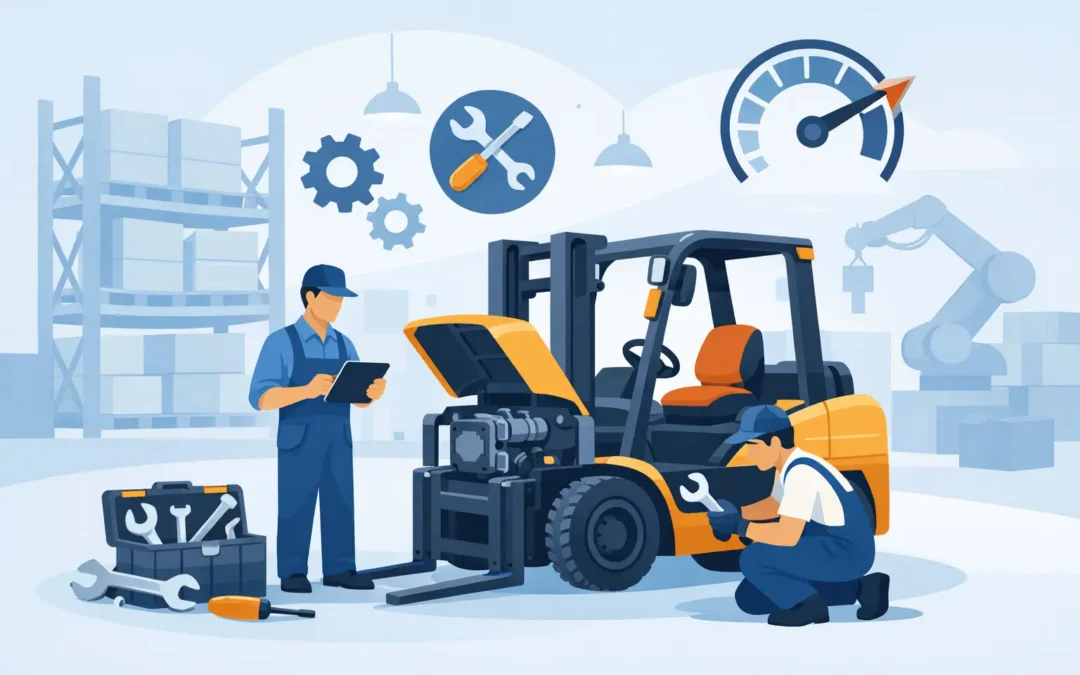
A forklift goes down at the wrong time every time. It happens during inbound rush, during order pull, or when a trailer is half-loaded and labor is standing around waiting. That is why a real warehouse forklift repair guide needs to focus on one thing first – getting the truck diagnosed quickly, safely, and without turning a repairable problem into a bigger one.
If you manage a warehouse, you already know the stakes. One disabled forklift can choke an aisle, delay shipments, and push labor costs up fast. The goal is not to make every operator into a technician. The goal is to know what to check, what to stop immediately, and when it makes more sense to bring in a repair specialist and get the unit back in service fast.
What a warehouse forklift repair guide should actually help you do
Most breakdown content is either too basic or too broad. In a working warehouse, you need practical decisions. Is the issue operational, electrical, hydraulic, battery-related, mast-related, or a safety lockout? Can your team handle the first checks in-house, or is the forklift unsafe to touch beyond shutdown and inspection?
A good guide helps you separate low-risk checks from high-risk repairs. That matters even more with electric forklifts, where battery systems, wiring, controllers, and sensors can create failures that look simple on the surface but are not. A truck that will not move might have a dead battery, but it might also have a travel interlock, damaged harness, bad contactor, brake issue, or controller fault.
Start with safety, not speed
Fast service matters. Unsafe shortcuts cost more.
Before anyone starts troubleshooting, park the forklift on level ground, lower the forks, key it off, and secure it from use. If the unit failed under load, if hydraulic oil is visible, if the mast is binding, or if the brakes feel weak, take it out of service immediately. Do not let production pressure turn into a preventable injury.
For electric forklifts, disconnect procedures matter. Battery compartments, connectors, cables, and charging systems need careful handling. Arc risk, damaged connectors, and acid exposure are not minor issues. If your team is not trained for electrical diagnosis, stop at the inspection stage and call for service.
The first checks that save time
Before assuming the worst, check the simple things that commonly stop a forklift from operating. Start with battery charge and battery connection on electric units. A low battery, loose connector, corroded terminal, or damaged cable can create no-start and no-travel complaints. If the truck powers on but performance is weak, battery condition is still one of the first places to look.
Then check the obvious operating conditions. Is the emergency disconnect engaged? Is the seat switch functioning? Is the parking brake fully released? Are there fault codes on the display? Did the issue start after charging, impact, or washing the unit? These details help narrow the cause faster than random parts swapping.
Hydraulic fluid level, visible leaks, tire condition, and mast chain condition also deserve a quick look. If the truck starts but will not lift properly, moves unevenly, or makes unusual noises under load, you may be dealing with a hydraulic or mast issue rather than an electrical one.
Common warehouse forklift problems and what they usually mean
A forklift that will not start is not always a starter problem. On electric units, it often points to the battery, charger output, fuse protection, safety interlocks, key switch, contactors, or control system faults. On internal combustion units, fuel delivery, ignition, and starter circuits come into play. The symptom is simple. The root cause usually is not.
A forklift that starts but will not move often points to travel motor issues, brake system drag, controller faults, directional switch problems, or interlock conditions. If movement is jerky or weak, the issue may involve battery voltage under load, worn electrical components, or motor performance.
A truck that lifts slowly or drops pressure under load often leads back to hydraulic leaks, worn seals, low fluid, contaminated fluid, pump wear, or valve problems. If the mast is sticking or racking, chain wear, roller damage, or mast alignment issues should be considered. Those are not areas for guesswork. A bad call there can create a major safety problem.
Brake complaints should always be treated seriously. Soft braking, pulling, noise, or poor stopping distance can take a forklift from inconvenient to dangerous in one shift. The same goes for steering issues. Hard steering, sloppy response, or sudden changes in turning feel usually mean the unit should be removed from service until properly inspected.
When in-house troubleshooting makes sense
There is a line between smart first checks and expensive trial-and-error. In-house troubleshooting makes sense when your team is handling basic inspections, battery checks, visible damage review, fluid checks, and fault code documentation. These steps can save time and help a field technician arrive prepared.
It usually does not make sense for warehouse staff to chase electrical faults deep into an electric forklift, open hydraulic systems without proper procedure, or replace parts based on assumption. That approach tends to create repeat failures, unnecessary downtime, and higher total cost. A cheap guess is often the expensive option.
If the forklift is under heavy daily use, the better move is usually fast diagnosis by an experienced technician. That is especially true if the unit is throwing intermittent faults, failing under load, losing power after charging, or showing signs of controller, motor, mast, brake, or hydraulic trouble.
Why electric forklifts need a different repair mindset
Electric forklifts are workhorses in modern warehouses, but they do not fail the same way older engine-driven trucks do. Many issues involve systems talking to each other – battery, charger, controller, contactor, motor, sensors, harnesses, and onboard diagnostics. A fault in one area can trigger symptoms somewhere else.
That is where experience matters. You can replace a visible part and still miss the real issue. A worn connector may have started the heat damage. A charging problem may actually be battery-related. A travel complaint may be tied to a brake switch or seat interlock. Good electric forklift repair is not just wrench work. It is diagnosis.
This is also where downtime can stretch out if the wrong service company gets involved. General equipment repair outfits may cover a lot of machinery, but electric lift equipment has its own failure patterns and service demands. Specialist knowledge usually gets you to the root cause faster.
Preventive maintenance is still the cheapest repair
No warehouse wants to hear about maintenance when a truck is already down. Still, the best repair budget is the one that avoids emergency calls where possible.
A consistent maintenance schedule catches battery wear, cable damage, leaks, brake wear, mast problems, and tire issues before they shut down a shift. It also helps you plan repairs around operations instead of reacting in the middle of a workload spike. That matters for cost, labor flow, and safety.
The trade-off is simple. Preventive service takes planning and budget discipline. Emergency breakdowns cost more per event and usually hit when you can least absorb the disruption. Most operations managers already know that. The challenge is sticking to it when things get busy.
When to call for forklift repair right away
Some problems are immediate service calls. A forklift that will not start after basic checks, loses hydraulic function, leaks fluid, throws repeated fault codes, overheats connections, will not charge correctly, or shows brake or steering problems should be seen by a technician. The same goes for impact damage, mast issues, or anything that affects safe lifting and travel.
If you are managing multiple units, speed matters as much as repair quality. Waiting days for a callback or going through a sales chain just to explain the problem wastes time. You need direct access to someone who understands forklifts, can ask the right questions, and can get a truck back in service without dragging the process out.
That is why many warehouses prefer a technician-led service company like CSC Forklift Repair. Faster response, stronger electric forklift knowledge, and fair pricing are not marketing extras. They are what keep downtime from spreading across your operation.
Use this guide to make the next breakdown smaller
The best use of a warehouse forklift repair guide is not to turn your warehouse into a repair shop. It is to help your team respond the right way in the first ten minutes. Secure the unit. Check the basics. Document the symptoms. Do not guess on safety-critical or electrical issues. Then get a qualified technician involved before a small failure becomes a long outage.
Every hour a forklift sits dead on the floor costs money somewhere else. The faster you identify the problem and make a smart repair decision, the faster the warehouse gets moving again.