
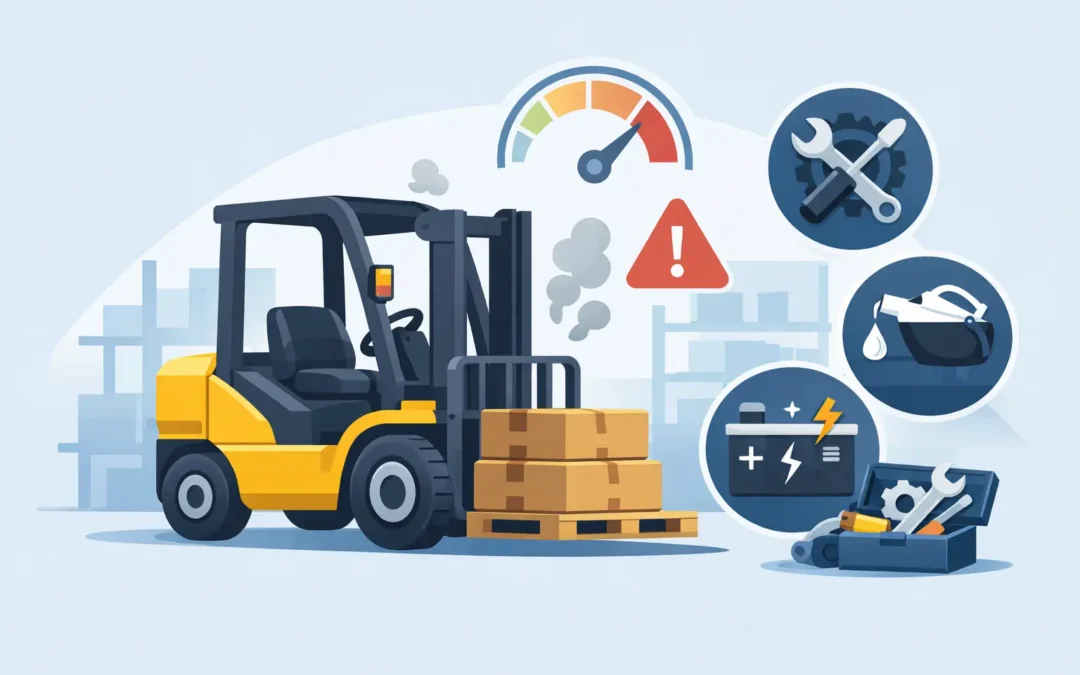
A forklift usually gives you a warning before it quits. The problem is that busy operations teams often have to keep freight moving, cover shifts, and hit shipping deadlines while those warnings get ignored. If you are seeing the top signs forklift needs service, waiting rarely saves money. It usually turns a repair call into downtime, safety risk, and a bigger invoice.
For warehouse managers, fleet supervisors, and contractors, the real cost is not just the broken part. It is the stalled pallet, the late truck, the backed-up crew, and the operator who gets stuck with a machine that does not feel right. When a forklift starts acting differently, that is the time to get it checked.
Top signs forklift needs service before a breakdown
Some warning signs are obvious. Others show up gradually and are easy to write off as normal wear. The mistake is treating small performance changes like they can wait forever. Forklifts, especially electric units, tend to get more expensive the longer a problem is allowed to spread.
Slow or weak lifting
If the mast is lifting slower than normal, struggling under routine loads, or hesitating on the way up, something is off. It could be a hydraulic issue, a worn pump, low fluid, a leak, or a control problem. On electric forklifts, it may also point to battery or motor performance issues.
This matters because weak lifting is not just annoying. It slows the whole workflow and can create unsafe load handling. If an operator has to compensate for poor lifting performance, your equipment is already costing you in lost time.
Steering feels loose, stiff, or inconsistent
Operators know when steering starts to feel wrong. Maybe the wheel has more play than usual. Maybe turning takes extra effort. Maybe the truck pulls or reacts late. None of that should be brushed off.
Steering issues can come from worn components, hydraulic trouble, tire wear, or alignment problems. In tight warehouse aisles or active jobsites, poor steering becomes a safety issue fast. If the forklift is not tracking correctly, service should be scheduled right away.
Unusual noises during operation
Forklifts are work machines, so some operating noise is normal. New grinding, squealing, knocking, clicking, or whining is not. Different sounds point to different problems, but the common theme is simple – mechanical parts are wearing, loosening, or failing.
A whining sound may show up in the hydraulic system. Grinding can point to brakes, bearings, or mast rollers. Clicking may be electrical. The exact cause depends on the machine, but new noise is one of the clearest signs a technician needs to inspect it before something locks up or breaks under load.
Fluid leaks under the truck
Any leak deserves attention. Hydraulic fluid, brake fluid, gear oil, and coolant leaks all create risk. A small drip can turn into a major failure with very little notice, especially if a line, seal, or fitting gives out during operation.
Leaks also create floor hazards. In a warehouse or plant, that means slip risk for employees and reduced traction for the machine itself. If you are seeing puddles, wet fittings, or residue around hoses and cylinders, do not wait for the forklift to stop moving before you call.
Top signs a forklift needs service on electric units
Electric forklifts often show trouble through performance changes before they completely fail. That can work in your favor if someone catches the warning signs early.
Battery is not holding a charge
If the truck is losing charge faster than usual, taking longer to recharge, or struggling to make it through a normal shift, the battery system needs attention. Sometimes it is battery age. Sometimes it is charger-related. Sometimes the issue is deeper in the electrical system.
What matters is that reduced run time affects labor planning immediately. Operators start swapping equipment, charging schedules get messy, and productivity drops. For fleets that rely heavily on electric forklifts, battery and charging issues should be treated as service priorities, not minor inconveniences.
Power cuts in and out
Intermittent power is one of the more frustrating forklift problems because it can appear and disappear before anyone gets a clear answer. The truck may hesitate on acceleration, lose function briefly, restart after sitting, or throw inconsistent fault behavior.
That kind of issue may involve wiring, connectors, controllers, contactors, or battery connections. It also tends to get worse, not better. If a forklift is not delivering steady power, it should be inspected before it strands an operator in the middle of a shift.
Dashboard warning lights or fault codes
A warning light is there for a reason. Too many teams reset the code, keep using the truck, and hope the machine sorts itself out. That usually buys a little time, but not much.
Modern forklifts monitor key systems closely. A code may point to motor heat, battery problems, sensor issues, hydraulic faults, or electronic control failures. Some codes are minor. Some mean the truck should come out of service immediately. Either way, repeated warnings are a sign the forklift needs professional service, not guesswork.
Signs the forklift is becoming unsafe to operate
Some service issues are mostly about productivity. Others cross the line into immediate safety risk. That line matters.
Brakes do not feel right
If stopping distance increases, braking feels soft, the truck pulls while stopping, or the brakes make noise, stop treating it like a nuisance. Brake issues need fast attention. A forklift carrying weight in a busy facility cannot afford braking uncertainty.
Even if the truck still stops, reduced braking performance means wear is already happening. Pads, drums, lines, cylinders, or related components may all be in play depending on the equipment. Delaying service here is a bad bet.
Mast movement is jerky or unstable
A mast should move in a controlled, predictable way. If it jerks, shudders, tilts unevenly, or feels unstable under a normal load, that points to wear or hydraulic trouble that can affect load security.
This is one of those issues where operators often adapt and keep working around it. That is exactly what should not happen. Unstable mast behavior can compromise both the load and the operator. Get it checked before the problem forces the decision for you.
Tires are worn or damaged
Forklift tires take abuse, especially in mixed-use environments with rough surfaces, debris, dock plates, and constant turning. If the tires are chunking, cracking, wearing unevenly, or losing profile, service is overdue.
Tire wear affects stability, braking, and steering. It also puts more stress on other components. On cushion tire forklifts in warehouse settings, a worn tire can make the truck feel rough and unpredictable long before it is completely shot.
When small issues start stacking up
A single symptom might not shut a forklift down today. But when the truck has weak lift, rough steering, a warning light, and a leak all at once, the pattern is clear. Equipment does not usually repair itself under heavy daily use.
This is where many operations lose money. They keep squeezing another shift out of the truck because it is still technically running. Then it fails at the worst possible time – during receiving, before a delivery push, or when backup units are already tied up.
A good rule is simple: if operators are talking about the same machine every day, it needs service. Repeated complaints are operational data. Pay attention to them.
Why fast service matters more than cheap delay
The cheapest repair is often the one done early. Waiting can turn a worn component into collateral damage across the system. A minor hydraulic leak can become pump damage. Electrical resistance at a connector can damage controls. Tire wear can contribute to steering and stability issues.
There is also the labor side. A forklift that underperforms slows operators, forces equipment reshuffling, and creates frustration on the floor. Those costs do not always show up on the repair invoice, but they hit the business just the same.
That is why direct access to a technician matters. You do not need a long sales process when a machine is down or close to it. You need someone who can diagnose the problem, show up fast, and fix it right the first time.
What to do when you spot the signs
Start with the operator report. Get specific about what the truck is doing, when it happens, and whether the issue is getting worse. If the problem affects braking, steering, mast stability, or power reliability, pull the unit from service until it is inspected.
For less urgent performance issues, do not let them sit for weeks. Schedule service before they become downtime. If your fleet runs electric forklifts, this matters even more because battery, control, and drive issues can escalate quickly if they are ignored.
CSC Forklift Repair works with businesses that cannot afford to wait around for answers. Fast response, experienced technicians, fair rates. That is what keeps equipment moving and budgets under control.
If your forklift sounds wrong, steers wrong, leaks, slows down, or starts throwing codes, trust what the machine is telling you. Catch it early, get it serviced, and keep your operation moving.