
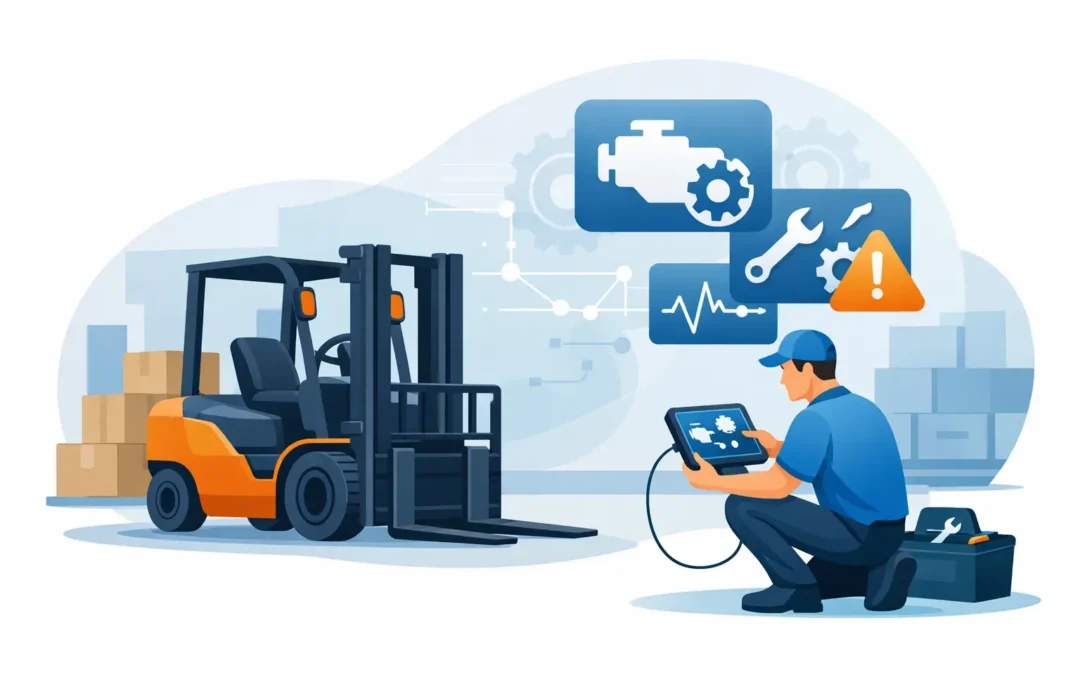
A forklift goes down in the middle of a shift, and the real cost starts piling up before the repair even begins. Orders back up. Crews wait around. Another truck gets pushed harder than it should. That is why onsite forklift diagnostics matter. You do not need guesses, delays, or a service chain that turns a simple failure into a full-day problem. You need a technician who can get to the machine, find the fault fast, and tell you what it will take to get it back in service.
For warehouses, manufacturers, and contractors, diagnostic speed is not a nice extra. It is the difference between a manageable repair and lost production. The longer a forklift sits, the more expensive the day gets. Good field diagnostics cut that dead time at the source.
What onsite forklift diagnostics actually do
Onsite forklift diagnostics are the process of identifying the exact cause of a forklift problem at your facility or jobsite instead of hauling the unit to a shop first. That sounds simple, but it changes the whole service timeline. Travel, loading, unloading, and offsite queue time are removed from the equation. The technician sees the truck where it failed, under the same operating conditions, and can usually narrow the problem down faster.
That matters even more with electric forklifts. Battery systems, controllers, contactors, wiring, chargers, sensors, and drive components can all create similar symptoms. A truck that will not move, lifts slowly, throws a code, or loses power under load may not have an obvious cause. Swapping parts based on a hunch gets expensive fast. Proper diagnostics save money because they focus on the fault, not the guess.
In many cases, field diagnostics also lead straight into repair. If the issue is minor, the same visit can turn into a same-day fix. If parts are needed, you still get a clear direction right away instead of waiting days just to learn what is wrong.
Why fast diagnostics matter more than fast estimates
A lot of service providers talk about response time, but not all response is equal. A quick callback that leads to a slow diagnosis does not help much when a critical truck is out of service. What most operations managers actually need is useful action. They need someone who can get onsite, inspect the equipment, test the system, and make a call based on experience.
That is where real field service stands apart from a generic dispatch model. When you can speak directly with a technician, the process moves faster. You can describe the symptoms, share the make and model, explain whether the unit is electric or internal combustion, and mention any warning codes or recent repairs. That early information helps the tech arrive prepared.
It also helps avoid a common problem in forklift repair – misdiagnosis from incomplete information. A forklift that intermittently cuts out may have a traction system issue, a battery connection issue, or a safety interlock problem. If the person taking the call does not understand the machine, the service visit starts behind.
Common problems found during onsite forklift diagnostics
Every fleet is different, but certain failures show up again and again. Electric forklifts often present drive, lift, battery, charging, and control issues that need proper testing rather than visual inspection alone. A unit may have battery voltage problems, damaged cables, weak connections, faulty seat switches, brake switch issues, hydraulic electrical faults, or failed controller inputs.
Mechanical problems are just as common. Mast issues, lift chain wear, hydraulic leaks, steer axle problems, brake concerns, and tire-related handling problems can all show up as performance complaints. Operators usually describe symptoms, not causes. They will say the truck feels weak, jerky, noisy, slow, or unsafe. A good technician works backward from that symptom to the root fault.
Intermittent issues are often the most expensive if they are handled poorly. A truck that only acts up when hot, under load, or late in the shift can fool an inexperienced service provider. That is one reason onsite work helps. The technician can inspect the actual duty cycle, operating surface, charging setup, and usage pattern instead of relying on a secondhand story.
Onsite forklift diagnostics for electric forklifts
Electric forklifts need a different level of service knowledge. The problem is not just whether the truck turns on. The real question is what the electrical system is doing under load, during lift, in travel, and through its safety circuits.
This is where specialist experience matters. Electric units can produce faults that look mechanical at first, then turn out to be electrical. Or the opposite. A slow hydraulic function may trace back to a weak electrical command. A no-travel complaint may come from a brake release issue, a control input fault, or a battery problem that only shows itself during operation.
Onsite diagnostics on electric equipment should include fault-code review when available, voltage testing, cable and connector inspection, charging-system checks, and practical function testing. It is not enough to clear a code and hope it stays gone. If the underlying problem is still there, the downtime comes right back.
That is one reason companies call specialists like CSC Forklift Repair when electric trucks go down. The issue is not just getting somebody out there. It is getting somebody who knows what they are looking at.
When onsite diagnostics are the better call
Not every repair can be completed in the field, and it is better to say that plainly. Some major component failures, structural issues, and heavy rebuild work may still require shop service. But diagnostics should not be delayed just because the final repair might be larger.
In most situations, onsite evaluation is still the smarter first move. If the problem is a dead truck blocking an aisle, a charger issue affecting battery rotation, an intermittent electrical fault, or a machine that will not pass pre-shift inspection, you need answers where the machine sits. The same is true on jobsites where hauling equipment out creates another layer of delay and cost.
The trade-off is straightforward. A field visit may cost more upfront than a phone estimate, but it usually saves far more by shortening downtime and reducing wrong-part replacement. For most operations, that is the better math.
What a good diagnostic visit should look like
A proper service call should feel organized, direct, and useful from the start. You should not have to chase updates or wait around wondering if anyone understands the urgency. The right process begins before the technician arrives, with the right questions about the truck, the symptoms, and the operating environment.
Once onsite, the technician should inspect the machine, verify the complaint, and test the systems tied to that problem. That may involve operating the truck, checking battery condition, tracing electrical circuits, reviewing fault history, or isolating hydraulic or mechanical failures. After that, you should get a clear explanation of what failed, what can be done immediately, and whether parts or follow-up work are needed.
That clarity matters. Equipment managers do not need padded language. They need a straight answer. Is this a quick repair, a safety issue, a repeat failure, or a sign of a larger maintenance problem in the fleet?
The hidden cost of waiting too long
A lot of companies try to stretch a forklift problem for another day or two. Sometimes that works. Often it makes the repair bigger.
Loose battery cables turn into heat damage. Small hydraulic leaks become contamination problems. Brake or steering complaints become safety issues. Faults that cause intermittent shutdowns start disrupting labor planning and order flow. By the time the call gets made, the truck has usually cost more than the service visit would have.
The same pattern shows up in multi-unit fleets. When one forklift goes down, the workload shifts to the others. That increases wear, raises operator frustration, and puts more pressure on the next machine in line. One diagnostic delay can turn into a broader uptime problem.
Choosing a service partner for onsite forklift diagnostics
If your operation depends on forklifts every day, the right service partner is not just the cheapest line item. It is the one that gets to the fault fast, repairs it correctly, and does not waste your time. That means technician access, real troubleshooting ability, and experience with the equipment you actually run.
For companies with electric fleets, that point is even sharper. General equipment service may be enough for some basic jobs, but electrical faults, control-system problems, and intermittent failures need trained eyes. Fast service without technical depth is just fast confusion.
When a forklift is down, the smartest move is usually the simplest one. Get a qualified technician onsite. Get the machine tested where it failed. Get a straight answer on the problem and the next step. That is how downtime gets contained before it starts spreading across the rest of the day.
If a truck in your fleet is acting up, do not wait for the problem to get more expensive. The fastest path back to work is usually the one that starts at your facility, with the right technician, right now.