A forklift that will not steer right is not a minor annoyance. It slows travel, throws off load handling, chews up tires, and puts operators in a bad spot fast. When you need forklift steering repair, the real issue is not just the steering system itself. It is lost time, delayed loads, backed-up docks, and a machine that cannot be trusted in a tight work area.
That is why steering problems need a quick, accurate diagnosis. Not guesses. Not parts swapping. Not a three-day wait to talk to somebody who has never held a wrench. If your forklift pulls, binds, feels loose at the wheel, or loses steering assist, the right move is to get a technician involved before a small issue turns into a bigger repair and a bigger safety problem.
What forklift steering problems usually mean
Forklift steering systems take a beating. In warehouse use, they deal with constant turning, stop-and-go travel, floor transitions, and operator impact from rough surfaces. In yard or outdoor applications, add uneven ground, debris, and weather. Over time, wear shows up in places that directly affect steering response.
On many units, the problem traces back to hydraulic loss, worn linkage, steering cylinder issues, orbital valve trouble, or damage in the steer axle assembly. On electric forklifts, steering can also involve sensors, electronic steering control, wiring faults, or electric power steering components. That matters because the repair path is different. A general equipment company may treat every steering complaint the same. A specialist knows when the issue is mechanical, hydraulic, electrical, or a combination of all three.
The symptoms can look simple at first. A steering wheel with extra play may point to linkage wear. Hard steering may be hydraulic pressure loss, a failing pump, contamination, or a binding kingpin. Jerky movement can come from low fluid, air in the system, worn components, or an intermittent electronic fault. If the truck turns one direction better than the other, that is a clue too. Good diagnosis starts with the pattern, not just the complaint.
Common signs you need forklift steering repair
Some failures stop the truck immediately. Others let the machine limp along while damage gets worse. That second category is where repair costs rise.
If operators report that the forklift drifts, takes constant correction, or feels unstable when turning, do not write it off as normal wear. If steering effort changes throughout the shift, especially after the unit warms up, that can point to hydraulic or electrical steering issues. Fluid leaks around the steer cylinder, odd tire wear, wheel chatter in turns, or clunking from the rear axle also deserve attention.
Electric forklifts deserve an even closer look. A steering fault on an electric unit may trigger warning codes, reduced performance, or inconsistent assist. Sometimes the truck still moves, but steering response becomes unreliable. That is not a machine you want around racks, trailers, pedestrians, or production lines.
Why fast diagnosis matters more than fast parts ordering
A lot of repair delays come from misdiagnosis. Somebody hears “hard steering” and orders a pump. The pump is not the issue. Now the machine is still down, the wrong part has been installed, and labor has been wasted.
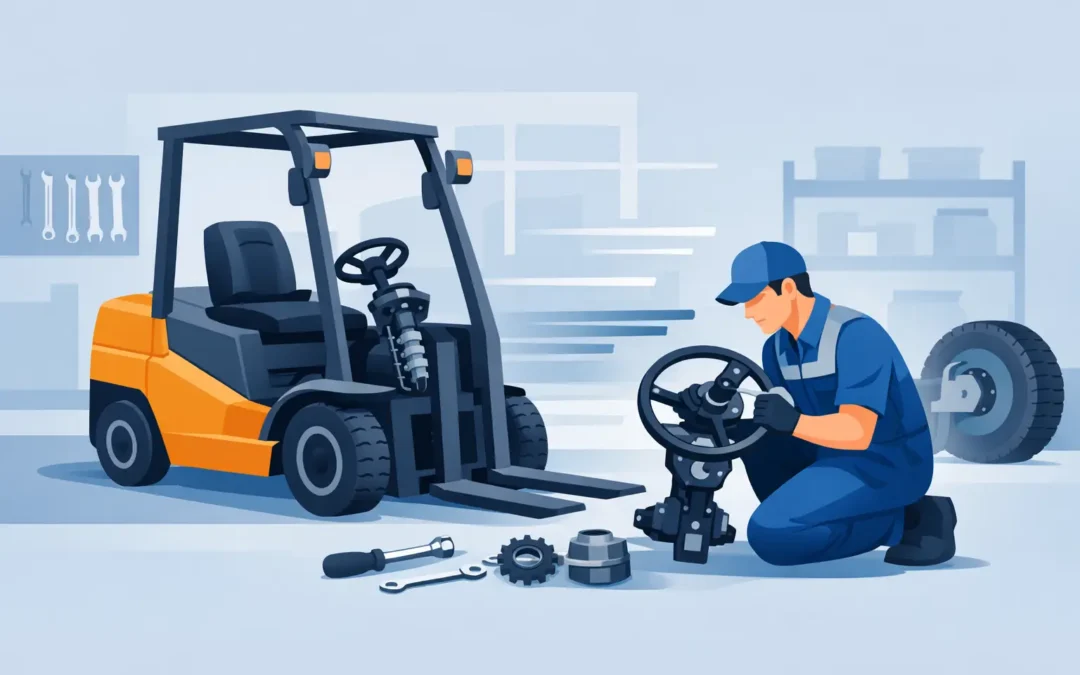
Real forklift steering repair starts with system testing. Pressure checks, inspection of hoses and fittings, evaluation of the steer axle, linkage condition, steering cylinder movement, and, on electric units, proper electrical and control-system diagnosis. That process saves time because it gets to the actual failure faster.
It also protects your budget. Steering systems are connected systems. Replacing one failed component without addressing the root cause can lead to repeat failures. A contaminated hydraulic system can ruin new parts. A worn pivot point can overload another steering component. A bad electrical connection can mimic a much more expensive steering control failure. The cheapest repair is the one done right the first time.
Forklift steering repair on electric units
This is where experience matters. Electric forklifts often use steering systems that blend mechanical components with electrical controls. A truck may have a steering motor, electronic control module inputs, angle sensors, or integrated safety logic that affects steering behavior. If a technician is strong on internal combustion forklifts but weak on electric systems, diagnosis slows down.
That shows up in the field as wasted hours. Parts get replaced one by one. The truck remains unreliable. Meanwhile, your operators are waiting, your backup equipment is tied up, or your team is rearranging the day around one machine that should already be back in service.
Specialized electric forklift service cuts through that. The issue may still be straightforward – damaged wiring, a failed sensor, low voltage affecting steering response, or a failing assist motor. But you only get to that answer quickly if the technician understands the platform. That is one reason companies that run electric fleets should not hand steering issues to just any mobile repair provider.
What a proper steering repair should include
A good repair is more than replacing the failed part. The technician should verify why the failure happened, inspect related components, and confirm that the truck is safe to return to service.
That usually means checking for looseness in the steer axle and linkage, evaluating tires and wheel condition, looking for leaks or contamination, confirming steering response under load and during travel, and making sure the operator does not leave with a machine that still feels wrong. If the repair is hydraulic, fluid condition matters. If the repair is electrical, wiring integrity, connectors, battery condition, and fault code review matter.
There is also a practical side. Some repairs are clearly field-service jobs. Others depend on damage severity, parts access, or whether major axle work is needed. A good service team will tell you that plainly. No runaround. No vague promises. Just a realistic path to get the truck back online as quickly and affordably as possible.
When to stop operating the forklift
Not every steering complaint means immediate shutdown, but many do. If the forklift has delayed steering response, inconsistent assist, severe looseness, hydraulic leakage, grinding, binding, or any loss of directional control, stop using it. The cost of keeping it in operation is usually far higher than the cost of the repair call.
This is especially true in tight aisles, busy loading areas, and mixed pedestrian environments. A steering problem is not isolated to one component. It affects control of the entire truck. If the operator cannot place the machine accurately, every turn becomes a risk to product, racking, trailers, and people.
How to reduce repeat steering failures
Not every steering failure is preventable, but a lot of them are made worse by delayed service and skipped inspections. Small leaks get ignored. Tire wear gets written off. Operators report extra play in the wheel and nobody checks it until the machine starts fighting turns.
Routine service helps, but only if it is done with attention to actual wear points. Steering linkage, axle pivots, hydraulic condition, and component looseness need eyes on them. Electric units also need proper electrical inspection, not just battery service. If your fleet runs hard, especially across multiple shifts, steering complaints should be treated as early warnings instead of low-priority maintenance notes.
This is where a responsive service partner pays off. Fast field diagnosis keeps one bad steering component from taking down a whole shift. It also helps maintenance teams that are already stretched thin. You do not need another layer of delay between the breakdown and the technician. You need someone who can get to the truck, find the fault, and fix it.
Choosing the right service company for forklift steering repair
The lowest hourly rate is not always the lowest final cost. If the technician is slow to diagnose, unfamiliar with your forklift type, or quick to guess at parts, your downtime bill climbs fast. For steering issues, speed and technical accuracy matter more than a cheap-looking quote.
Ask the practical questions. Can you speak directly with a technician? Do they work on electric forklifts regularly? Can they troubleshoot hydraulic, mechanical, and electrical steering faults? Do they understand that your real problem is uptime, not paperwork?
That is the standard serious operations managers should expect. Faster service. Better workmanship. Fair pricing. If a repair company cannot move with urgency when a steering failure hits, they are not really helping your operation.
At CSC Forklift Repair, that is the point of the service call. Get the machine diagnosed quickly. Fix what failed. Prevent the repeat problem if possible. Get you back to work without wasting a day chasing answers.
If your forklift is fighting the operator, pulling off line, leaking at the steer end, or showing electric steering faults, do not let it turn into a longer outage. Steering problems rarely fix themselves, but they do get more expensive when they are ignored. A quick call now is usually the cheapest move you can make.
Forklift or Lift Down Right Now?
Talk directly to an experienced technician, not a call center. Mobile repair for electric, LP and diesel forklifts, scissor lifts and boom lifts across the Sacramento area.
📞 Call (916) 827-0510