
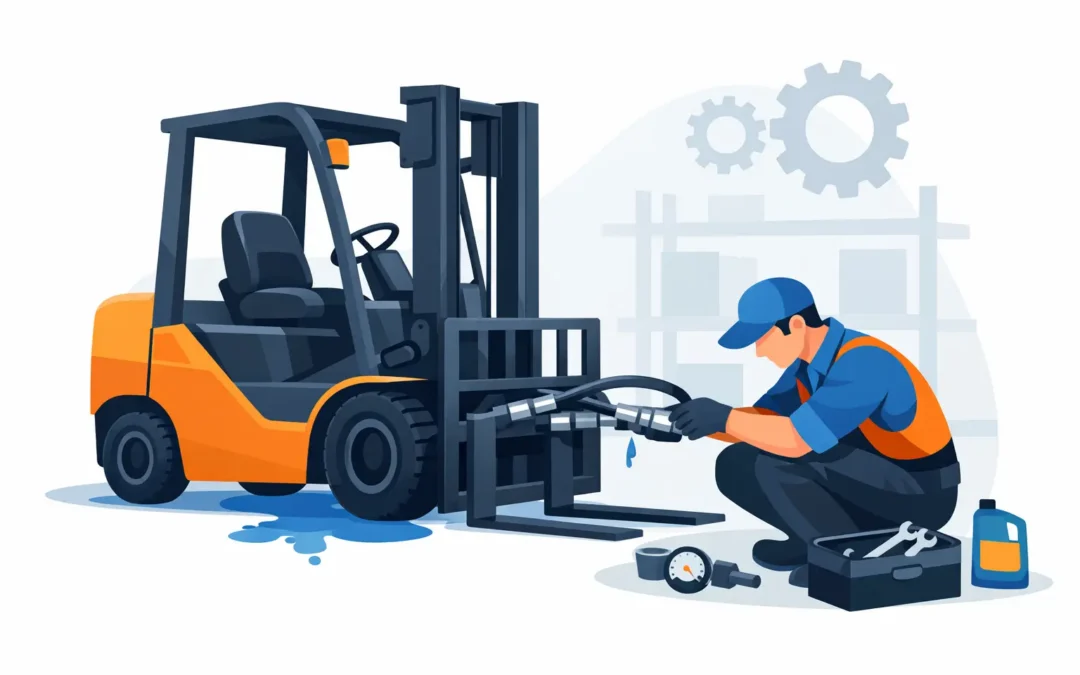
A forklift leaves a thin red line on the floor, and the real cost starts before the cleanup does. Lost lift power, unsafe handling, product delays, and a machine that can go from usable to sidelined fast – that is why forklift hydraulic leak repair needs to happen early, not after the leak gets worse.
For warehouse teams, plant managers, and contractors, a hydraulic leak is not just a maintenance issue. It is a downtime issue. It affects safety, load control, and daily output. The right response is fast diagnosis, a clean repair, and getting the truck back to work without wasting time on guesswork.
Why hydraulic leaks on forklifts get expensive fast
Hydraulic systems run the mast, tilt, side shift, lift cylinders, and other attachment functions. When fluid starts escaping, system pressure drops. That can show up as slow lifting, drifting forks, weak tilt, erratic attachment movement, or visible fluid around hoses and fittings.
Small leaks rarely stay small. A sweating hose can turn into a split line. A loose fitting can hide a damaged seal underneath. If the forklift keeps running low on fluid, pumps can wear faster, components can overheat, and contamination can spread through the system. What could have been a hose replacement becomes a bigger hydraulic repair.
There is also the floor hazard. Oil on concrete creates slip risk for pedestrians and traction issues for equipment. In a busy warehouse or loading area, that is not a side problem. It is a safety exposure that can shut down more than one truck.
Common causes behind forklift hydraulic leak repair
Most leaks come from predictable wear points. Hoses age, crack, or rub through where routing is tight. Fittings loosen over time from vibration. Cylinder seals wear out and start bypassing or leaking externally. O-rings flatten, harden, or split. In some cases, a mast chain issue, impact damage, or poor previous repair work puts extra stress on hydraulic components and starts the leak.
Electric forklifts have their own pattern of trouble. Because they often work indoors on hard surfaces and in tight aisles, hose abrasion and fitting damage around steering and lift circuits can show up sooner than operators expect. Add heavy daily cycling, and minor hydraulic weakness becomes noticeable quickly.
Temperature and operating conditions matter too. Cold starts can make brittle hoses fail. Dirty environments can damage rods and seals. A forklift used hard on multiple shifts will expose weak components faster than a lightly used backup unit.
Signs you need forklift hydraulic leak repair now
Visible fluid is the obvious one, but not every leak announces itself with a puddle. Sometimes the first sign is performance. The mast may drift down when raised. Tilt may not hold position. Steering may feel inconsistent on units with hydraulic steering assist. Operators may report that the truck sounds different when lifting, or that it hesitates under load.
Watch for fluid on cylinder rods, wet hose jackets, oil collecting at fitting joints, or grime sticking to damp areas around the valve body and pump. A strong burnt-oil smell, repeated need to top off hydraulic fluid, or a reservoir level that keeps dropping are also clear warnings.
If a forklift is leaking and also losing function, that is not a wait-until-next-week repair. It needs service before it creates a larger failure or a safety event.
What a proper forklift hydraulic leak repair should include
A real repair starts with locating the exact leak source. That sounds simple, but it is where a lot of wasted time happens. Hydraulic fluid moves. It runs down hoses, frames, and cylinder bodies, which means the wettest area is not always the failure point.
The system usually needs to be cleaned first. Then the technician runs and cycles the hydraulic functions to trace where fluid is escaping under pressure. That process matters. Replacing the wrong hose or tightening the wrong fitting does not solve anything.
Once the leak source is confirmed, the repair may involve replacing a damaged hose, resealing a cylinder, changing fittings, installing new O-rings, or addressing pump and valve leaks. A good technician also checks for the reason the part failed. If a new hose gets routed against a sharp edge, the same problem comes back. If a cylinder rod is scored, new seals alone may not last.
After the repair, the system should be refilled as needed, air should be worked out through proper cycling, and the truck should be tested under actual function. Lift, lower, tilt, side shift, and any auxiliary circuits should all be checked before the forklift goes back into service.
When in-house maintenance can help and when it should stop
An experienced maintenance team can often handle basic hydraulic issues, especially if the problem is obvious and the shop is equipped for safe repair. Replacing an accessible hose, correcting a loose fitting, or identifying a leaking connection may be straightforward.
But there is a line between simple maintenance and repair that burns labor hours without fixing the real problem. If the leak source is unclear, the cylinder needs resealing, the truck has repeated hydraulic failure, or the forklift is down in the middle of operations, it usually makes more sense to bring in a field technician who works on lift equipment every day.
Hydraulic systems are high pressure systems. That matters. A rushed repair can create injection injury risk, component damage, or a truck that still is not safe to use. If your team is guessing, the cheapest move is usually to stop guessing.
Forklift hydraulic leak repair and uptime
For most operations, the real issue is not the price of a hose or seal kit. It is what happens while the truck is out. One disabled forklift can slow receiving, staging, loading, production support, and order movement. If it is a key unit or a specialty truck, the disruption gets expensive fast.
That is why response time matters as much as the repair itself. You need a technician who can identify the problem quickly, show up prepared, and fix what failed without turning one service call into three. Speed matters, but so does workmanship. A quick patch that fails again next week is not fast. It is repeat downtime.
This is where a specialist has an edge. Companies like CSC Forklift Repair focus on lift equipment, so hydraulic issues are not being approached like general mechanical service. The goal is simple – find it, fix it, verify it, and get the equipment back in service at a fair cost.
How to reduce repeat hydraulic leaks
Prevention is not complicated, but it does require attention. Operators should report slow lift, drift, or visible oil immediately instead of running the truck until failure. Daily walkarounds should include a quick look at hoses, cylinders, and the floor under parked equipment. Maintenance teams should watch for hose rubbing, clamp failures, and dirty rod surfaces that can shorten seal life.
Fluid condition matters too. Wrong fluid, low fluid, or contaminated fluid can hurt hydraulic performance and component life. So can skipped maintenance on equipment that runs hard every day. If a forklift has had more than one hydraulic leak in a short period, it is worth checking the broader system instead of treating each failure as a one-off problem.
There is also a budget reality here. Planned maintenance usually costs less than emergency service, product delays, cleanup time, and overtime caused by a breakdown. Not every leak can be prevented, but plenty of larger repairs start as smaller warning signs that were easy to catch.
Choosing the right repair response
If the forklift is actively leaking, losing lift performance, or creating a safety hazard, take it out of service and get it checked. Waiting rarely saves money. It usually increases repair scope and extends downtime.
A good service partner will ask the right questions right away. What model is it? Where is the fluid showing up? Which hydraulic functions are affected? Did the issue start suddenly or get worse over time? That kind of triage helps speed up the repair and avoid wasted trips.
The best repair call is the one that gets the right technician to the machine fast, with a clear understanding of what is likely wrong. That is how you keep a leak from becoming a bigger equipment problem.
If your forklift is leaving oil on the floor or losing hydraulic function, treat it like the uptime issue it is. Fast action now usually costs less than waiting for the truck to quit at the worst possible moment.