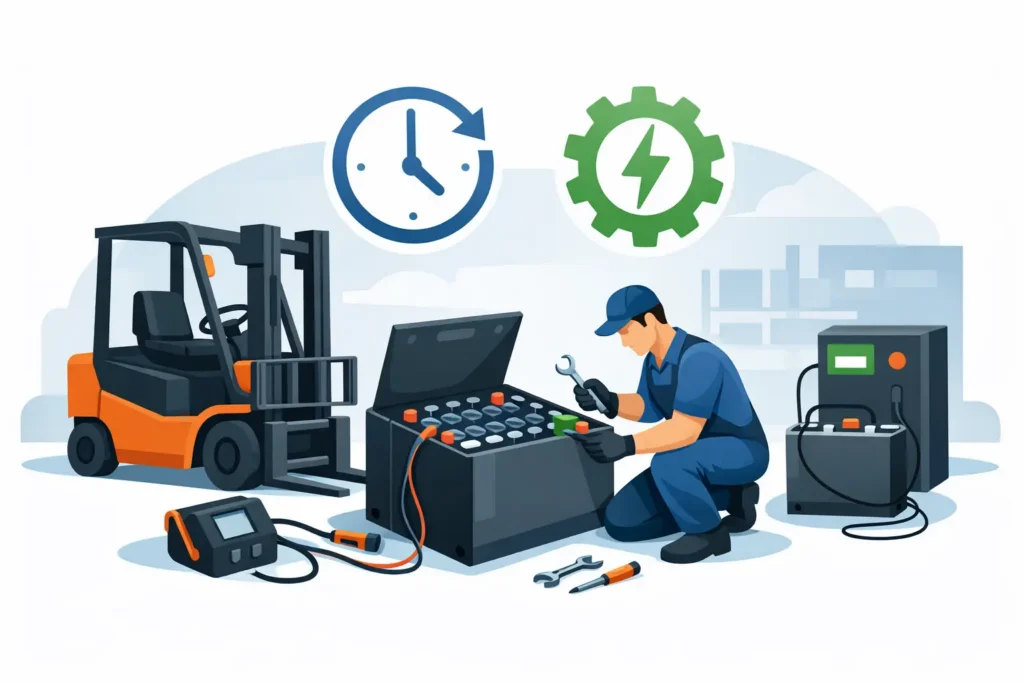
A dead electric forklift in the middle of a shift is not a minor inconvenience. It slows picking, stalls loading, backs up labor, and puts pressure on every other truck in the fleet. That is why forklift battery repair matters so much – not as a side issue, but as a direct uptime issue that affects output, labor efficiency, and delivery schedules.
For most operations, the real question is not whether a battery problem can be fixed. It is how fast the issue can be diagnosed, whether the repair is actually worth doing, and how to avoid losing another shift to the same problem next week. Battery trouble is rarely random. It usually leaves clues before the truck stops working.
What forklift battery repair usually involves
Forklift battery repair can mean several different things depending on the battery type, age, and failure point. On electric forklifts with lead-acid batteries, repairs often involve damaged cables, burned connectors, corroded terminals, watering-related issues, charger connection problems, bad cells, or battery pack imbalance. In some cases, the problem is not the battery itself at all. It may be a charger fault, a truck-side connection issue, or a control problem that looks like battery failure.
That is where a lot of downtime gets wasted. A battery gets blamed, a replacement gets discussed, and the actual issue turns out to be a loose cable, heat-damaged connector, or charging problem. Good service starts with diagnosis, not guessing.
Lithium systems are a different conversation. They can deliver longer run times and lower maintenance, but when they fail, the repair path is more specialized. Battery management system faults, communication issues, module failures, and charger compatibility problems require technicians who understand electric equipment, not general repair work.
Signs your forklift battery needs repair before it fails completely
Most battery failures do not happen without warning. The problem is that busy operations often keep running through the warning signs until the truck is down.
If a forklift is losing run time faster than normal, charging unusually slowly, showing inconsistent power during lifts, or getting hot around cables and connectors, something is off. You may also notice visible corrosion, swelling, acid residue, strong odors, or repeated low-voltage conditions after what should have been a full charge. On some trucks, operators report sluggish acceleration or intermittent shutdowns long before the battery is tagged as the cause.
These symptoms matter because battery issues tend to spread. A bad connection creates heat. Heat damages terminals and cables. Poor charging hurts cell performance. Weak cells force the rest of the battery to work harder. What starts as a repairable issue can turn into a much more expensive failure if it sits too long.
Common causes behind forklift battery problems
The most common battery failures come from preventable wear, not rare defects. Overwatering and underwatering are both frequent problems with lead-acid batteries. Too much water can cause overflow and corrosion. Too little can expose plates and shorten battery life fast. Equalization schedules also get skipped in busy shops, which leads to poor battery balance and lower performance.
Charging habits are another major factor. Opportunity charging without a plan, repeated partial charging, using the wrong charger, or unplugging before a proper cycle finishes can all reduce battery life. So can running batteries too low before charging. If operators are rotating trucks and chargers without clear procedures, battery damage tends to follow.
Then there is the hardware side. Connectors wear out. Cables crack. Terminals loosen. Battery restraints fail and allow vibration. Charger plugs get heat-damaged. Even a strong battery will perform badly if the electrical path is compromised.
When forklift battery repair makes sense – and when it does not
Not every battery issue justifies a full repair. Sometimes the smartest move is a targeted repair that gets the truck back in service quickly. Sometimes replacement is the better financial call.
If the battery has a bad connector, cable issue, isolated cell problem, watering damage, or charger-related fault, repair often makes sense. These are the kinds of issues that can be corrected without throwing away the entire battery investment. If the battery still has solid overall life left, a repair can be a cost-effective way to extend service and reduce immediate downtime.
If the battery is already at the end of its service life, has multiple failing cells, severe plate damage, structural case damage, or chronic performance loss across the pack, repair may only buy a little time. In those cases, the real cost question is not repair price alone. It is how much repeated downtime, emergency service, and reduced truck productivity are costing you every week.
This is where experienced diagnosis matters. A cheap repair that fails again in days is not cheap. A more direct recommendation saves time, labor, and frustration.
Why fast diagnosis matters more than long explanations
Operations managers do not need a lecture when a truck is down. They need to know what failed, what it will take to fix it, and how soon the unit can be back to work.
Battery issues are easy to misread if the technician is not used to electric forklifts. A truck that will not charge may have a charger problem. A truck that loses power under load may have a cable resistance issue. A battery warning may be tied to a control fault or communication problem. The longer that diagnosis is delayed, the more your crew ends up working around dead equipment.
That is why direct technician access matters. When you can speak to someone who understands electric forklift systems right away, the process moves faster. You get practical answers, not a slow handoff through layers of office traffic.
Forklift battery repair and safety cannot be separated
Battery work is not just a maintenance issue. It is a safety issue. Lead-acid batteries involve acid exposure, electrical hazards, and heavy components. Damaged cables can arc. Corroded terminals can overheat. Charging areas can create gas hazards if ventilation is poor. Lithium systems carry their own electrical and thermal risks.
If your team sees melted connectors, burned cable ends, leaking battery cases, strong sulfur smells, or repeated overheating, do not keep forcing the truck into service. That is not stretching value. That is increasing risk to operators, equipment, and the facility.
Safe repair means proper testing, proper handling, and proper replacement of damaged electrical components. It also means checking the related systems around the battery instead of treating the visible symptom as the whole problem.
How to reduce repeat battery failures
The fastest repair is the one you do not need twice. If your fleet sees repeated battery issues, the root cause is often operational.
Start with charging discipline. Make sure each battery is matched to the correct charger and charged according to a consistent process. Review watering procedures and timing. Train operators to report weak run time, hot connectors, and charging irregularities early instead of after a breakdown. Inspect cables, terminals, and plugs as part of regular service, not after visible damage appears.
It also helps to look at usage patterns. A battery that is undersized for the application will fail early no matter how often it gets serviced. Heavy multi-shift use, freezer environments, and constant stop-start demand all change what a battery can realistically deliver. Sometimes the issue is not repair quality. It is an application mismatch.
What to expect from a service partner
When you call for forklift battery repair, the service response should be simple. You should be able to explain the symptoms, get immediate technical direction, and move quickly toward on-site diagnosis or repair. You should also get a straight answer on whether the battery is worth repairing.
That matters because downtime has a cost curve. The first hour hurts. The second shift hurts more. By the time supervisors are shuffling trucks, delaying loads, or paying overtime to catch up, the real expense is no longer just the battery problem. It is the operational drag created by waiting.
A strong repair partner understands that. They know the battery is tied to the entire workstream. They also know that affordability matters. Fast service without inflated pricing is not a bonus in this business. It is the standard serious operations expect.
For companies running electric forklifts every day, battery trouble should be treated like any other critical equipment failure – quickly, accurately, and with a clear eye on cost. If you are dealing with weak run time, charging issues, damaged connectors, or repeated battery-related shutdowns, get the problem diagnosed before a repairable issue becomes a replacement emergency. A good technician saves more than a battery. They save the shift.